What are the quality inspection standards for paper corner protectors?_News Center Co., Ltd._Wuyi Jianhua Paper Products Factory_Zhongshang 114 Industry Resources Network 
在线客服 在线客服邀请中...
关闭

您好,现在客服正邀请与您通话,请留下您的联系方式,客服将尽快与您取得联系。

 点击提交代表您同意《服务条款》《隐私政策》
Wuyi Jianhua Paper Products Factory

Paper tubes, paper rings, paper corner protectors, and ot...

24-hour Service Hotline
13868900523
Current Location:Home>News Center Co., Ltd.>What are the quality inspection standards for paper corner protectors?

    What are the quality inspection standards for paper corner protectors?

    2025-11-24

    The quality inspection of paper corner protectors must comply with national/industry standards (such as GB/T 22906-2008 "Paper Corner Protectors", QB/T 4863-2015 "Industrial Paper Tubes and Paper Corner Protectors") and integrate protective requirements based on the usage scenario.Appearance, dimensional accuracy, mechanical properties, adhesive performance, functional characteristicsThe company has established a standard with five core dimensions to ensure effective protection of goods during transportation and stacking. Below is a detailed breakdown of the inspection criteria, including index definitions, testing methods, and qualification requirements:

    I. Basic Appearance Inspection Standards (Visual Judgment of Process Compliance)

    Surface Quality

    • Inspection ItemsFlatness, damage, contamination, overflow of adhesive, burrs, warping, and delamination.

    • Testing MethodVisual inspection under natural light (distance 30cm) + hand touch (surface and edges).

    • Qualification Standards

      • Surface shows no visible damage, tears, or holes; free of oil stains, dust, and other contaminants.

      • No visible excess glue (adhesive area ≤ 5mm²/㎡), no glue strands exposed.

      • Edge is smooth with no burrs (feels smooth to the touch), no lifted or curled edges.

      • Interlayer has no spontaneous stratification or bubbles, with a smooth surface free of bumps or dents (bump height ≤ 0.5mm).

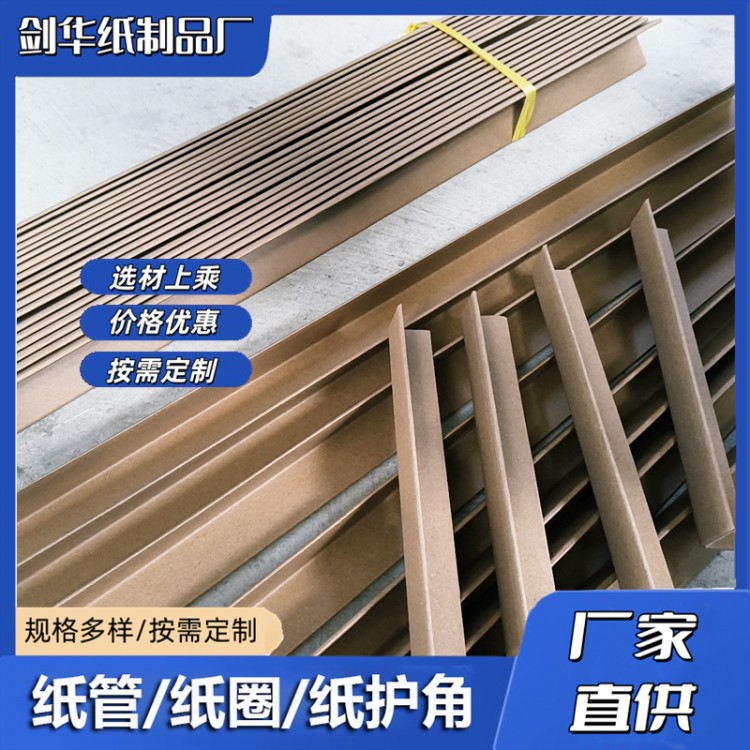
    2. Shape Regularity (for L-shaped / U-shaped)

    • Inspection ItemsL-angle, U-curved, straightness.

    • Testing MethodMeasurements are taken using a straight edge (L-shaped) and a compass (U-shaped), with straightness checked by the stringing method.

    • Eligibility Criteria

      • L-angle: 90°±1° (deviation exceeding 2° is considered不合格);

      • U-shape curve: Seams perfectly with standard mold without gaps (gap ≤ 0.3mm).

      • Straightness: Bending deviation within 1mm per meter (to avoid affecting product adhesion).

    Size Precision Inspection Standards (Core Impact on Compatibility)

    Key Size Metrics

    Inspection ItemsDefinedInspection ToolQualification Standards (Tolerance Range)
    LengthAxial distance between the ends of the paper corner protectorRuler (Accuracy: 1mm) / Caliper≤1000mm: ±1mm; 1000-2000mm: ±2mm; >2000mm: ±3mm
    Width (Wing Span)L/Shaped or U-Shaped single wing spanCaliper (Accuracy: 0.01mm)Standard specifications (30/40/50/80mm) deviation ≤ ±0.5mm
    Thickness (Wing Thickness)Thickness of multiple paper layers in a single wingCaliper (accuracy of 0.01mm)±0.3mm for thickness ≤ 5mm; ±0.5mm for thickness > 5mm
    Uniform wall thicknessThickness variation at different positions on the same wingCaliper (Multi-Point Measurement)The maximum deviation is ≤0.3mm (to avoid uneven force distribution).

    2. Testing Methods

    • Measure along the axis of the paper corner protector at 3 evenly spaced points, and take the average.

    • Width/Thickness: Measure 4 evenly distributed points at each of the 3 cross-sections at both ends and in the middle, and take the average.

    • Wall thickness uniformity: The difference between the maximum and minimum thickness of the same cross-section must meet the standard.

    III. Mechanical Property Testing Standards (Core Protection Strength Assurance)

    Compressive strength (resistance to longitudinal compression, the most critical indicator)

    • DefinedThe maximum load-bearing capacity of paper corner protectors when uniformly pressured along their length determines whether they will collapse when stacked.

    • Inspection StandardsReferencing GB/T 22906-2008, a compression testing machine is utilized.

    • Testing Method

    1. A 100mm long specimen (retaining its complete shape) is vertically placed in the testing machine fixture.

    2. Apply pressure at a uniform rate of 10mm/min, and record the maximum force value at the point of crush (unit: N).

  • Qualification Standards(Graded by thickness / application)

    Paper corner protector thickness (mm)Standard Grade (Packaging/Logistics Use)High-strength grade (for household appliances / building materials)
    3~5≥800N≥1200N
    6~8≥1500N≥2000N
    ≥10≥2500N≥3500N
  • 2. Bending Strength (resistance to lateral bending)

    • DefineThe paper corner protector's ability to withstand lateral forces, preventing collisions and bending during transportation.

    • Testing Method

    1. 300mm long specimen, simply supported at both ends (span distance of 200mm).

    2. Apply a concentrated load at a rate of 5mm/min in the middle position, and record the force value (in N) when the bending deformation reaches 5mm.

  • Qualification Standards≥800N (≥1200N when thickness ≥5mm), no permanent deformation after unloading.

  • 3. Impact Resistance (ability to withstand accidental collisions)

    • Testing MethodThe paper corner protector (full length) was freely dropped from a height of 1.0m onto concrete ground, with one drop on each end and one on each side.

    • Qualification StandardsNo damage, no significant deformation (bending deviation ≤ 2mm), no delamination between layers after falling.

    4. Peel Strength (interlayer adhesion)

    • DefineMeasure the bond strength of multi-layer paper to prevent the use of middle delamination.

    • Inspection Method

    1. Score a 100mm-long incision along the axis of the paper corner protector, separating the two layers of paper.

    2. The average peel force (unit: N/100mm) was recorded by stretching at a speed of 50mm/min using a tensile testing machine.

  • Eligibility Standards≥50N/100mm (requires force to tear open; easy to separate indicates non-compliance).

  • Four: Adhesive Performance Testing Standards (to prevent delamination and layering)

    Routine adhesive inspection

    • Inspection ItemsInterlayer adhesion and uniformity of bonding.

    • Detection Method

      • No visible stratification or bubbles observed by visual inspection.

      • Hand-tear Test: Apply force to tear along the interlayer without large-scale separation (separation area ≤ 5% is considered pass).

    2. Waterproof Adhesive Test (for products used in humid environments)

    • Testing MethodPlace the sample in 25°C tap water for a 30-minute soak, then dry it off and test for peel strength.

    • Eligibility StandardsThe peel strength decline is ≤30%, with no obvious delamination or adhesive failure.

    Adhesives Environmental Sustainability (Food / Electronics Industry)

    • Testing ProjectFormaldehyde emissions, heavy metals (lead, cadmium), VOCs.

    • Qualification Standards

      • Formaldehyde emission ≤ 0.1mg/m³ (compliant with GB 18583-2008 "Limit of Harmful Substances in Adhesives")

      • Lead (Pb) ≤ 0.05 mg/kg, Cadmium (Cd) ≤ 0.01 mg/kg.

      • VOC content ≤ 100g/L (aqueous adhesive).

    V. Functional Feature Inspection Standards (Special Scenario Specific Requirements)

    Moisture Resistance (for Outdoor / Humid Environments)

    • Testing MethodSamples were placed in a controlled humidity and temperature chamber at 90% humidity and 25℃ for 48 hours, then removed for appearance and compressive strength testing.

    • Qualification StandardsNo softening, molding, or reduction in compressive strength by ≤20%; surface coated or paraffin-treated products exhibit no water leakage after immersion for 30 minutes.

    Anti-static (for electronic / precision instrument packaging)

    • Inspection ItemsSurface Resistance.

    • Inspection ToolSurface Resistance Tester

    • Standards of QualificationSurface resistivity: 10⁶~10⁹Ω (meets the static protection requirements of the electronics industry), with uniform distribution (difference between different points ≤ 1 order of magnitude).

    3. Flame Retardancy (for high temperature / flammable environments)

    • Testing StandardsRefer to GB/T 8624-2012 "Classification of Combustion Performance of Building Materials and Products."

    • Inspection MethodVertical combustion test, observe the combustion time after igniting the sample.

    • Eligibility StandardsBurn time ≤ 30s, burn length ≤ 100mm, no dripping to ignite the filter paper below.

    4. Food Contact Safety (for food packaging)

    • Inspection ItemsWhitening agents, microorganisms, and heavy metal leachability.

    • Standards of Qualification

      • No significant fluorescence observed under UV light (no optical brightener detected).

      • Total colony count ≤ 100 CFU/g; No pathogenic bacteria (Salmonella, E. coli) detected.

      • Lead migration: ≤0.05mg/kg; Arsenic migration: ≤0.01mg/kg (compliant with GB 4806.8-2016).

    Section 6: Inspection Sampling and Determination Rules

    Sampling Method

    • Batch ≤ 5000: Randomly select 5 samples, with each sample undergoing appearance, size, and mechanical property inspections.

    • Bulk orders 5001-10000 units: Randomly select 10 units.

    • Bulk > 10,000 units: Randomly select 15 units, with 5 units used for destructive testing (compressive, peel).

    2. Determination Rules

    • All inspection items passed, the entire batch is deemed qualified.

    • If one indicator fails, double the sampling for re-inspection; if the re-inspection still fails, the entire batch will be rejected.

    • Surface defects (such as slight overflow of adhesive) may not exceed 2 per item, and the overall rejection rate of the batch should not exceed 3% to be deemed acceptable (negotiated acceptance).

    Section VII: Additional Inspection Requirements for Common Application Scenarios

    Application ScenariosAdditional Inspection ItemsEligibility Standards
    Appliance PackagingEdge fitment, compressive strength (≥2000N)Seamlessly fits along the edges of home appliances without gaps, can be stacked in 3 layers without deformation.
    Cross-border LogisticsMoisture Content,熏蒸免除证明Moisture content 8%~12%, free from wood components (dewaxed)
    Electronic Component PackagingAnti-static, dust-free, no sheddingSurface resistance: 10⁶~10⁹ Ω, no paper屑falling.
    Building Materials (Glass / Tiles) PackagingImpact resistance, edge smoothness1 meter drop with no damage, edges free of burrs or scratches

    Summary

    The quality inspection of paper corner protectors requires "comprehensive basic indicators + differentiated scenario indicators": standard logistics packaging emphasizes appearance, dimensions, and basic compressive strength; while high-end fields (electronics, appliances, cross-border) require additional compliance with environmental protection, static electricity resistance, and weather resistance, etc. Adhering to these standards ensures the protective performance, compatibility, and safety of paper corner protectors, preventing damage to cargo during transportation due to quality issues. In actual inspections, additional specialized testing items can be added according to customer-specific requirements (such as special dimensions, functions).


Contact us

Wuyi Jianhua Paper Products Factory
Service Hotline 13868900523
Company Phone 13868900523
Company Address Jinhua Wuyi Wangzhuang Town Gumashan Industrial Zone

Message Consultation

 Click OK to indicate that you agree to《Service terms》《Privacy policy》

b2b.china9.net © Zhongshang 114 Hebei Network Technology Co., Ltd.Address: Room 6009, Oriental New World Center, No.118 East Zhongshan Road, Qiaoxi District, Shijiazhuang City, Hebei ProvincePlatform Service Hotline: 4006299930

 Click OK to indicate that you agree to《Service terms》《Privacy policy》