Bend Machines, Chamfering Machines, CNC Bend Machines, Al...

In the field of mechanical processing, chamfering is an indispensable basic operation that removes burrs from workpiece edges, optimizes the appearance of the workpiece, and enhances its safety and assembly compatibility. As the core equipment for chamfering work, chamfering machines can be categorized into CNC chamfering machines, pneumatic chamfering machines, and manual models, depending on their technical principles and operation methods. Each type of chamfering machine has its own strengths and is suitable for different production scenarios. Next, we will delve into their classifications, working principles, and differentiated advantages.
The CNC chamfering machine is centered around a computer control system, which can be further divided into three-axis CNC chamfering machines, five-axis CNC chamfering machines, and so on based on the degree of automation and processing capability. Such equipment typically consists of a bed, spindle system, feed system, CNC system, and auxiliary devices. The bed, as a fundamental component, provides stable support for the equipment. The spindle system drives the cutting tools at high speeds to achieve the cutting function. Under the instructions of the CNC system, the feed system precisely controls the movement of the workpiece or tool. The CNC system serves as the "brain" of the entire machine, responsible for receiving and processing programming instructions, and coordinating the operation of various components. Auxiliary devices include cooling systems, chip removal systems, etc., ensuring the normal operation of the equipment and the cleanliness of the processing environment.
The working principle of the CNC chamfering machine is based on digital program control. Operators first create a processing program using dedicated programming software, which includes information such as machining paths and cutting parameters according to the design requirements of the workpiece. Once the program is completed, it is transmitted to the machine's CNC system. The CNC system converts the received program into electrical signals, which drive the servo motors to operate, controlling the movement of the machine's axes. This enables relative motion between the tool and the workpiece, performing chamfering processing along the predetermined trajectory and parameters. During the machining process, sensors continuously monitor the machine's operational status and processing accuracy. If any deviation occurs, the CNC system automatically compensates and adjusts to ensure that the processing accuracy remains within the specified range.
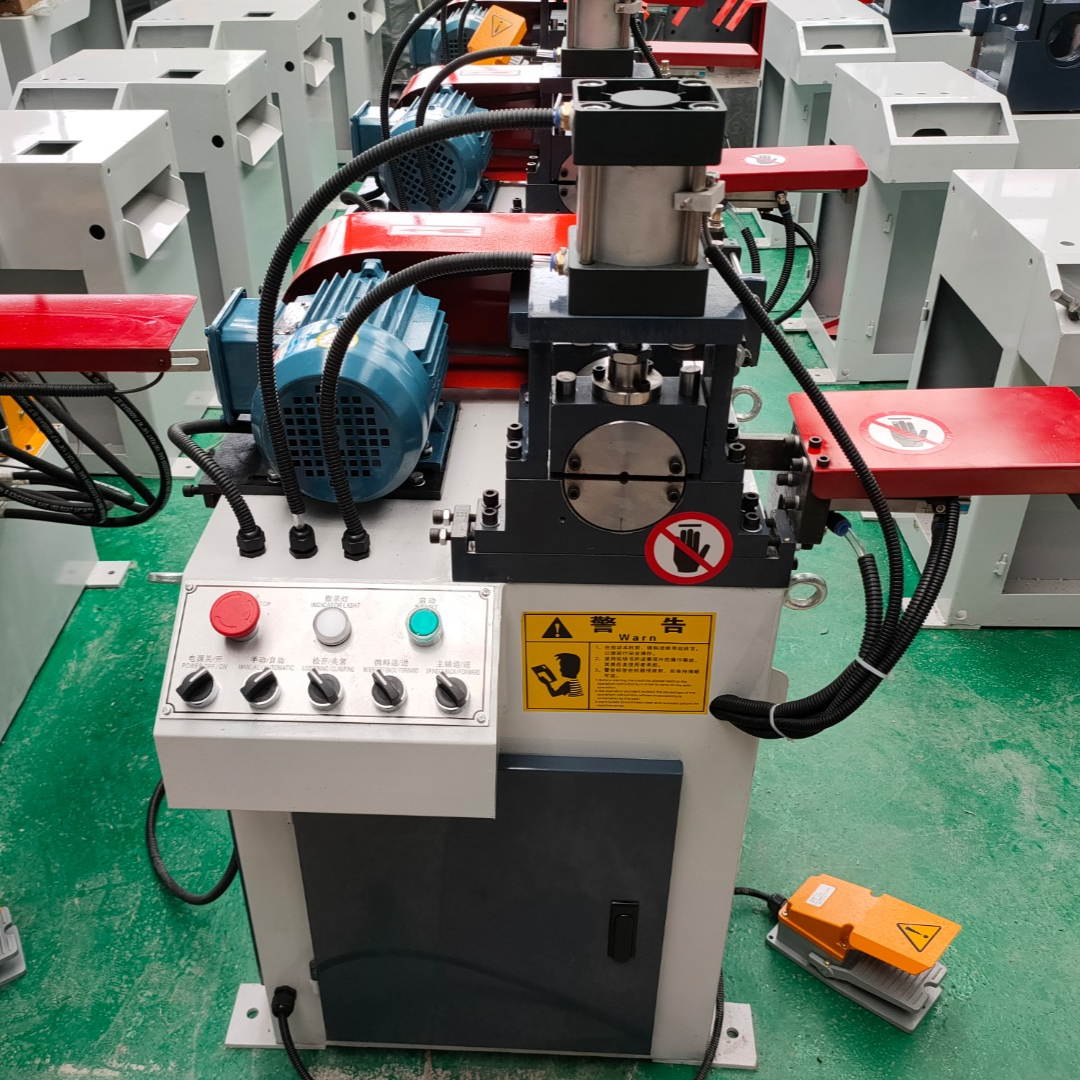
The pneumatic deburring machines can be categorized into handheld and benchtop models based on their pneumatic power systems and operation methods. Handheld pneumatic deburring machines are compact and lightweight, making them easy to carry and use in various work environments; benchtop models are more stationary and suitable for bulk processing in fixed locations such as workshops. Pneumatic deburring machines are mainly composed of pneumatic motors, tool holding devices, pressure regulators, and air hoses. The pneumatic motor serves as the power source, driving its internal blades to rotate via compressed air, providing power to the cutting tools; the tool holding device is used to secure and replace tools; the pressure regulator adjusts the pressure of the compressed air, controlling the speed and torque of the pneumatic motor; and the air hoses are responsible for transmitting the compressed air.
The working principle of the pneumatic chamfering machine is based on the energy conversion of compressed air. Once the compressed air source is connected, the compressed air flows through the air管道 into the pneumatic motor, propelling the internal blades of the motor to rotate at high speed, which in turn drives the tool to rotate. Operators control the contact angle and position of the tool with the workpiece, utilizing the rotational cutting force of the tool to chamfer the edges of the workpiece. During the process, the pressure of the compressed air can be adjusted by the pressure regulator to modify the speed of the pneumatic motor and the cutting force of the tool, accommodating different materials and processing requirements of the workpiece.
Manual chamfering machines come in a variety of types, with common ones being manual desktop chamfering machines and manual portable chamfering machines. The manual desktop chamfering machine typically consists of a worktable, a fixed bracket, a rotating blade disc, and a handle. The worktable is used to place the workpiece, the fixed bracket ensures the stability of the blade disc, and the operator rotates the blade disc to chamfer the workpiece through the handle. The manual portable chamfering machine is more compact and flexible, primarily composed of a handle, a blade head, and a simple fixing device, making it convenient for use on construction sites or when it's difficult to move the workpiece.
The manual chamfering machine operates entirely by human power. Operators rotate or move the blade by exerting force on the handle, bringing it into contact with the workpiece edge for cutting, thereby completing the chamfering task. During the machining process, operators must rely on their experience and skills to control the feed rate, cutting depth, and chamfer angle of the blade to ensure the quality of the work.
In summary, CNC chamfering machines excel in high precision, automation, and the ability to process complex shapes, making them ideal for large-scale production with stringent precision and efficiency requirements. Pneumatic chamfering machines dominate in small and medium-sized enterprises and various material processing scenarios due to their high efficiency, energy savings, low cost, and ease of operation. Manual models, on the other hand, are the ideal tools for on-site and small-batch processing due to their flexibility and low cost. In actual production, companies should choose the appropriate chamfering machine type based on their production needs, precision requirements, budget, and other factors to achieve optimal processing results and economic benefits.


b2b.china9.net © Zhongshang 114 Hebei Network Technology Co., Ltd.Address: Room 6009, Oriental New World Center, No.118 East Zhongshan Road, Qiaoxi District, Shijiazhuang City, Hebei ProvincePlatform Service Hotline: 4006299930