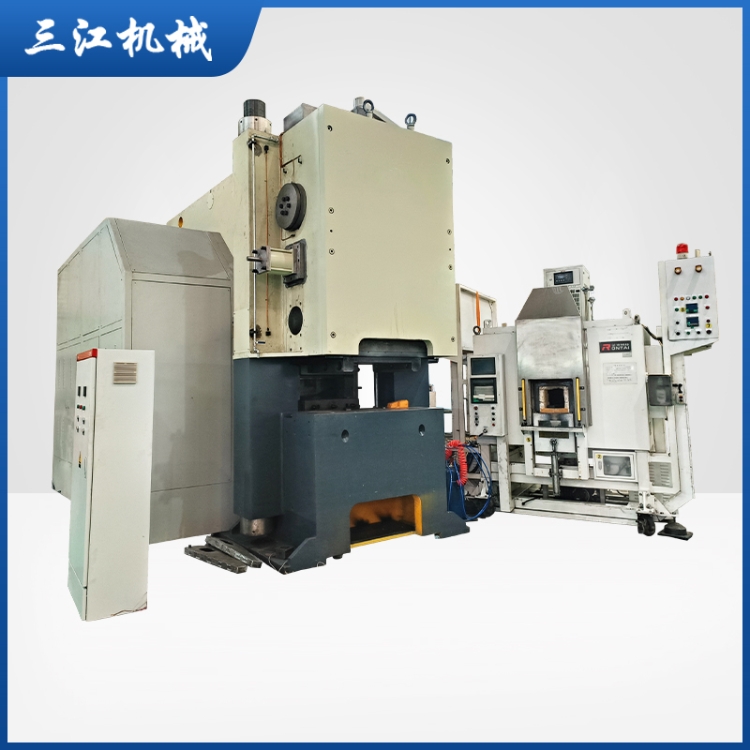
Flat forging machines, automotive half shaft forging equi...

Generally, mechanical press machines are characterized by their fast production speed, while hydraulic presses offer greater flexibility for more complex forming processes. In this article, we will discuss the differences between them in terms of mechanism and application.
Principle of Operation: Mechanical Press Machine
Mechanical presses generate power in a mechanical manner, as their name suggests. The main motor is connected to a crankshaft, which cycles the punch and a flywheel. In simple mechanical presses, the clutch directly controls the motor. In larger and more complex presses, the flywheel activates a small gear system during motion, rotating the crankshaft. While the motor powers the main system, the flywheel stores this kinetic energy and transfers it to the rest of the machine. Larger flywheels produce higher levels of energy. This enables mechanical presses to achieve high production speeds and force, especially when dealing with relatively flat and simple workpieces.
Simple setup and operation requirements translate into rapid and repeatable results. Mechanical presses are also less prone to leakage since they do not require hydraulic oil to power themselves. However, they lack the stroke length of stamping presses, which limits their applications.
The working principle of hydraulic presses:
Hydraulic presses exert force on fluids to generate power. They are primarily composed of pistons and power units/pumps. The pump moves the piston, increasing the internal fluid pressure. The pressure then moves along the piston's axis, creating a linear momentum that pushes the pressure onto the workpiece. Unlike mechanical presses, the amount of force a hydraulic press can produce depends on the working pressure and cylinder diameter. The hydraulic power unit also plays a significant role in the operating speed of the piston rod. Overall, due to the variable stroke length of stamping, hydraulic presses have a wider range of applications. Despite these advantages, hydraulic presses are typically prone to leakage due to fluid mechanics. Additionally, their operating speed is generally lower compared to mechanical presses.
Although the two machines have similar functions, the hydraulic press is more versatile in its applications. This is due to its ability to create highly complex shapes and its cost-effective maintenance. The automotive industry, in particular, frequently utilizes hydraulic presses for processing a variety of car parts. On the other hand, mechanical presses are used in applications where speed and output are the primary concerns.


b2b.china9.net © Zhongshang 114 Hebei Network Technology Co., Ltd.Address: Room 6009, Oriental New World Center, No.118 East Zhongshan Road, Qiaoxi District, Shijiazhuang City, Hebei ProvincePlatform Service Hotline: 4006299930