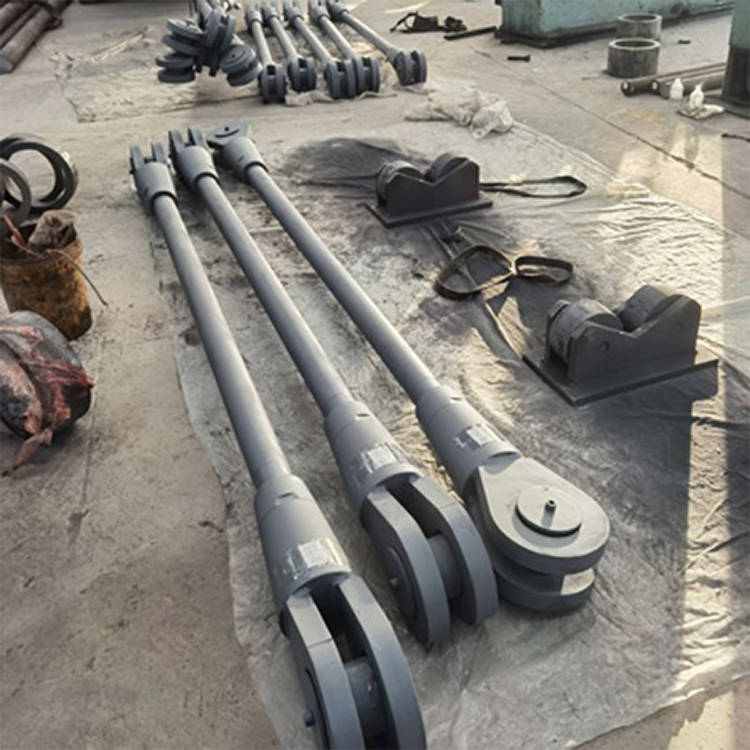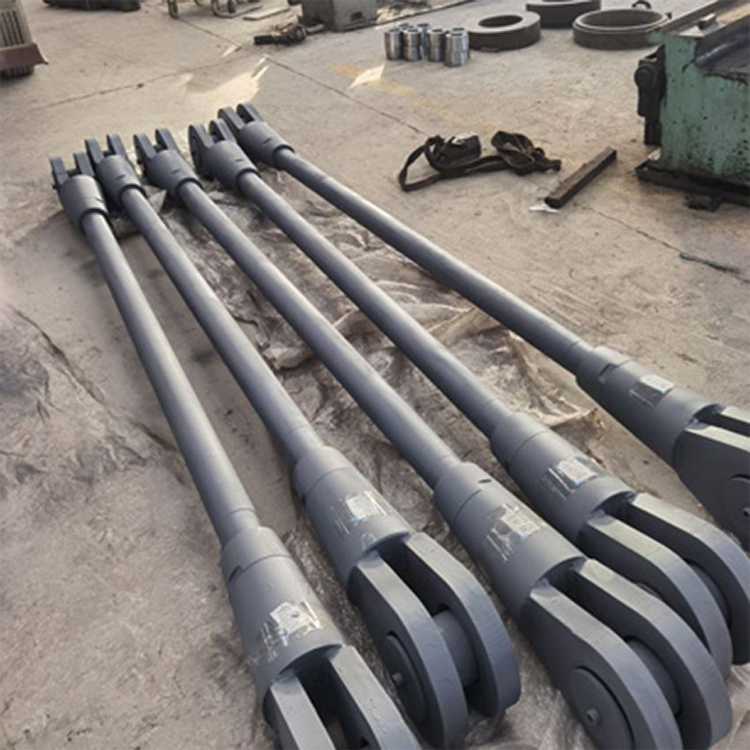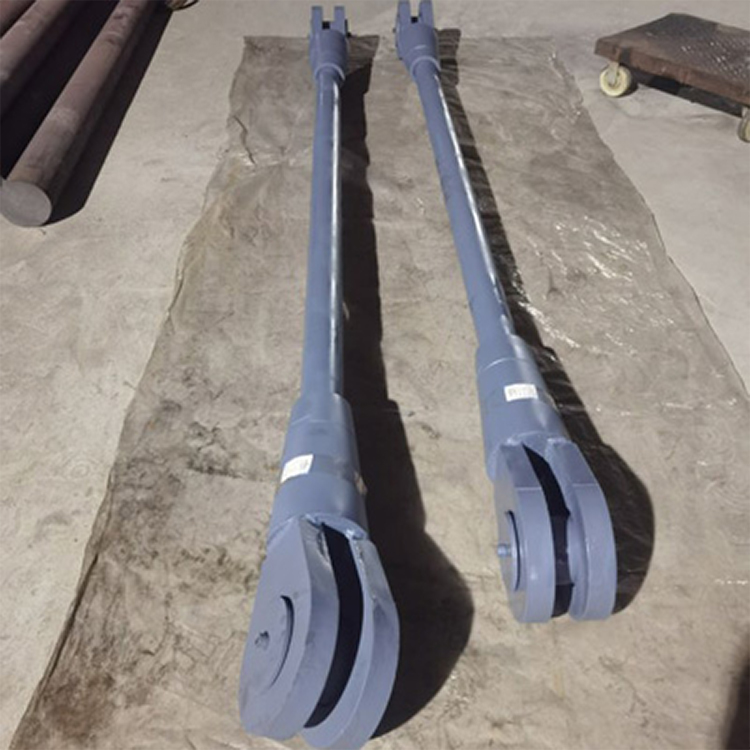
Steel Tie Rods, Stainless Steel Tie Rods, High-Strength S...

Stay-tension cables are a critical component of cable-stayed bridges, serving as the direct load-bearing structure for the main beam. The construction quality of stay-tension cables directly impacts the quality and service life of the bridge. Moreover, the installation of stay-tension cables is a typical large-span spatial three-dimensional construction task, requiring strong technical expertise and brand planning, with high risks. It is essential to scientifically formulate construction plans and operational details, reasonably arrange construction equipment, meticulously organize, and coordinate harmoniously to ensure the safe and efficient completion of the stay-tension cable installation work.
1.1 Disassembly and Installation of Stay Cables - The disassembly and installation of stay cables are typically procedures.
The bridge is situated on a steep slope with limited transportation conditions, making the original method of setting up suspension cables by transporting them to the吊架 below the bridge and then lifting them up with the hoisting system unsuitable. Instead, a new approach is being adopted by directly setting up hoisting points at the top of the tower for one end of the suspension cables. This allows the cables to be lifted and vertically placed without the need for full-scale lifting onto the bridge. As the last few suspension cables are longer, one end can be lifted to the top of the tower while the other is still on the ground. A pulley block system is then used to connect and lift the entire cable to the bridge.
1.2 Installation of Cable Stayed Beam End
After the stay cables are pulled from the bridge deck to the section of the main beam to be installed, the front boom of the cantilever is used in conjunction with a hand winch to fit the end of the stay conduit over the stay cable for keyword optimization ranking. Subsequently, the anchor head of the stay cable is connected to the tie system of the cantilever with steel bands, completing the installation of the stay cable at the beam end.
3.1 Cable Stay Tower End Installation
The installation of the stay cable tower end involves threading the anchor head of the stay cable into the stay tower's conduit and initially securing it to the anchor plate at the end of the stay hole. Since one end of the stay cable is already connected to a suspended basket, the cable is subjected to significant installation forces due to its own weight and horizontal tension. The installation traction of the stay cable can be estimated based on the cable length and the geometric distance between the upper and lower anchor holes, determining the distance of one end of the cable from the corresponding anchor plate at the stay hole when the traction force is T. ΔL = L0 - L + (ω^2 * Lx^2 * L0) / (24T^2) - TL / (AE) Where: ΔL - The distance of the top end of the stay cable from the tower's corresponding stay hole anchor plate when the traction force is T; L0 - The geometric distance between the center of the upper and lower stay hole anchor plates; L - The length of the stay cable; ω - The unit length weight of the stay cable; Lx - The horizontal projection length of L; T - The calculated traction force; A - The cross-sectional area of the steel wire in the stay cable; E - The elastic modulus of the vertical cable. Using the above formula, the installation forces of the stay cables from 0 to 7# are below 20 tons, from 8 to 17# are below 80 tons, and from 18 to 22# will reach 150 tons. Three hanging methods are adopted based on the three different installation forces. Hanging Method 1 - Pulley Block Hanging For stay cables 0 to 7#, with smaller installation forces, the single-point hanging method using a pulley block is directly applied. The pulley block吊点 is set on the anchoring point of the upper stay cable, pulled by a 4-line Φ34.5 steel wire rope winch to the outside of the tower. The pulley block outside the tower is designed for a traction force of 20 tons, with a φ21.5mm steel wire rope passing through 8 lines. The safety factor of the lifting rope in the pulley block is K = 7.8.
Installation Method 2 - Combination of Pulley Block and Soft Traction Hanger for Cables 8 to 17, the tension applied ranges from 20t to 80t. Directly using a pulley block for hanger installation is not economical due to the larger tonnage of the pulley block, multiple working lines of the hoisting rope, and the need for a specially designed cable clamp for connection to the stay cables. We utilize the original 20t pulley block in conjunction with steel strand soft traction hanger, which consists of 7 φ15.24mm steel strands, a soft traction connector, and an extended jacking system. Detailed arrangement is shown in Figure 3.
In the design of the soft traction continuous jacking system, the clever use of the tensioning jacks for the stayed cables eliminates the need to purchase additional continuous jacks separately. The soft traction continuous jacking system consists of a 600t jack, soft traction supports, soft traction anchors, moving anchors, tool clamps, and spring plates. It utilizes the self-locking properties of steel strand and clamps. When the jack injects oil, the steel strand is anchored to the cylinder on the moving anchor and synchronously stretched outward with the cylinder. When the jack retracts, the steel strand is anchored to the fixed anchor installed on the soft traction supports, and the moving anchor synchronously retracts with the cylinder. This repeated operation of injecting and retracting oil in the jack achieves continuous jacking. After the stayed cable anchor is pulled out of the conduit, the stayed cable anchor ring is placed on, the soft traction connector is removed, and the tensioning rod is directly installed for cable force adjustment. This method is safe and reliable in construction, eliminates the need for additional jack installation for cable adjustment, and is efficient. The procedure for combining the pulley block with the soft traction cable hoisting is as follows: ① The pulley block pulls the stayed cable to near the conduit exit and installs the soft traction system; ② Continuously jack the anchor out of the conduit exit; ③ Place the anchor nut on, remove the soft traction system; ④ Install the tensioning rod for cable force adjustment.
Installation Method 3 - Combination of Soft and Hard Traction for Cable Harnessing: The tension force for the 18-22# stay cables is installed between 80-200t. A combination of soft and hard traction with cable harnessing is proposed, which involves connecting a fixed-length rod after the soft traction. The rod is a Φ120mm tension rod. After the anchor head is tensioned out by the soft traction, the rod is directly tensioned until the stay cable anchor is pulled out of the conduit. The length of the rod can be calculated using the above formula, but it should not be too long, as there may not be enough installation space within the tower. If the length is insufficient, several sections of rods can be assembled. According to the calculation, for the Longxi Bridge cable harnessing, only one 1.4m section of rod is sufficient to meet the requirements.
b2b.china9.net © Zhongshang 114 Hebei Network Technology Co., Ltd.Address: Room 6009, Oriental New World Center, No.118 East Zhongshan Road, Qiaoxi District, Shijiazhuang City, Hebei ProvincePlatform Service Hotline: 4006299930