




- AllProduct Category
-
Blender Category
Aeration Stirring
Screening Equipment
Suction Mud Remover
Submersible Pump
Electric Motor Products
Other Environmental Protection Equipment


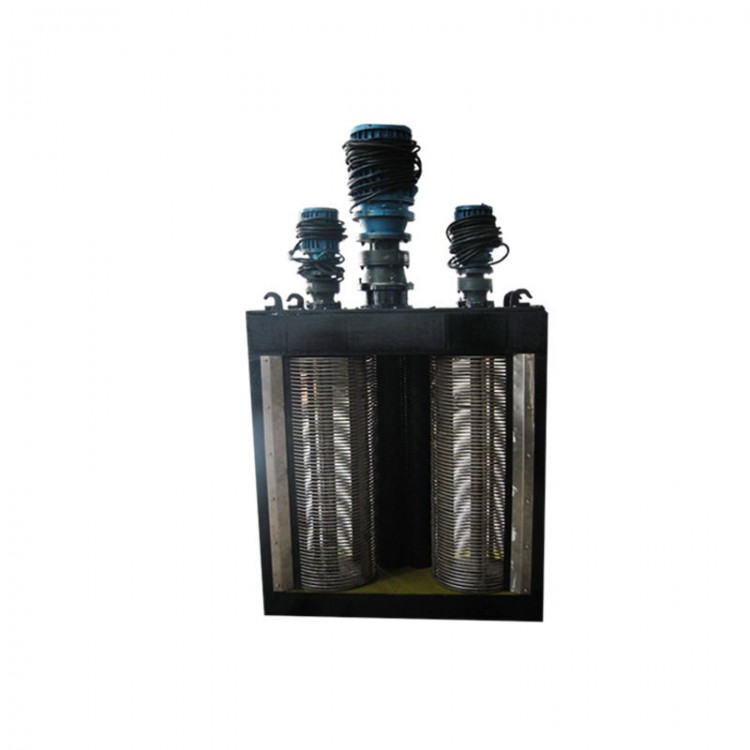
详情描述
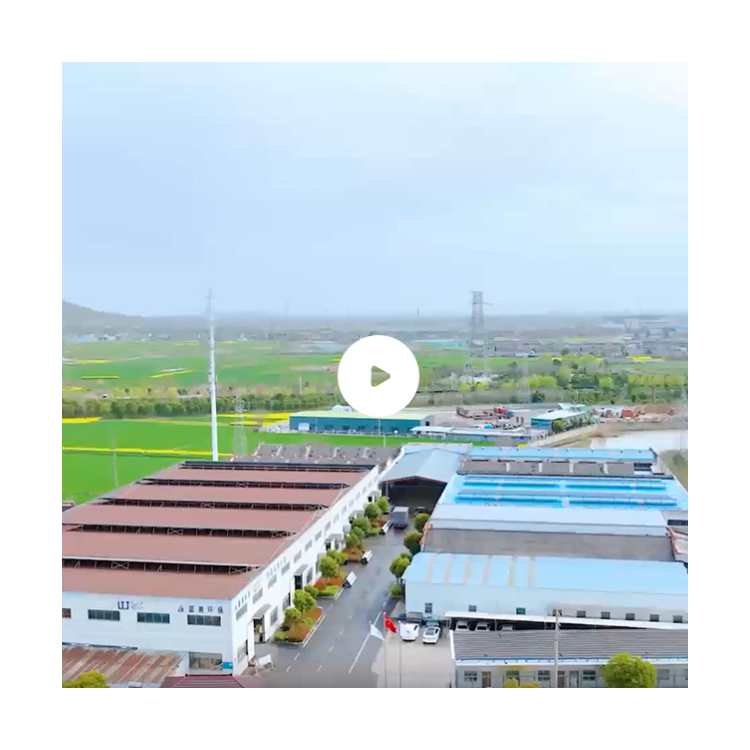
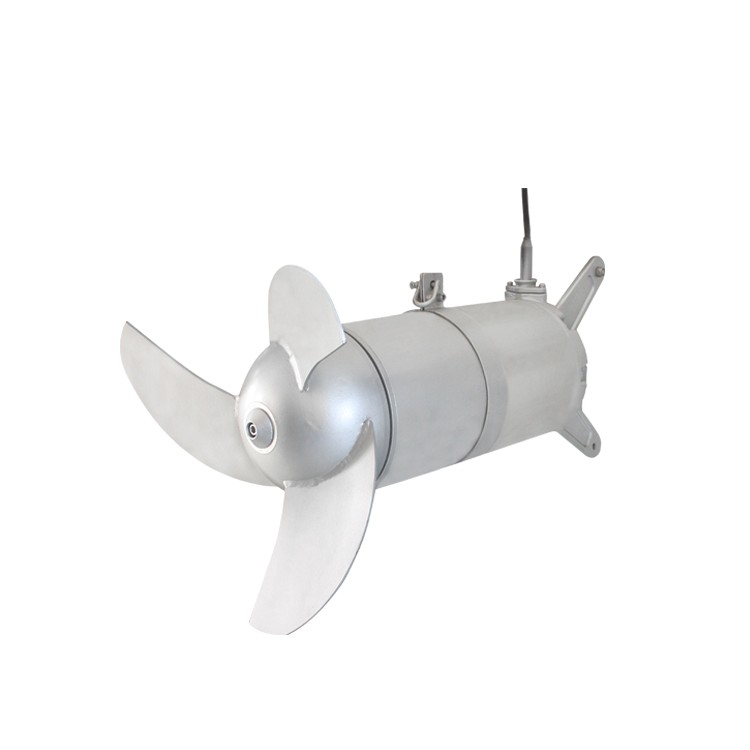
QXB Centrifugal Submersible Aerator Applications:
Aerators are used in wastewater treatment plant aeration tanks and grit chambers to oxygenate and mix the wastewater sludge mixture, as well as to biologically treat wastewater or oxygenate ponds for aquaculture.
QXB Centrifugal Submersible Aerator Working Principle:
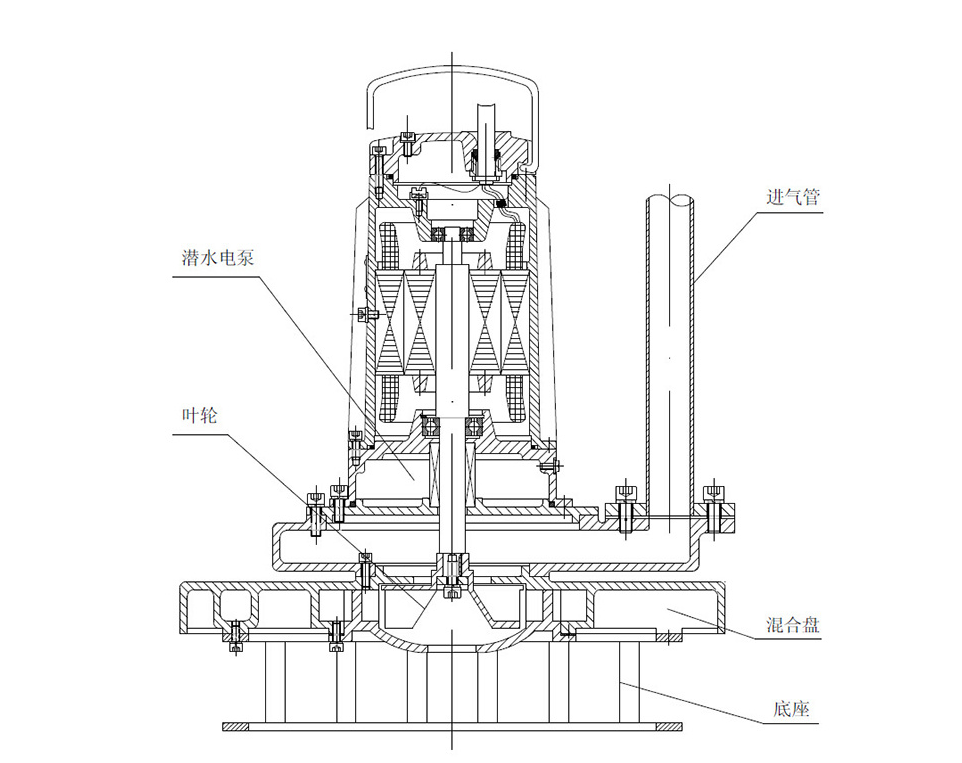
The aerator features a direct-drive structure. As the rotating impeller generates a centrifugal force in the water, a low-pressure area forms around the impeller. Air is then吸入 through the intake pipe, where it mixes with water in the mixing dish. This well-mixed and uniform mixture is subsequently automatically discharged through the outlet.
This process includes the following aspects:
The air and water mixed in the mixed disc produce a gas-liquid mixing effect, and the gas-liquid mixture discharged from the outlet forms a circulation and convection.
High-speed movement of oxygen molecules within a large volume of air achieves an extremely high oxygen absorption efficiency.
QXB Centrifugal Submersible Aerator Features:
High oxygen solubility, with a large proportion of small bubbles, offering high oxygenation efficiency and a wide oxygenation area.
The pool has no dead zones, and the horizontal aeration flow with entrained bubbles can fully scour every corner of the pool bottom.
Simple, compact structure with long machinery life, bearings capable of withstanding heavy loads, shaft sealing by oil bath, and air intake impeller cavity to prevent contact between water and sealing during operation—all these ensure the aeration machine operates continuously for 24 hours with long-term, trouble-free performance.
Save on engineering investment, no gas source required, eliminates blowers, easy installation, low noise.
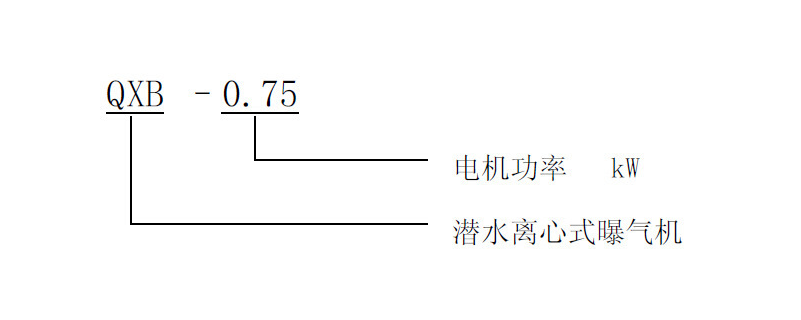
QXB Submerged Centrifugal Aerator Model Representation Method:
QXB Centrifugal Submersible Aerator Structural Diagram:
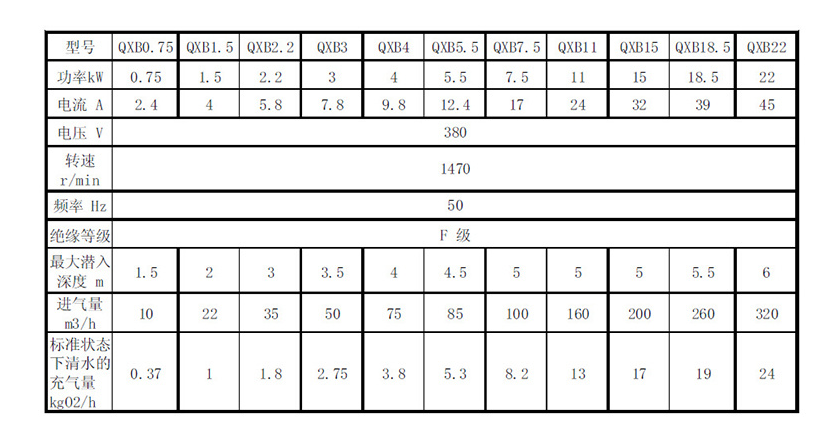
QXB Centrifugal Submersible Aerator Performance Parameters:
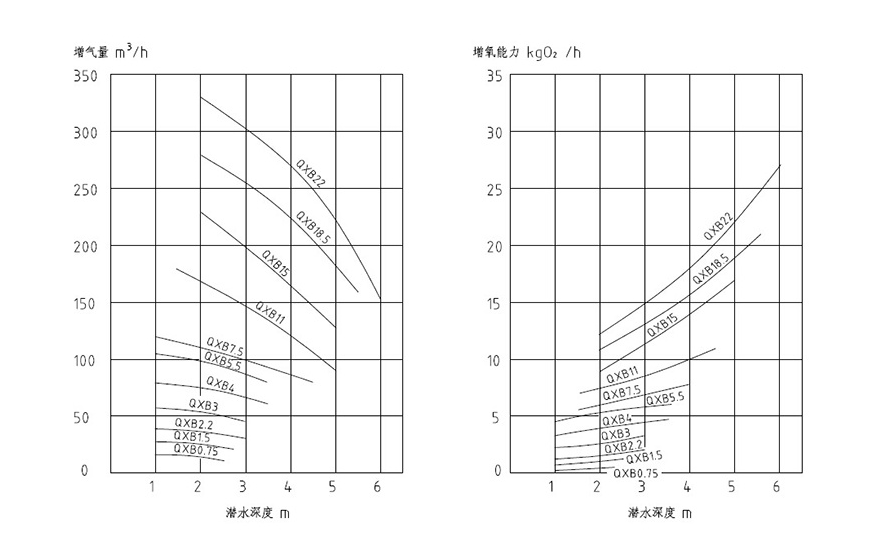
QXB Centrifugal Submersible Aerator Performance Curve
Troubleshooting Methods
| Fault Phenomenon | Reason Analysis | Exclusion Method |
| Power Equipment - Overload | 1. The inlet pool does not meet the requirements. 2. The blades of the submersible aeration pump are entangled with debris. 3. The blades of the submersible aeration pump are rubbing against the guide vanes. 4. The rotational speed of the潜水曝气机 exceeds the specified value. | 1. Improve water intake conditions 2. Clear away debris; wash with water 3. Inspect the blade wear and readjust the installation 4. Adjust the original motor to match the rated speed |
| Reduced aeration or no aeration | 1. The dive aerator's immersion depth is too deep. 2. Worn outer diameter of impeller blades or damaged blade sections Diving aerator direction is incorrect. 4. The impeller is loose. 5. Scuba aeration pumps have impurities causing blockages | 1. Improve Submersible Aerator 2. Impeller Replacement 3. Correct Rotation Direction 4. Fasteners 5. Clear away debris, rinse with water |
| Operation with noise or vibration | 1. The installation foundation of the submersible aeration machine is not sturdy or the screws and nuts are loose. 2. Impeller and guide vane friction 3. Loose impeller screws or partial damage to the blades 4. Inconsistent water inflow state 5. Scuba air compressor with impurities causing blockage | 1. Reinforce the foundation, tighten the screws 2. Inspection Centers and Gaps 3. Set-screw or replace impeller 4. Adjust the water inflow state 5. Clear away debris, wash with water |
| Dive Aeration Machine - Cannot Start or Fuse Blown | 1. Winding, junction, or cable disconnection 2. Diving aeration pump clog 3. Leaking or Water Damage 4. Short circuit | 1. Check with an ohmmeter 2. Cut off the power and clear away debris. 3. Inspect the insulation; if below the specified value, it must be dried. 4. Inspect and use after repair. |
| Dive Aerator - Once the machine starts, the overload breaker trips. | Low Voltage 2. High voltage 3. Incorrect motor wiring or connector mix-up 4. Control cabinet electrical failure | 1. Currently not in use or voltage drop caused by long lines 2. Install the transformer and adjust the voltage to the specified level. 3. Adjust wiring and connectors 4. Inspect and replace electrical components |
询价单


