


- AllProduct Category
-
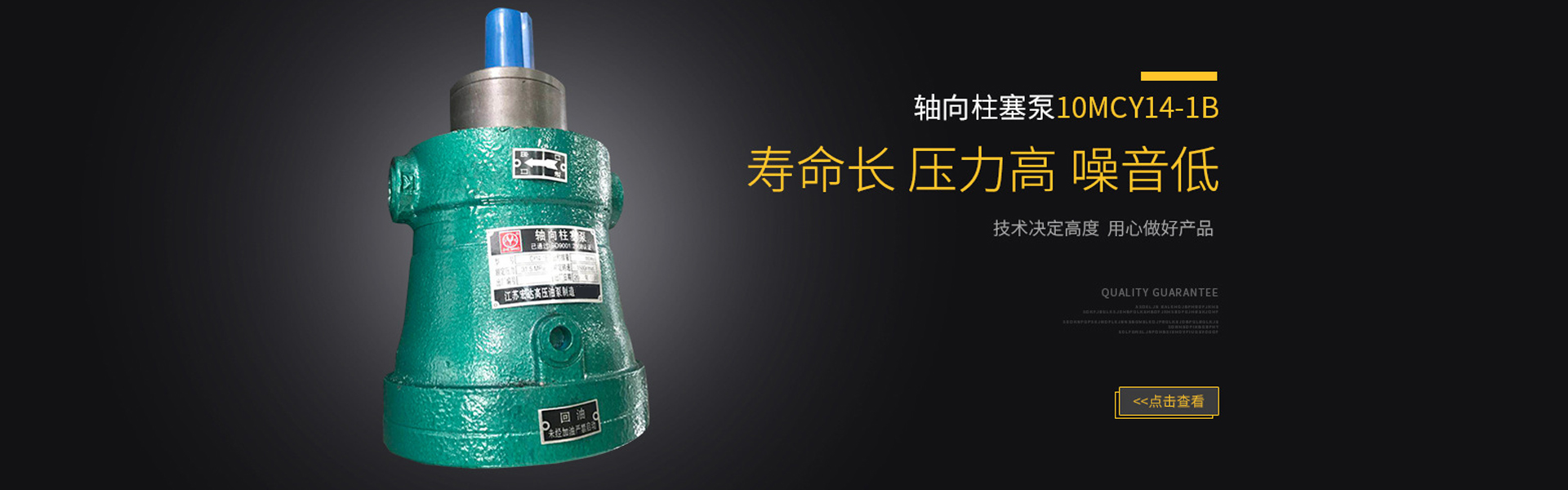
CY14-1B Series Axial Piston Pump
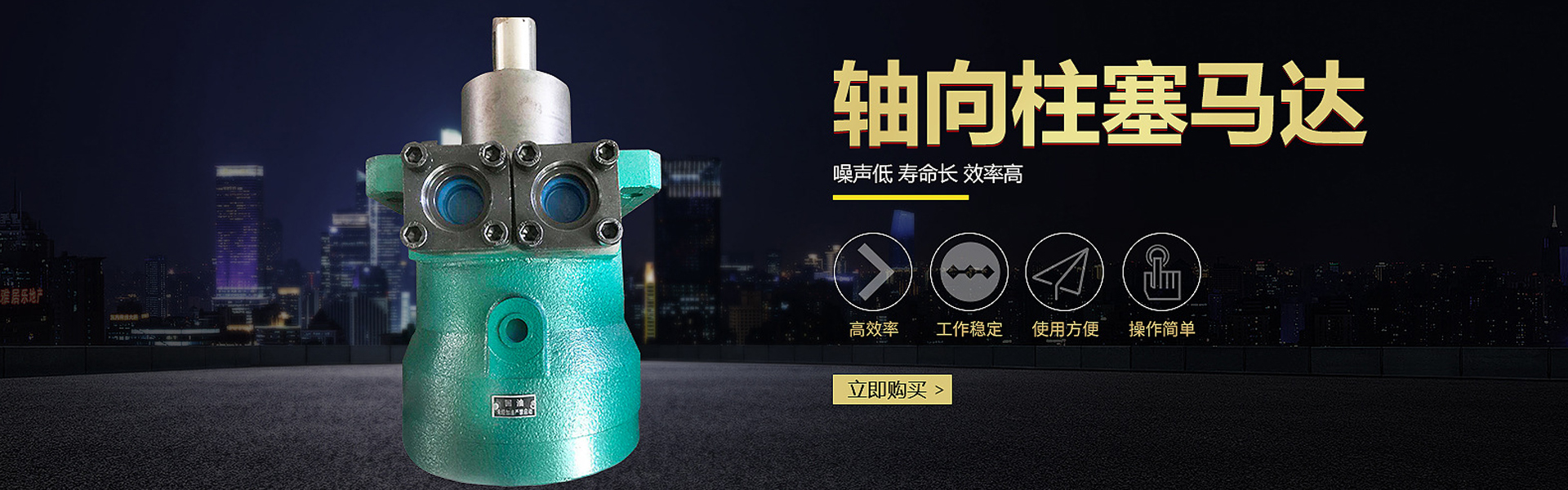
HY Series Plunger Pumps
XM40/MX75 Motor
A2F Series Inclined Axial Pump
A7V Series Inclined Axial Variable Pump
Oil Pump Accessories





详情描述
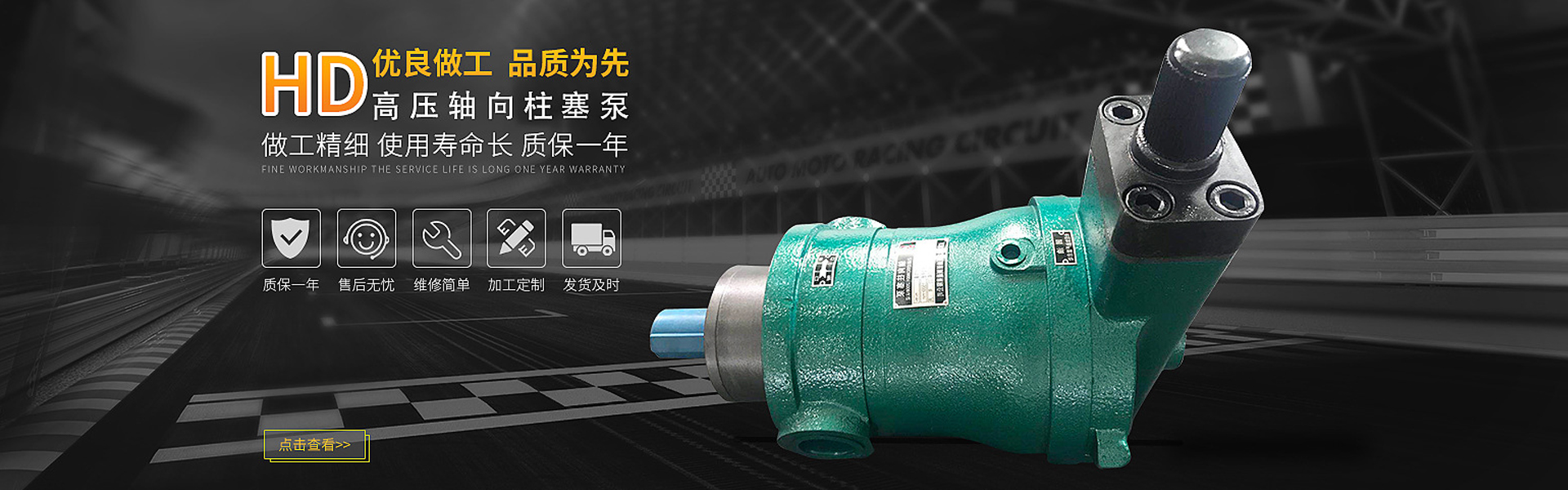
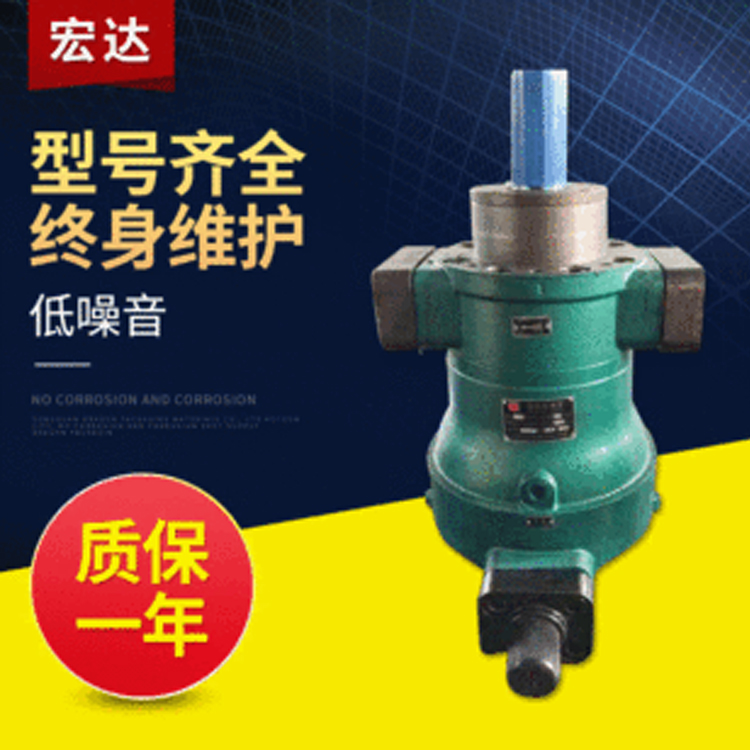
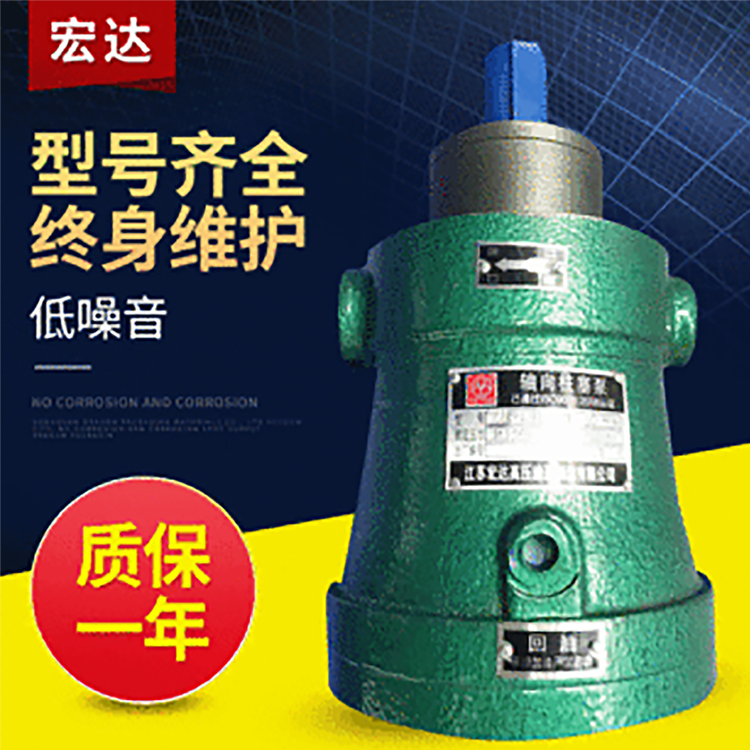
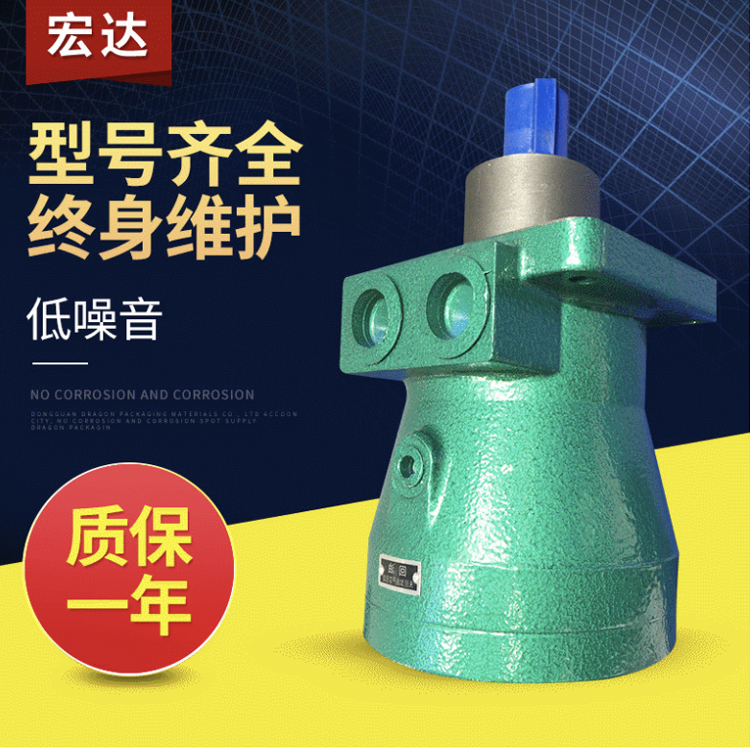
YCY14-1B Pressure Variable Axial Plunger Pump
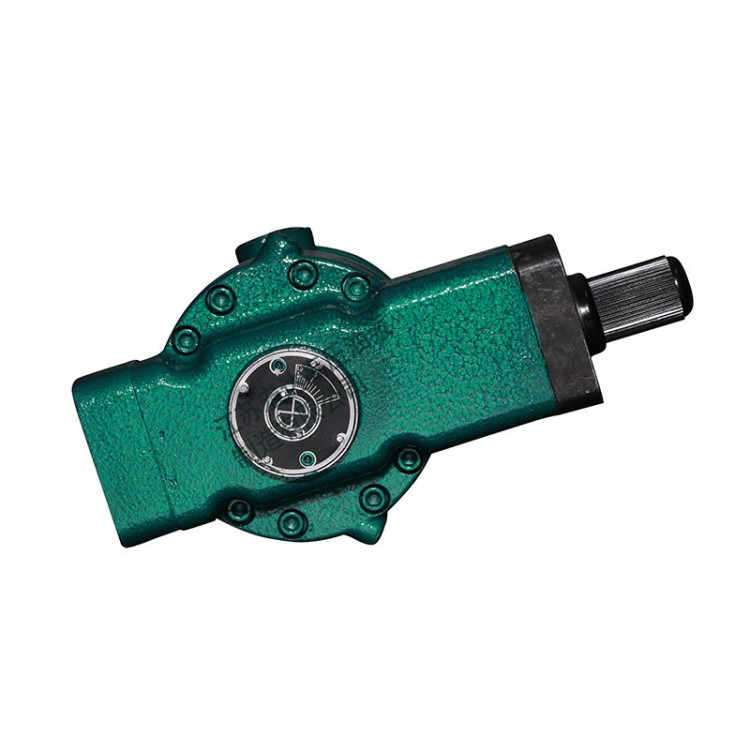
CY14 Axial TypePlunger pumpThis is an axial plunger pump using an oiling disk and cylinder rotation. Due to the hydraulic static balance structure between the slide shoe and variable head, as well as between the oiling disk and cylinder, it boasts advantages such as simple structure, compact size, high efficiency, long service life, light weight, and strong self-priming ability compared to other types of pumps. It is suitable for machine tools, forging, metallurgy, engineering, mining machinery, and other hydraulic transmission systems. This pump can also be used as a hydraulic motor by simply replacing the motor oiling disk.
Model Description

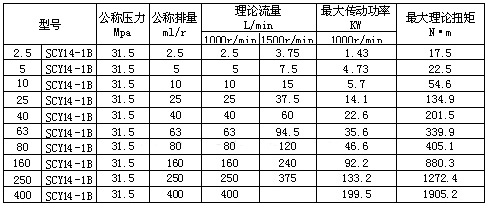
63SCY14-1B has a nominal flow rate of 63L/min at 1000r/min, with manual variable forward rotation, cylinder body rotationAxial Piston Pump(B-Type Drawing)
Series specifications
Terms of Use
Axial piston pumps are a precision component, and their correct usage directly impacts the pump's lifespan. Therefore, all users must strictly adhere to the following requirements to properly operate this pump.
1. Installation
(1) The oil pump can be mounted using a bracket or flange. The pump and the prime mover should be supported by a common foundation bracket. The bracket, flange, and foundation should all have sufficient rigidity to prevent vibration during operation. For pumps with a flow rate of 160L/min or more, due to the higher power of the prime mover, it is recommended not to install them on the oil tank.
(2) The alignment error between the pump's drive shaft and the output shaft of the prime mover, along with the alignment method, are as follows:
A. Bracket Installation: The method for checking the installation accuracy between the prime mover output shaft and the bracket is illustrated in Figures 12-1 and 12-2.

B. Flange Installation: In this type of installation, if the prime mover and pump are connected by a coupling, the installation accuracy check method is as shown in the above figure. If the pump shaft is directly inserted into the output shaft of the prime mover, refer to Figures 13-1 and 13-2 for the installation accuracy check method.
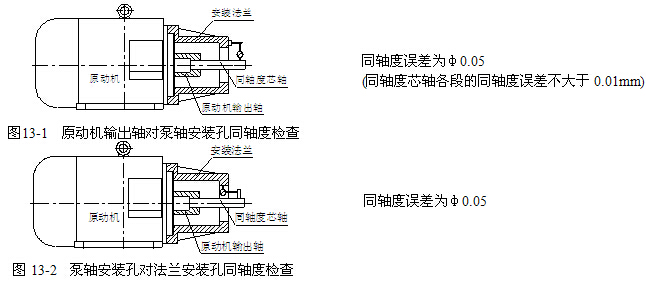
Verticality error: 0.05
(R is the diameter of the circular distribution of pump mounting holes)
(3) It is recommended to use an elastic coupling to connect the pump and the prime mover's drive shaft as much as possible. Since the pump's drive shaft cannot withstand bending moments, it is strictly prohibited to install a belt or gear on the pump shaft to drive the oil pump. If it is necessary to connect the pump with a belt or gear, it is suggested to add a bracket for installing the belt or gear (Figure 14).
(4) The rotation direction of the oil pump, as indicated by the pump label. If the rotation direction is not specified when ordering, the pump will be supplied in a clockwise direction (as viewed from the shaft end). To change the pump's rotation direction, please contact the manufacturer.
(5) The installation of the oil pump should consider ease of maintenance, allowing the variable housing to be easily removed for the convenient extraction of the cylinder block and oil distribution plate inside the pump.
2. Fuel Tank Design
Due to the pump's use of static hydraulic bearings, strict attention must be paid to preventing oil contamination. The design quality of the oil tank significantly affects oil contamination. The hydraulic pipeline should be thoroughly cleaned before installation, typically with acid pickling for steel pipes, followed by neutralization treatment; cleaning should be done after welding to ensure pipeline cleanliness. The oil tank design must be sealed to prevent continuous contamination.

Figure 14: Installation Methods for Pumps Driven by Belt Pulleys or Gears
Key Points for Fuel Tank Design:
The fuel tank capacity should be three times the flow rate per minute of all pumps in an open-loop system. In a closed-loop system, the tank capacity can also be referenced to the above principle, but the flow rate of the oil pump can be considered based on the replenishment pump's flow rate. For systems with accumulators, the fuel tank should be able to accommodate the return flow of the accumulator. Additionally, the fuel tank capacity should also consider the system's heat generation. If there are no strict requirements for the equipment's volume and weight, to enhance cooling efficiency, the tank capacity can be appropriately increased.
To prevent continuous oil contamination, the oil tank must be strictly sealed. Oil that leaks from the valve and pipes onto the tank lid must not flow back into the tank. The internal tank is connected to the atmosphere through an air filter. The air filter must be cleaned simultaneously when cleaning the oil tank. The pipes inserted into the tank must be tightly sealed to the tank lid to prevent dust from entering.
The pump is designed for normal operation within a temperature range of 10~65°C. If operation exceeds this range, a heating or cooling unit must be installed in the hydraulic system.
3. Filter
The cleanliness of the working hydraulic fluid significantly affects the lifespan of the oil pump. Baffles should be installed inside the tank to eliminate air bubbles during the return oil process, equipped with 80 mesh screens. The hydraulic system should be fitted with a fine filter of 15μ to 20μ in the return oil section to maintain the cleanliness of the system fluid. (Do not install a fine filter on the pump's leakage oil pipe to avoid increasing the pressure in the casing cavity, leading to oil leakage at the skeleton seal. The pump's inlet pipe should not be fitted with a filter to prevent increasing the suction resistance.)
In addition to the requirements mentioned above, users must pay special attention to:
(1) Before installation and trial run, the fuel tank, pipes, cylinders, valves, etc., must be thoroughly cleaned. When refilling the fuel tank with new oil, the oil must also be filtered through an oil filter to prevent contamination of the oil due to unclean oil drums.
(2) After one week of use, the new pump requires a full oil change, including cleaning the oil tank and filter. Then, depending on the machine's workload, replace the oil filter with a 15μ to 20μ filter every 3 to 6 months, or change the oil and clean the oil tank.
(3) It is strictly prohibited to open the oil tank cover or oil filling hole due to system heating during use.
4. Self-priming and piping
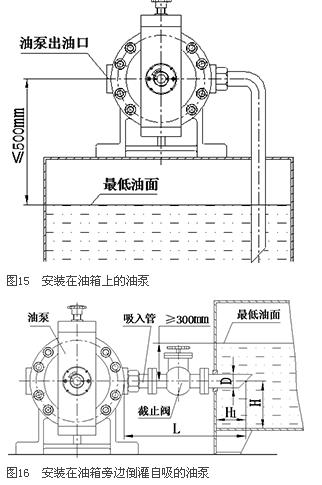
When installing an oil pump, it's advisable to position the oil tank's liquid level above the pump's intake port as much as possible. For pumps with flow rates less than 160L/min, they can be installed on the oil tank for self-priming. For pumps with flow rates above 160L/min, reverse priming should be used. The diameter of the suction pipe should not be smaller than the recommended size, and the diameter of the shut-off valve should be one size larger than the intake pipe. The distance H1 from the intake pipe end to the side wall of the oil tank should be greater than 3D, and the distance H to the bottom of the oil tank should be greater than 2D; no more than two bends should be used. Both the suction pipe and the leakage pipe must be below 200mm from the low oil level of the oil tank to prevent air from entering.
(1) Self-priming installed on fuel tank (Fig. 15)
a. The center height to the lowest oil surface of the oil pump does not exceed 500mm.
b. Oil filters are not permitted to be installed on the intake pipe.
c. If the oil pump requires reduced bias angle start-up, it cannot guarantee self-priming (if the user needs a lower flow rate during operation, they should adjust the flow rate using a variable mechanism after the pump has started at full bias angle).
(2) Back-Flow Self-Priming (Fig. 16)
a. The distance from the low fuel level in the fuel tank to the center of the pump should be ≥300; the pump can start self-priming with a slight angle.
b. The length of the oil pump's inlet pipe, L, is less than 2500mm.
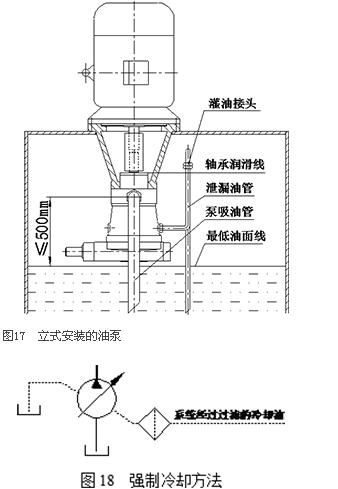
(3) Self-priming vertical mounted oil pump (Fig. 17)
a. The distance from the oil pump intake to the lowest oil level must not exceed 500mm.
b. The filling joint on the leaking oil pipe should be higher than the oil pump bearing lubrication line (end cover flange).
5. Method of connecting the oil pipeline for leakage
(1) The oil leak outlet must be directly connected to the oil tank; it must not be connected to the system pipeline.
(2) When the pump frequently operates at zero bias angle or the system working pressure is below 8MPa, causing excessive leakage and resulting in the pump body heating up, cooling measures can be considered. A branch pipe can be分流 from the system return oil pipe and connected to the leakage oil outlet at the bottom of the oil pump for forced circulation cooling (as shown in Figure 18). The oil pressure within the housing should be less than 0.05MPa.
(3) When using a pressurized oil tank due to the requirements of the hydraulic system, the pressure should not exceed 0.05 MPa.
6. Working Medium
(1) Recommend using domestic N32-46 hydraulic oil or other hydraulic oils with a viscosity index of 90 or greater and a range of E50=3~5. The moisture, ash, and acid value in the oil must comply with the relevant specifications for hydraulic oil.
(2) The normal operating oil temperature for this pump is 10~65°C. If 10# aviation hydraulic oil is used, the cooling system performance must be excellent.
7. Initiate
(1) Prior to operation, check if the oil pump is installed correctly and reliably, and if the coupling is installed to specifications. Rotate the coupling by hand to verify that the pump shaft rotates evenly. Also, inspect if the two couplings are coaxial and if there is the necessary axial clearance.
(2) Before initial use or after long-term storage, it is mandatory to fill the pump with clean working oil through the leakage oil port on the pump housing before starting. Failure to do so is prohibited! Check the pump's rotation direction before starting!
(3) Adjust the system's relief valves to the low setting; strictly prohibit starting with a load!
(4) Upon starting the pump, it should be manually operated first, and then run continuously after normal oil output. After running for a certain period without any malfunctions, gradually adjust to the required pressure and flow rate. The pressure setting of the safety valve in the hydraulic system must not exceed 35 MPa.
(5) When a pump is restarted after being out of service for more than three months, it should be run dry for half an hour first. If abnormal temperature rise, leakage, vibration, or noise is detected during operation, the pump should be stopped immediately for inspection.
8. Load Operation
(1) Low-load Operation: After completing the aforementioned preparations, start the pump and run it under a pressure of 1~2 MPa for half an hour.
(2) Full Load Operation: After the low load operation is completed, gradually adjust the pressure of the overflow valve and safety valve to the high pressure of the hydraulic system and run for 15 minutes. Check if the hydraulic system is operating normally. The high temperature on the pump housing is generally 10~15℃ higher than the oil temperature at the pump inlet in the oil tank. When the oil temperature in the tank reaches 65℃, the high temperature on the pump housing should not exceed 75~80℃. After the load operation is completed, the pump can enter normal operation.
(3) When stopping the oil pump, it should be unloaded first, then shut down.
Sectional view
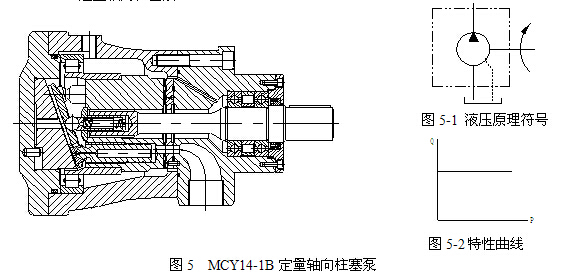
The inclined plate in the metering mechanism is always fixed on the metering end cover, and the stroke of the plunger cannot be altered, thus ensuring a constant flow rate.
Fault Handling
Operating Principle
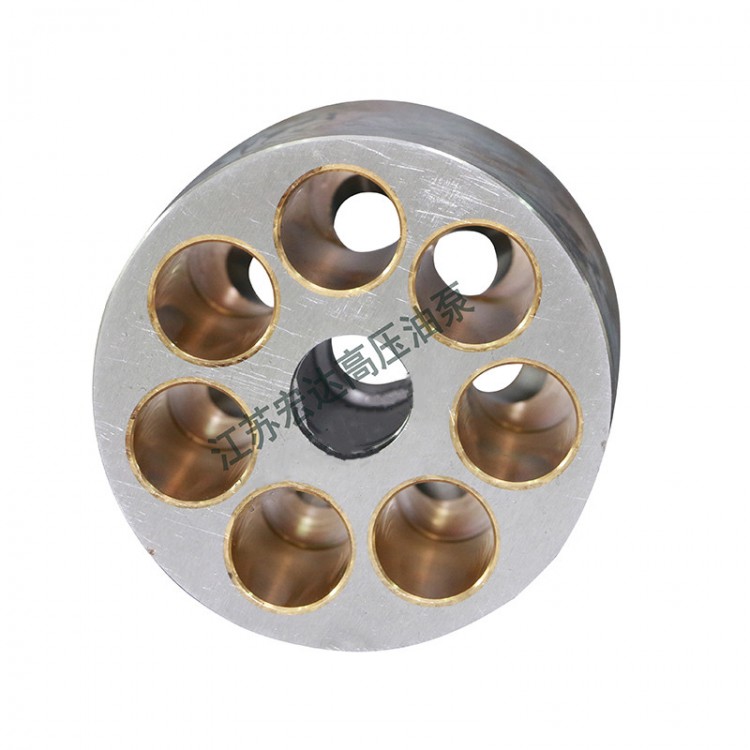
Axial piston pumps utilize a distribution plate for oil distribution, featuring a cylinder body rotation and an adjustable swashplate design. These pumps are designed with a hydrostatically balanced oil film thickness, ensuring the cylinder body operates under pure liquid friction with the distribution plate and the sliding shoe with the adjustable head. They offer advantages such as simple structure, compact size, low noise, high efficiency, long lifespan, and self-priming capability.
The CY14-1B series pumps are axial piston pumps that utilize a cylinder body rotation and variable head (tilting disk) for variable flow. Thanks to the hydraulic static balance oil film thickness design between the sliding shoe and variable head, and between the oil distribution plate and cylinder body, the two pairs of moving surfaces operate under pure liquid friction, eliminating the need for heavy thrust bearings. Compared to other types of pumps, they offer advantages such as simple structure, compact size, high efficiency, light weight, low noise, long service life, and strong self-priming ability. They are suitable for hydraulic equipment in forging machinery, machine tools, ships, aviation, metallurgical machinery, plastic machinery, construction machinery, and mining machinery.
Power Calculation
N = QP / (60η) (Kw) Actual motor power used
Q – Flow Rate, L/min (Actual Flow Rate)
P – Pressure MPa (Actual Operating Pressure)
η - Total Efficiency Varies from 0.85
Users can select the motor after calculating the actual load based on the formula listed above.
Dimensions
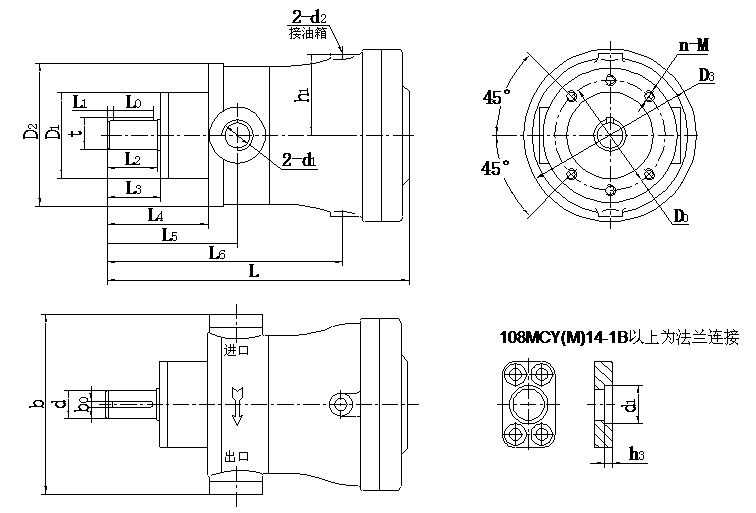
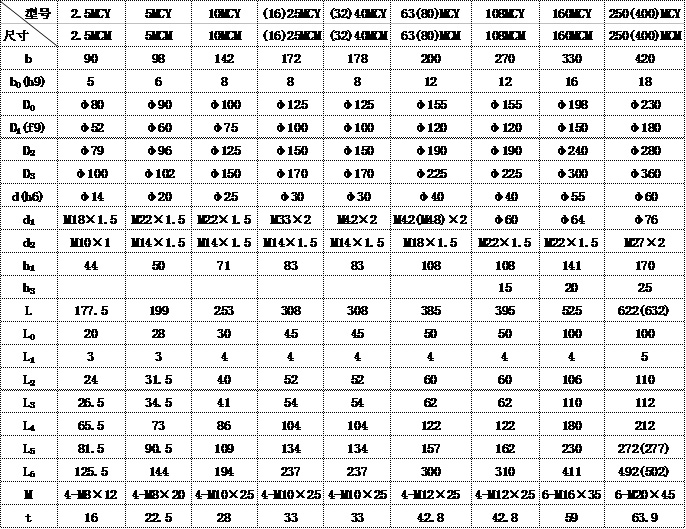
MCY (M) 14-1B Axial Piston Pump (Illustrated as a clockwise pump; the inlet and outlet ports of the reverse pump are opposite to those of the clockwise pump)
询价单

