
 Equipment asset allocation, disposal, sale, and upgrade改造
 Overall Equipment Effectiveness (OEE)
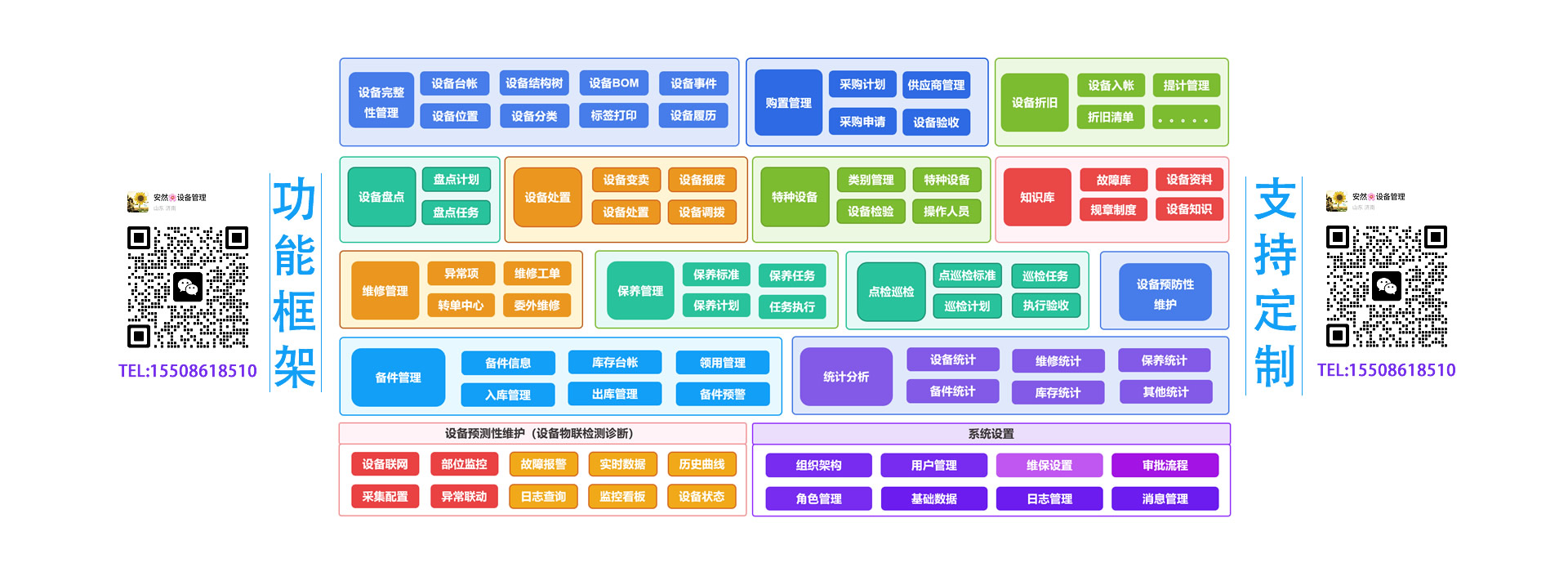
 Equipment Statistics, Data Analysis, Efficiency Enhancement
 Single-item, single-code scanning for repair management
 Equipment procurement, inspection, supplier management
 One-Item-One-Code Scanning Repair Management System Software
 Equipment Assets, Equipment Inventory Management
Product Details




产品Price Negotiable
最小起订Quantity: 供货总Quantity:


Operation and Maintenance Method |
|
Operating System |
Supports Android, Apple, and HarmonyOS |
Supportable Devices |
Mobile phones, computers, tablets, mobile PDAs, patrol meters, etc. |
Support Platforms |
DingTalk, WeChat Work, Feishu |
Domestic-made |
Domestic software, self-controllable, meets the requirements of information creation |
System Features |
Supports domestic operating systems such as Kylin and UnitedOS, as well as domestic databases like Dameng and Gauss. |
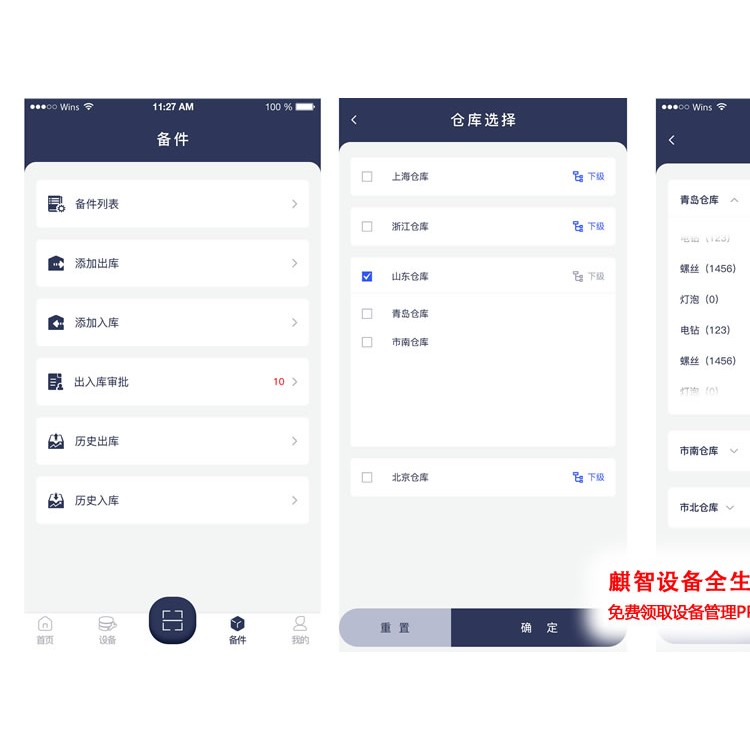
Equipment correlation, maintenance correlation, inventory alert, enhance production efficiency, and reduce maintenance costs During the process of corporate digital transformation, the comprehensive management of equipment throughout its entire lifecycle is indeed a core area, as equipment forms the foundation of production activities. The health, efficiency, and reliability of equipment directly impact a company's production capacity, quality, and economic benefits. Therefore, as the core of infrastructure equipment digitalization, the equipment lifecycle management system should indeed be regarded as a priority project to consider. Spares management is a crucial component for the smooth operation of the production process, especially in industries that rely on complex equipment and systems. It not only ensures the availability of spare parts but also their quality and timeliness, enabling rapid maintenance in the event of equipment issues. Spares and replacement parts management is a complex process requiring collaboration between multiple departments. Especially in large-scale manufacturing and heavy industries, effective spares management is crucial for ensuring stable production operations. By adopting modern technologies such as the Internet of Things (IoT) and artificial intelligence, companies can further optimize the spares management process, enhancing its efficiency and effectiveness. Connect with equipment for clear spare parts information; promptly provide spare parts inventory updates, establish procurement plans; logically categorize accessories, and clearly define priorities. Spares and parts management is a core function in many manufacturing and industrial enterprises, as shortages or late procurement of spare parts can lead to equipment downtime, thereby affecting production efficiency and profits. Parts are issued against work orders, associated with equipment and submitted for review; approval is required before use. The entire process of parts usage is fully recorded and traceable. The inventory, usage, and tracking of spare parts are crucial aspects for a company's equipment maintenance and operations. An orderly management of spare parts can reduce costs, enhance equipment availability, and boost production efficiency. The system can manage multiple warehouses across different regions. Simplifies warehouse maintenance processes, manages and tracks spare parts suppliers and purchase orders, sets up safety stock alerts, and scientifically maintains inventory balance, ensuring that replacement parts arrive before you need them. By asset coding, quickly locate the corresponding spare parts, enhance maintenance efficiency, reduce repair time, ensuring the equipment operates as reliably as possible with minimal downtime. Basic spare parts information:Establish a two-way link between equipment assets and maintenance materials. View BOM through equipment assets and view equipment assets through spare parts, achieving a two-way association. Parts Procurement:Inventory alerts, purchase requests, purchase orders, supplier management, contract management. Parts Relevance and Analysis:Parts and equipment are interrelated in a many-to-many relationship. Analysis of parts usage includes average lifespan and usage trends. Accessible reports and KPIs from the repair warehouse encompass, but are not limited to, parts service level, parts turnover rate, parts consumption statistics based on different cost centers, and cost summaries based on various locations. Warehouse Management:Warehouse supports multi-regional, multi-warehouse management, and during the procurement of spare parts, it allows for cross-regional, multi-warehouse coordination. Inventory in and out supports process approval. Documentation, tracking, feedback, and analysis:Parts usage records and parts flow with feedback. Support comprehensive analysis on factors such as quantity, lifespan, and cost. Real-time inventory monitoring: Ensure inventory levels are maintained at a reasonable level to avoid overstocking or understocking, as both conditions can increase costs. Historical Data Analysis: Analyzing historical data to predict future parts demand helps avoid emergency purchases, which are often more costly. Performance indicators: such as the turnover rate and expiration rate of spare parts. Cost Analysis: Monitor the overall cost of parts management and identify opportunities for optimization. Parts and accessories management ensures continuous operation of equipment, reduces downtime, and thereby enhances production efficiency. API data can be integrated with ERP, MES, OA, and human resources performance systems. Open APIs, standardized data, easy to use Directly interface with other production systems such as MES, MOM, etc., serving as a supplementary channel for production data. The equipment management system can be privately deployed, with API internal network calls, ensuring high data privacy. The Kizhi Equipment Management System OEE_API currently provides the following data: Basic Equipment Information (e.g., Equipment ID, Equipment Name, Location, etc.) Real-time Overall Equipment Effectiveness (OEE) value Three Key Elements (Availability, Performance Efficiency, Quality) Equipment failure or shutdown codes and related durations Equipment production data (such as production quantity, good quality quantity, defective quantity, etc.) Note: As the system is upgraded, the data provided by the API will continue to expand.Replacement Parts Management

Parts Information Sharing:
Parts Consumption Tracking:
Multi-warehouse, cross-regional management:
Maintain high operational efficiency:
Spares and Replacement Parts Management

Reduce Costs and Save Budget


Free Open API Data
Phone Consultation