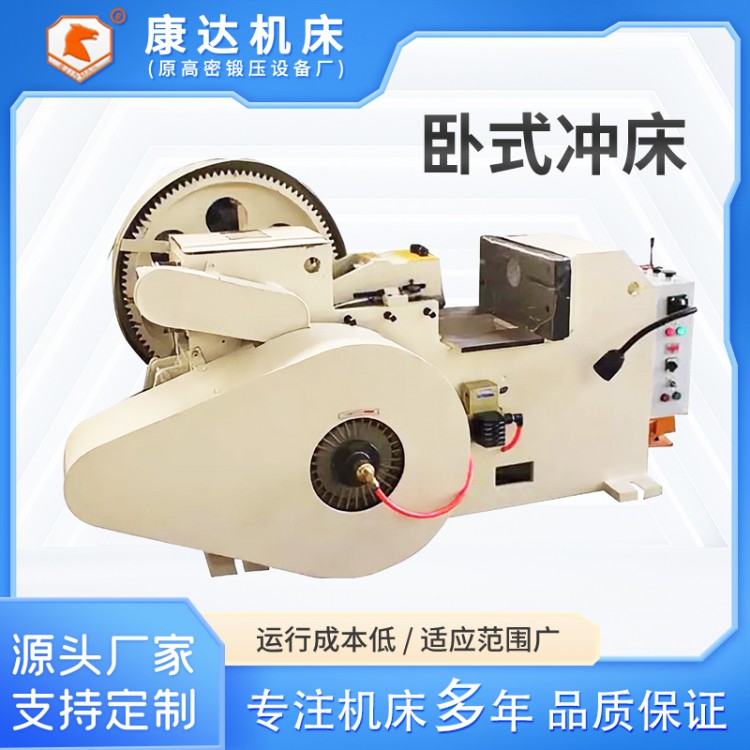
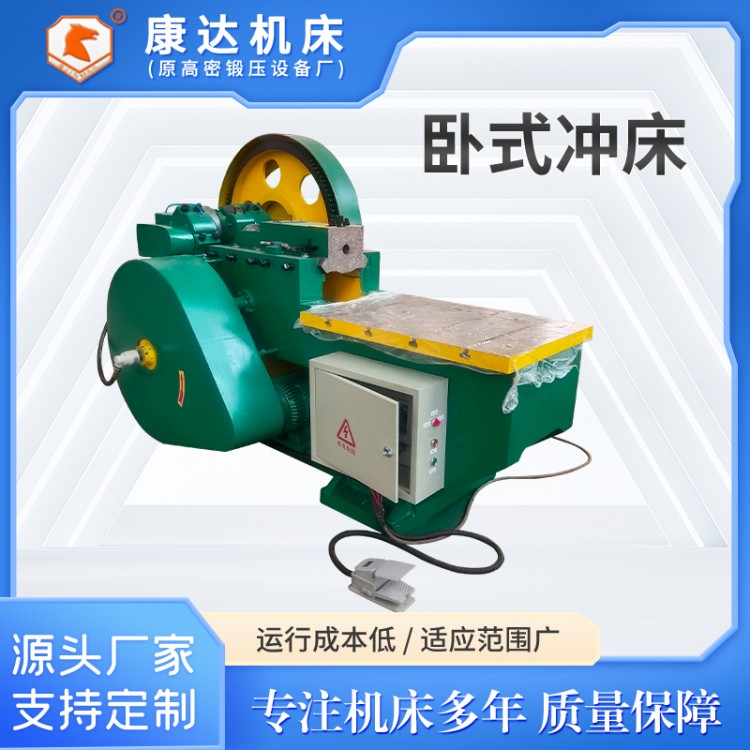
Press machines, punch presses, pneumatic punch presses, m...

How to Adjust the Air Clutch Clearance on a Press Machine? Now, let's learn from Shandong Kunda Machine Tools.
The pneumatic press utilizes high-pressure gas generated by a compressor, which is then transported through a pipeline to an electromagnetic valve. The movement of the valve is controlled by a foot switch, thereby regulating the cylinder's operational state to complete the punching process.
Our JQ21 series pneumatic clutch pressure machines and JQ23 series pneumatic clutch pressure machines offer the following advantages:
Rigorous in rigidity, stable in precision, featuring a mechanical overload protector within the slider, ensuring long-lasting safety and reliability for the machine tool.
The machine tool features a compact structure with a combined pneumatic friction clutch brake, ensuring smooth transmission, simple operation, sensitive movement, and low noise.
Electrical and pneumatic controls enable incremental movement, single-stroke stamping, continuous stamping, and emergency stop functions.
Electrical controls are equipped with sockets for installing photoelectric safety protection devices to meet the safety requirements for personal protection of users.
Machine tools automate production for high efficiency.
The stroke of a combined pneumatic friction clutch used in pneumatic presses is one of the critical parameters affecting the reliability and safety of the clutch operation. A too small gap can lead to overheating of the clutch, while an excessively large gap can cause a significant braking angle, posing a risk of continuous surges. It is recommended to supply air when measuring the clutch gap, ideally for the brake pad gap. Turn off the pneumatic press and simultaneously press the test button on the double-acting valve with both hands to supply air, or use electrical control methods to do so. Insert a feeler gauge between the brake friction pad and friction disc to measure the stroke value, which should be a significant gap (it is advisable to measure at four points around the circumference in a cross pattern). For medium and small clutches, a stroke of 1.5 to 2.0 millimeters is ideal, while for large ones, 2.0 to 3.0 millimeters is recommended. According to the clutch user manual, friction pads should be replaced or the gap adjusted when wear exceeds a certain limit.
The pneumatic pressure machine's pneumatic combined clutch is a dry friction clutch. Its clutch and braking components are integrated. When the cylinder is intake, the piston pushes against the spring, releasing the braking disc and clamping the clutch disc, transferring the flywheel's power to the gear shaft. When the cylinder exhausts, the spring clamps the braking disc, releases the clutch disc, and applies the braking force of the flywheel to the machine body, stopping the slider's movement.
Therefore, there must be a gap between the clutch and the brake disc. The initial gap is between 1.5 to 2.5 depending on the size of the clutch. As the clutch continues to operate, the friction plate will gradually wear down, causing the gap to increase. When the gap becomes too large (greater than 4), the clutch may operate slowly. At this point, the gap needs to be adjusted. To adjust, do not start the flywheel, allow the clutch cylinder to vent and seal, loosen the screws between the cylinder and the brake disc, and place equal-thickness shims between them (a shim between each screw). Then, begin to tighten the screws, ensuring even force and a top-tightening technique. After adding the shims, allow the clutch to return to its initial gap.
b2b.china9.net © Zhongshang 114 Hebei Network Technology Co., Ltd.Address: Room 6009, Oriental New World Center, No.118 East Zhongshan Road, Qiaoxi District, Shijiazhuang City, Hebei ProvincePlatform Service Hotline: 4006299930