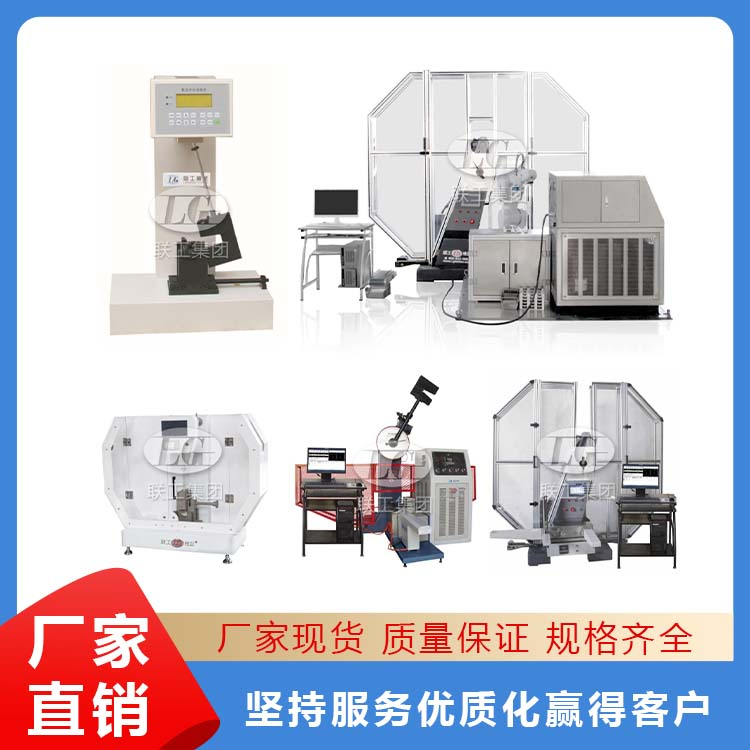
Q1: What is the basic principle and core purpose of the low-temperature brittle impact tester?
The Low Temperature Fracture Impact Tester is used to determine the critical temperature at which a material transitions from ductile to brittle under low temperatures (brittle temperature). Its principle involves freezing the sample in a controlled low-temperature medium (such as anhydrous ethanol) and then subjecting it to mechanical impact at a standard speed to observe whether the sample fractures brittlely. The purposes of the test include:
- Fragility Temperature DeterminationDetermine the lowest temperature at which the material does not fail under low-temperature impact or the temperature at which 50% of the samples are destroyed.
- Material Property EvaluationBy comparing the brittle temperature of different formulations or processes, optimize the design for material cold resistance.
- Predicted Risk of ObsolescenceSimulate material behavior under actual low-temperature conditions to prevent component failure due to cracking (such as sealant cracking, electronic shell破裂, etc.).
The trial must strictly adhere to ISO 812.ISO 974、GB/T 15256、GB/T 5470-2008Shandong Lian Gong Detection Equipment Co., Ltd. produces low-temperature brittleness impact testers that ensure precise control of impact speed (typically 2.0 m/s ±0.2 m/s), freezing time (usually 3.0 ± 0.5 minutes), and temperature fluctuation (±1℃ or ±0.5℃), to avoid data discrepancies due to variations in testing conditions.
How to standardize the operation of a low-temperature brittleness impact tester?
Standard procedures and precautions to follow: (Taking the low-temperature brittle impact tester from Union Test as an example)
Operations Process:
- Sample PreparationSurface grinding without damage
PlasticA specimen bar measuring 20.0 ± 0.25 mm in length, 2.5 ± 0.1 mm in width, and 2.0 ± 0.1 mm in thickness; B specimen bar measuring 31.75 ± 6.35 mm in length, 6.35 ± 0.51 mm in width, and 1.91 ± 0.13 mm in thickness.
RubberSamples are 25~40mm in length, 6±1mm in width, and 2.0±0.2mm in thickness, with strips. Individual samples are 25±0.5mm in length, 6±0.5mm in width, and 2±0.3mm in thickness.
- Medium Injection:Add an appropriate amount of cooling medium (e.g., anhydrous ethanol) to the cooling tank and ensureCooling medium covers the copper pipes.
- Unveiling the testing machine equipmentAfter confirming that the power supply is at the specified voltage and the grounding is safe, and all parts of the equipment are in normal condition, turn on the "Power" switch.
- Frozen and Impact:
- Set temperature (e.g., -70°C), initiate refrigeration.When the set temperature is reached, the automatic alarm device emits a sound, and the thermostat timer begins to count down, displaying the constant temperature duration.;
- Clamping specimens (preventing over-tightening/loosening), frozen3.0±0.5min;
- Observe the impact results after the automatic impact.
- Result Determination:
- Remove the specimens and inspect each for damage. This includes specimens that are completely split into two or more parts, or those with visible cracks. If the specimen is not completely separated, bend it to 90 degrees along the direction of the impact-induced bend, then check for cracks in the bent section. Record the number of damaged specimens and the test temperature. Increase or decrease the temperature at intervals of 2°C or 5°C until the lowest temperature without any specimen damage and the highest temperature with all specimens damaged are determined.
- Single Sample Test: Remove the sample and allow it to rest for at least 30 seconds before wiping off any residual liquid on the surface. Bend the sample to 180° along the impact direction, and observe it carefully under bright light for any signs of damage and record them. When damage occurs to the sample, record the specific damage phenomenon. If damage is observed, increase the temperature of the refrigerant; if not, decrease the temperature until you find the highest temperature at which "at least two samples do not break" and "at least one sample breaks," and the difference is ≤1℃. End the experiment at this point.
- Multiple Sample Test Method: Remove the sample and inspect each one to determine if it is damaged. Any visible crack, hole, or complete break in the sample is considered damaged. If the sample is not completely broken, bend the sample along the impact direction to 90° and check for damage at the bend. If the sample is damaged, increase the temperature by 10℃ and repeat the test with a new set of samples. Otherwise, decrease the temperature until the sample is no longer damaged. Then, control the temperature increase or decrease at an interval of 2℃ until the lowest temperature at which a sample remains undamaged is determined. Record this temperature as the brittle temperature.
Key Points to Note:
- Temperature StabilityDuring freezing, the medium temperature fluctuation is ≤±1℃.
- Challenging uniquenessEach sample is impacted only once to prevent pre-damage.
- Equipment MaintenanceRegularly calibrate impact speed to ensure sample cleanliness and absence of debris; unauthorized adjustment of cylinder pressure is prohibited.
Q3: What is the difference between "brittle temperature" and "50% brittle temperature" in the low-temperature brittleness test?
Both indicate the low-temperature properties of materials, but with different definitions and application scenarios.
- Brittleness Temperature:
- DefineSample under impactUndisturbedzuiHigh temperature(As all ten samples did not break.)
- Applicable StandardsISO 812 Program A, GB/T 1682 Single Sample Method.
- Application ScenarioMaterial Quality Control (e.g., batch inspection of rubber sealing rings).
- 50% Brittleness Temperature:
- Define:Half of the samples failed at a temperature.Determined through statistical analysis of multiple trials.
- Applicable StandardsISO 812 Program B, GB/T 15256 Multi-Sample Method.
- AdvantageReflects the failure probability of materials, close to practical applications (such as automotive components tolerating a certain failure rate).
Case ComparisonAerospace seal requirements: Brittle temperature ≤ -55℃ (zero tolerance for failure); Automotive door handles: 50% brittle temperature ≤ -40℃, with some minor failures permitted.
Q4: What are specific application cases of the testing machine in automotive parts testing?
Focus on Low-Temperature Reliability Verification of Materials for Automotive Applications
- Power System:
- Engine sealing partsWe tested the crack resistance of nitrile rubber after -70℃ impact, optimizing the formula to enhance cold-start sealing.
- Insulation Material for Battery PacksThe company has measured the brittleness temperature of silicone at -50°C to prevent electric vehicles from cracking during low-temperature charging.
- Interior and exterior components:
- Plastic Door Handle/Instrument PanelTo verify the 50% brittle temperature of PP/ABS materials at -30℃ using the multi-sample method (GB/T 15256), in order to prevent cracking in cold climates.
- Tyre rubberCompare the brittleness temperatures of different vulcanization formulas, and opt for cold-resistant sidewall rubber (such as not cracking at -45℃).
- Electronic Components:
- Cable jacketPVC material is deemed qualified under AEC-Q102 standard if it bends 180° after being impacted at -40°C without any cracks.
Industry ValueBy filtering materials through brittle temperature data, we have reduced warranty claims rates in high-frigid regions (such as a 60% decrease in door handle breakage rates).
Q5: How to choose between the single sample method and the multi-sample method based on testing requirements?
Select based on test objectives, efficiency, and cost:
- Single Sample Test Method (GB/T 1682):
- ProcessSequentially test individual samples, adjust the temperature until the brittle temperature range is determined (the maximum temperature difference between "at least two samples not destroyed" and "at least one sample destroyed" is ≤1℃).
- AdvantageMinimal consumables required (only 5-10 samples), ideal for initial small batch screening in the R&D phase.
- LimitedTime-consuming (repeated cooling), single sample per test, not suitable for batch testing.
- Multiple Sample Testing Method (GB/T 15256):
- ProcessSingle冷冻5 samples at a time, calculate the 50% fracture rate after impact to determine the brittle temperature.
- AdvantagesEfficient (completes 5 samples at once), supporting probability analysis.