












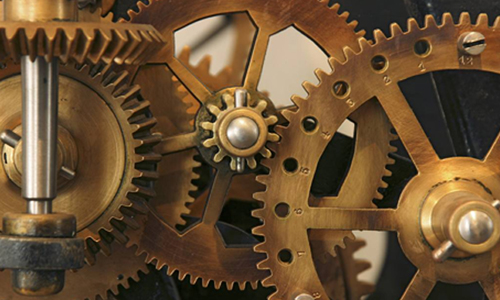
The mechanical manufacturing industry encompasses the production of various power machinery, lifting and transportation equipment, agricultural machinery, metallurgical and mining equipment, chemical machinery, textile machinery, machine tools, tools, instruments, gauges, and other mechanical equipment. It provides technical equipment for the entire national economy and is one of the main indicators of a country's level of industrialization, serving as a crucial pillar industry for the nation.
Actual Application
The essence of advanced manufacturing technology lies in its application. The development of mechanical automation should be guided by the actual production and development needs, as well as specific conditions of the enterprise. Only by adopting appropriate automation methods for suitable products can one achieve good technical and economic benefits, as well as social benefits. In the development of mechanical automation technology in our country, we should focus on practicality, which means generating real benefits for the national economy. The blind pursuit of automation and automatic lines, where the low-load production tasks can be completed in just 1 to 2 months, should be corrected. Efforts that do not significantly promote the national economy and are inefficient should be pursued cautiously. What we seek is efficiency, not just speed.
Development Advantages
Developing low-cost automation technology has great potential and broad prospects, with cost savings and quick returns on investment. Enhancing automation can achieve significant economic benefits with less effort, aligning well with China's current development needs and national conditions. In the second half of the 20th century, the Toyota Group of Japan pioneered the Lean Production (LP) model, which exemplifies achieving maximum output with minimal input. Drawing on foreign experience in developing low-cost automation in the mechanical manufacturing industry is beneficial. Chinese mechanical manufacturing enterprises have a large number of general-purpose machines. When developing modern mechanical automation technology, they should primarily utilize existing equipment, rationally adjust machine layout, add a few CNC machines, introduce CAD/CAM technology, fully leverage the advantages of computerized automation management and human creativity, and collectively create a people-centered production system with information automation as the guide. This system establishes an independent modular production system, providing a new approach for the development and application of mechanical automation technology in China that is cost-effective, fast-acting, and in line with the national conditions. In the long run, gradually improving manufacturing production in a sustainable manner requires the joint efforts of every entrepreneur and the state.
Implementation Status
Achieving mechanical automation is a process that evolves from basic to advanced, simple to complex, and imperfect to perfect. It's only after the operation of machinery is controlled by automatic controllers that production methods gradually transition from mechanization to mechanical control (traditional) automation, digital control automation, and computer control automation. It is only when an automated factory is established that the production process can be fully automated, leading to a comprehensive increase in productivity and reaching the advanced ideal stage of automation.
China's achievement of mechanical automation technology should be a long-term process, not something that can be achieved overnight. Currently, there is a阶段性 gap between China's mechanical manufacturing industry and the world's advanced standards. Under our national conditions, the widespread development and application of "full automation" or "high automation" through Computer Integrated Manufacturing Systems (CIMS) do not possess the necessary foundational technology, experience, or investment capabilities. Therefore, it is imperative to proceed with caution when considering the widespread development of full or high automation CIMS technology. Moreover, full or high automation CIMS technology is not an urgent priority for China's mechanical manufacturing industry but should be listed as one of the main development directions for mechanical manufacturing automation technology. It is advisable to develop automation technologies for mass production with mature processes. At the current stage in China, automation equipment in large-scale continuous production lines for similar products, such as cutting processing, still includes semi-automatic machines, automatic machines, combined machines, and their automated lines, as well as rotary component processing automated lines. In large-scale production of casting, forging, stamping, welding, heat treatment, and assembly, the use of rigid automation (automatic single machines and automated lines) is both reasonable and feasible, yielding good economic returns. For products with a variety of types in batch production, it is advisable to use equipment with rapid reconfiguration to form group production sections or assembly lines, interchangeable spindle combination machine automated lines, short automated lines, and composite manufacturing units to achieve group automation. For single-piece or small-batch production, it is best to start with promoting group technology, appropriately developing the use of numerical control machines or machining centers, and establishing some flexible manufacturing cells (FMCs) with targeted applications, which can yield favorable economic results.