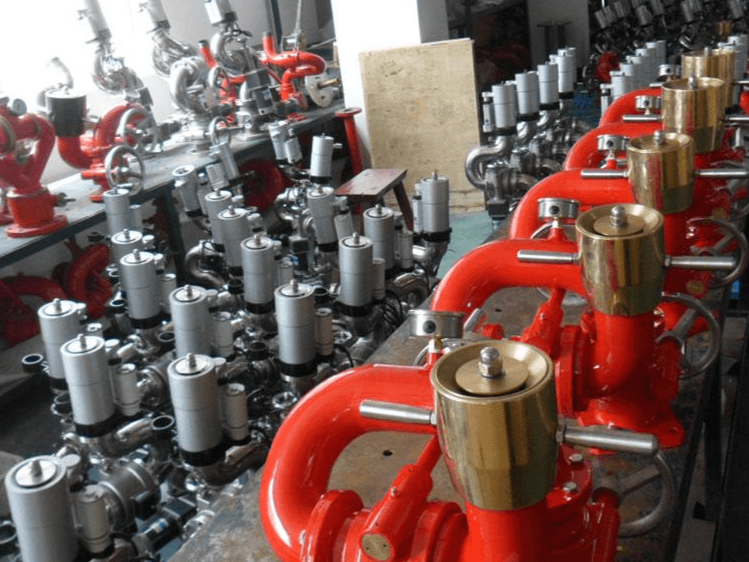

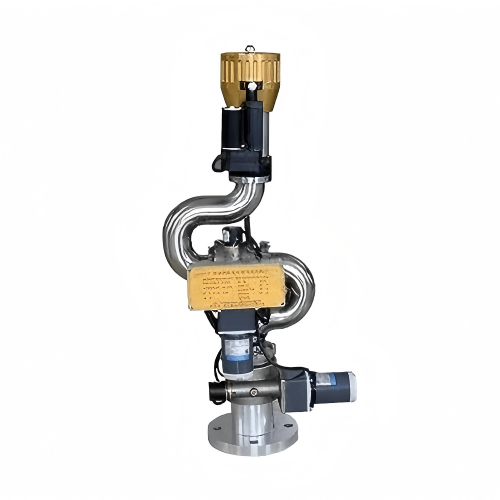







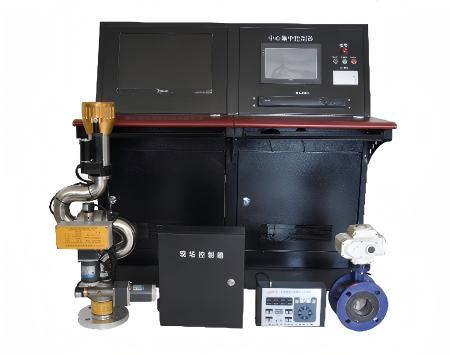
Commonly used automatic tracking and positioning jet fire suppression systems (also known as "large space water cannons" or "smart water cannons") are typically installed in public areas with high foot traffic such as large shopping malls, conference halls, cinemas, stadiums, and other public venues, as well as transportation hubs like airports, train stations, bus stations, and docks. They are also found in industrial settings such as large warehouses and production workshops. These devices feature automatic control, remote manual control, and on-site manual control functions. The detection methods for fire sources currently include red and ultraviolet detection positioning water cannons and video image detection. The following is an example of a video image detection system explanation:
Introduction to Video Image Detection
The ZDMS series automatic jet fire extinguishing devices feature a core component, the STM chip, produced by STMicroelectronics, the world's largest semiconductor manufacturer known for its stable performance. Signal processing employs advanced image analysis technology, while monitoring and communication utilize optical fiber transmission systems, significantly reducing signal and image loss. A new high-end video processor is used to analyze flame characteristics, yielding a wealth of information from the video, such as color, shape, flicker frequency, sharp angles, and circularity. Through comprehensive multi-characteristic judgment, the false alarm rate is greatly reduced, providing all-around "no死角" fire source monitoring and detection. Furthermore, video detection through image analysis can accurately locate the center of the flame with relatively high positioning precision (note the difference from conventional video surveillance).
One,
II. Product Features:
1) By analyzing the fire source and on-site construction installation, a comparison can be made with the following conventional aspects and red-ultraviolet detection:
a. Tracking and Positioning: In the process of positioning, as the fire source location changes, the cannon's direction also adjusts, achieving true tracking and positioning; the red and ultraviolet water cannon's positioning method is a one-time positioning and cannot change with the shift in fire source location.
b. In terms of positioning accuracy: Video detection analyzes captured images for data processing, transmitted to a micro-processing system, and achieves precise positioning with encoder positioning pulses. The red and ultraviolet detection fire suppression system also utilizes ultraviolet sensors as the starting signal, analyzing and comparing the signal voltage detected by the infrared sensor, and using stepper motors for positioning. Although the positioning is accurate and the scanning time is short, the infrared detection components are sensitive to other light sources and external temperatures, which can easily lead to misjudgments, causing premature or inaccurate positioning. Therefore, the environmental requirements for its use are higher than those for video detection.
c. Regarding the impact of temperature on detection: With image detection, as the analysis is based on video images, there is no direct correlation with temperature, so it is unaffected by temperature. The red and ultraviolet sensors detect the spectral radiation of carbon dioxide during combustion, which is highly sensitive to temperature. Combined with other light sources and environmental temperatures (such as summer), this can easily lead to false operations. Therefore, the advantage of image detection is evident.
d. Installation Requirements: For image detection, the specialized camera and high-end video processing system are used. Beyond ensuring waterproofing, lightning protection, and dust prevention, no stringent environmental requirements are needed. For the red and ultraviolet water cannons, in addition to the above requirements, avoid direct sunlight and high-frequency spark interference (such as welding) in a temperature-controlled environment. Therefore, the installation environment for red and ultraviolet water cannons is more demanding than that for image detection water cannons.
e. Mirror-like Reflections: The video water cannon can locate the actual fire source by comparing the characteristics of false fire and real fire. The red and ultraviolet system relies on the propagation characteristics of light. When there are relatively smooth objects nearby the fire source, such as mirrors, glass, iron plates, or marble, if these objects are close to the cannon, the cannon may locate the source as the mirror or glass instead of the actual fire. As modern building floors are generally smooth, the positioning of the red and ultraviolet water cannon is greatly affected. Additionally, strong light and lightning from the natural environment can also cause significant interference.
f. Visual Features: The video detection uses a new high-end video processor "camera" that allows for the observation of the camera's coverage area via a monitor, making installation and adjustment quite convenient; the red and ultraviolet detection system sensors can detect flame signals but cannot see them directly. The protected area of the detector can only be judged based on the laser light and the naked eye, making installation and adjustment relatively less convenient.
Section 3: On-Site Construction Installation and Precautions
The company, with years of experience in research and development, production, debugging, and post-maintenance of equipment, now provides several explanations regarding the installation and precautions for the intelligent water cannon.
Prior to installing the intelligent cannon, the water supply pipeline network must complete water pressure strength and tightness tests, and simultaneously carry out pipeline flushing.
b. The distance from the smart water cannon to the wall should not hinder the rotation of the cannon.
c. The short upright pipe should be securely fastened, and a sway-proof bracket should be set up 10 cm above the inlet flange of the intelligent water cannon.
d. Solenoid valves (small flow intelligent water cannon), electric valves (large flow intelligent water cannon), flow indicators, and gate valves should be installed horizontally.
e. There should be no obstructions within the detection range of the smart water cannon that could affect its movement and operation.
f. The on-site manual control panel for the smart water cannon should be installed in a convenient location for operation. During the process of operating the manual control panel, it should be possible to clearly observe the direction of operation and the stopping position of the water cannon.
g. The connection cables for the smart water cannon should be clearly categorized as束切线. Our company provides dedicated cables between the smart water cannon and the on-site control box to facilitate field operations and prevent performance issues due to incorrect wiring. Additionally, considering that the water cannon may tangle some cables during detection, the reserved cable length should be moderate.
Cautionary Notes:
1) The system should be powered by a single-phase power supply of 220V, 50Hz, and a voltage stabilizer (preferably an uninterruptible power supply) should be installed.
2) In environments with significant environmental interference, where standard video coaxial cables fail to meet the requirements, fiber optic transmission should be adopted.
3) Proper system grounding is a crucial measure to suppress interference. When encountering unexplained system malfunctions or false fire alarms, the first consideration should be the integrity of the system grounding, which is a type of anti-interference grounding.
4) Do not connect the system ground to the protective ground or the power neutral line, as this will cause permanent damage to equipment within the system.
5) On-site construction should comply with design requirements, and the system's central control bus should be separated from the high-voltage power supply (i.e., strong power, weak power) to prevent equipment malfunctions due to wiring issues ("A good horse for a good saddle").
6) Provide guidance for the installation and wiring of smart water cannons based on the actual conditions and characteristics of the site. Installers should consider site factors and the installation features of the water cannon equipment to determine positioning, clearly define the routing of lines, elevation requirements, and wiring requirements at different locations, as well as the installation elevation and fixing methods for equipment connections.
Installation requirements and precautions for the above equipment are detailed in the equipment installation manual or specific installation plan for the relevant project!
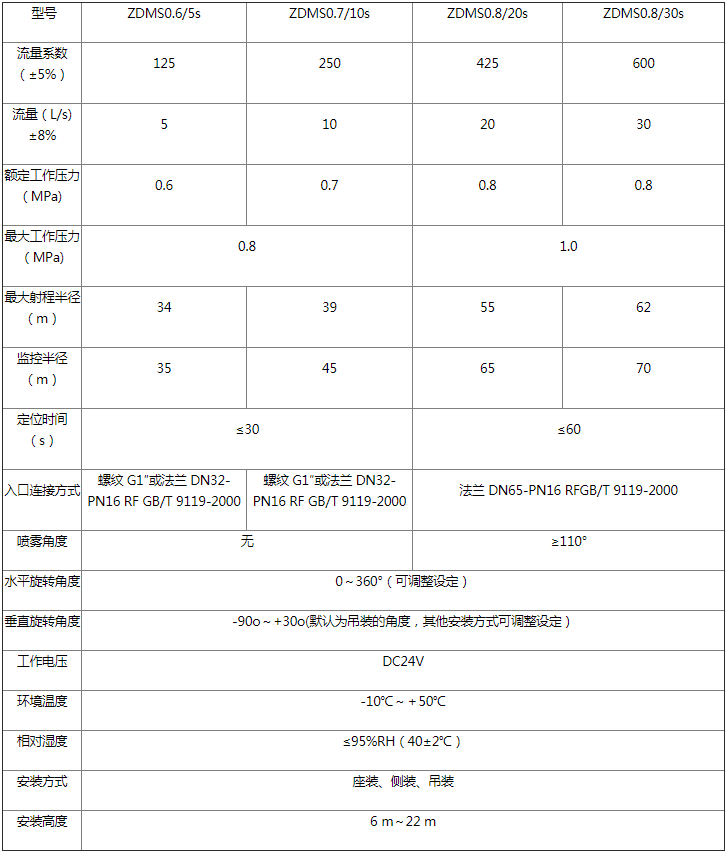
IV. Performance Parameters: