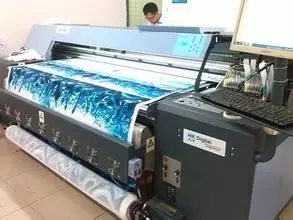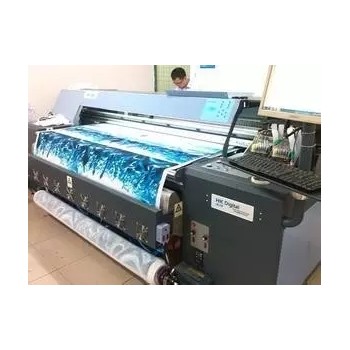











The working principle of digital inkjet printing technology involves applying external force to the ink, causing it to be ejected through nozzles onto the fabric to form a color dot.
Digital jet printing is a technology that sprays digital images, controlled by digital technology to determine when to spray and what color ink to use, as well as the movement in the X and Y directions, ensuring the formation of the required image and color on the fabric surface.
Digital printing's key technical specification is resolution (abbreviated as dpi), which refers to the number of dots per inch. During inkjet printing, different fabrics require varying levels of resolution.
Generally, an image is clear when dpi is between 180 to 360. For very fine images, dpi reaching 360 to 720 is sufficient.
Higher resolution requires a higher喷射 frequency and directional accuracy for the nozzle. Dye Boundless' digital printing section has also summarized some discussions on digital printing resolution.
The principle of jet printing:
1. Continuous Ink Jet CIJ (Continuous Ink Jet) 2. 高速打印机 High-speed Printer 3. 标签材料 Tag Material 4. 热转印标签 Thermal Transfer Labels 5. 激光打标 Laser Marking 6. 条形码 Barcode 7. 质量保证 Quality Assurance 8. 国际标准 International Standards 9. 外贸出口 Export Trade 10. 供应链管理 Supply Chain Managementntinuous Ink Jet)
The continuous jet principle involves applying high-frequency oscillating pressure to the ink, causing it to be emitted from the nozzle in a uniform, continuous stream of tiny droplets. An electric field is set up at the nozzle, which changes in synchronization with the graphic photoelectric conversion signal.
Liquid droplets are selectively charged in the charged electric field, and as the droplet stream continues through the deflection electric field, the charged droplets are deflected under the influence of the electric field, while uncharged droplets maintain a straight-line flight path.
Straight-flying droplets cannot reach the substrate to be printed and are collected by the wiper. Charged droplets are喷射 onto the substrate to be printed.
2. As-needed Jet Spray DOD (Drop on Demand)
The operational principle of the demand-activated jet printing system is that, when a print is required, the system applies high-frequency mechanical force and electromagnetic thermal shock to the ink within the nozzle, causing it to form tiny droplets that are jetted out from the nozzle and controlled by the computer to land on the designated pattern area.
The most widely used jet application on demand is thermal inkjet technology, which relies on thermal pulsations to generate ink droplets. It controls a heating resistor wire to a specified temperature by computer, causing the ink to vaporize (fog) and then be ejected from the nozzle.
Another DOD technology is the piezoelectric jetting system, which involves applying a voltage to the piezoelectric material under computer control, causing it to compress in the direction of the electric field and expand perpendicular to it, thereby ejecting ink.