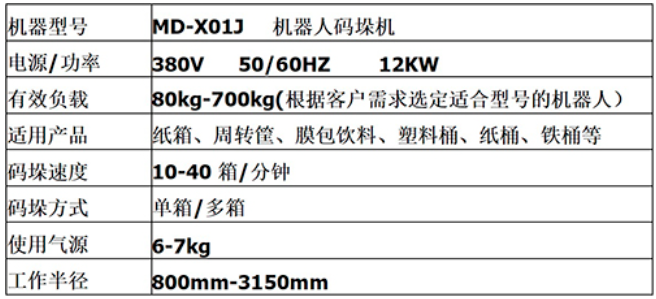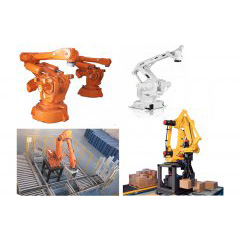







The application of robots in finished product stacking is becoming more widespread and increasingly recognized by the market. They possess unparalleled advantages over other equipment. In recent years, their use in developed countries like Europe, the US, and Japan has exceeded 70%. Currently, both domestically and internationally, the main robots used for stacking include those from ABB of Sweden, KUKA of Germany, FUJI ACE and FANUC of Japan, OKURA, and KAWASAKI. Stacking robots are primarily designed for packaging applications, being compact enough to integrate into tight packaging machinery yet meeting all your requirements for reach and payload. With motion control and tracking capabilities, they are highly suitable for flexible packaging systems, significantly reducing packaging cycle times. They offer high precision, coupled with exceptional conveyor tracking, ensuring top-notch pick-and-place accuracy in both stationary and moving operations. Their small size, speed, and optimization for packaging applications make them an inevitable choice for automation. Equipped with a full range of auxiliary equipment (from integrated air and signal systems to grippers), they can be paired with packaging software, featuring simple mechanical integration and very convenient programming. In terms of efficiency, stacking robots can not only handle heavy loads but also operate much faster and with higher quality than manual labor. Taking a four-axis handling robot as an example, they are available in various models ranging from 100Kg to 700Kg based on their load capacity. They can reach a maximum linear speed of 2500mm/s; their handling capacity can go up to 1600 times per hour. In terms of precision, each stacking robot has an independent control system, ensuring exceptional operational accuracy and a repeatable precision of ±0.5mm, fully satisfying the positioning requirements for logistics stacking operations. Featuring the most advanced 4-axis design, these robots offer a reach distance of 3.15m and a payload of 250kg, making them highly suitable for the automated stacking of materials in packaging forms such as bags, boxes, crates, and bottles. They are suitable for harsh environments with a protection rating of IP 67. The versatility, reach, and load capacity of these robots can almost meet any stacking application needs.