

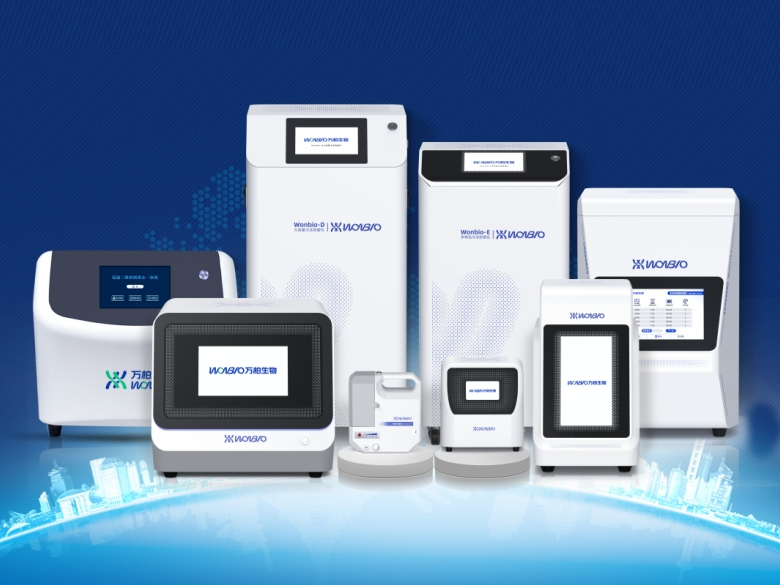


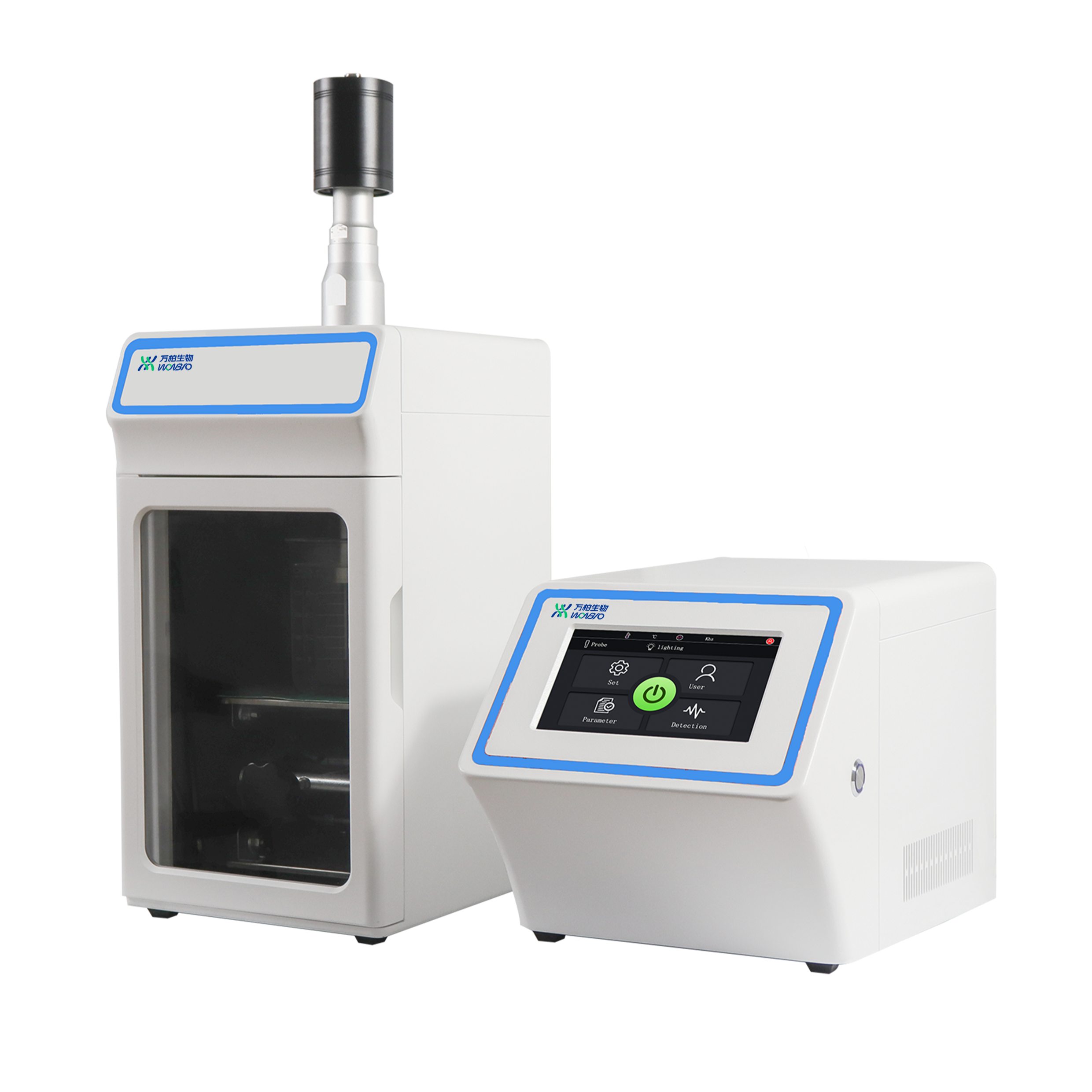





Product Introduction
During the experiment, the automatic continuous rotation of the centrifuge tubes ensures a more even distribution of the ultrasonic power. In the process, samples are placed in separate fully-sealed centrifuge tubes, eliminating any cross-contamination between samples and preventing the spread of mist.
An encounter with an ultrasonic homogenizer involves the use of strong ultrasound to generate cavitation effects in a liquid. The ultrasonic generator does not come into direct contact with the sample, effectively preventing contamination and also enhancing work efficiency. It is also capable of simultaneous processing of multiple samples (such as multiple centrifuge tubes, deep-well plates, etc.).
Product Features
Non-contact Ultrasonic Cell Disruption Instrument Features:
No aerosol particles generated - enhances biological safety, suitable for sterile operations
2. Eliminated the risk of sample cross-contamination; able to break chromosomes and rupture cells through centrifugal tubes.
3. Eliminated the traditional handheld probe and the cumbersome fixed probe, featuring a noise-dampening clamping device
4. The ultrasonic cell disruptor effectively prevents the formation of sample foam.
5. Chinese LCD display, power adjustable in 5W increments, impact mode with 5W fine-tuning each time.
6. This ultrasonic cell disruptor employs periodic pulse cell lysis, with adjustable start and stop times for the pulses, accuracy up to 0.1 seconds.
7. Handles a variety of samples; wide range of sample processing
8. Standard disposable PCR tubes (Eppendorf, 1.5~50ml Corning/Falcon tubes)
9. Ultrasonic cell disruptors are suitable for processing trace samples; as little as 5uL.
10. Can process 4 to 32 samples at once; select the corresponding model.
11. The automatic continuous rotation centrifuge tube ensures more uniform distribution of ultrasonic energy, dedicated data, and repeatability.
12. Ultrasonic Cell Disruption System with cooling water circulation tray, optional low-temperature cooling liquid circulation unit to avoid excessive temperature during the disruption process, which may affect the infectivity of the virus.
Product Applications
Used for the disruption of animal and plant tissue, cells, bacteria, and spore cultures; also suitable for emulsification, separation, and acceleration of chemical reactions; capable of breaking DNA, etc. Widely applied in biochemical, microbiological, pharmaceutical, surface, physical, and zoological fields. The non-contact ultrasonic cell disruptor eliminates the risk of sample cross-contamination; it can disrupt chromosomes and break cells through centrifuge tubes. It eliminates the complexities of traditional handheld probes and fixed probes, featuring a sound-dampening clamping device.












