







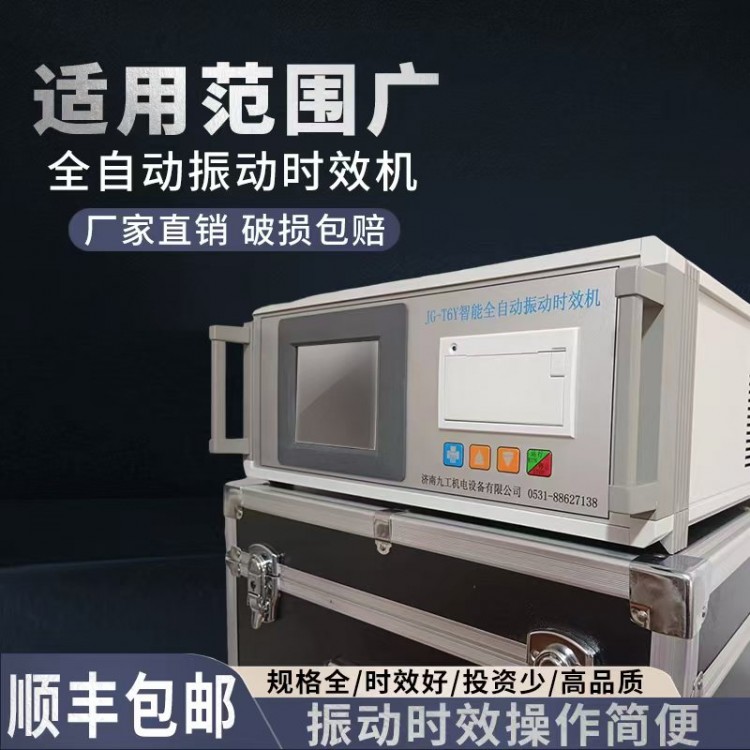
The vibration aging process utilizes the resonance principle:
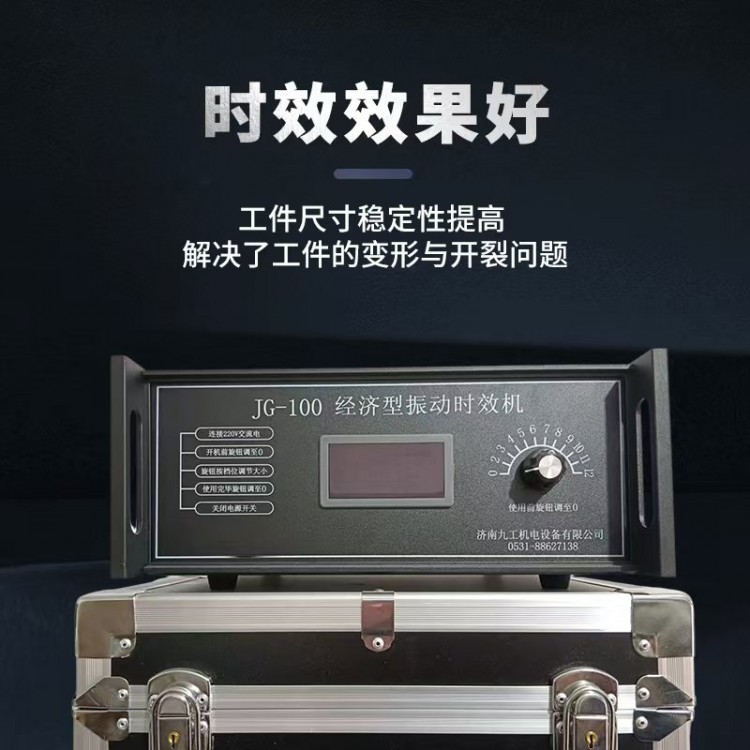
Vibration aging equipment, which utilizes vibration to relieve stress. The vibration, at a specific frequency and with a regular periodicity, prompts the displacement of residual stress crystals within the workpiece, reducing the stress at high points, thereby lowering the overall stress to a stress equilibrium point.
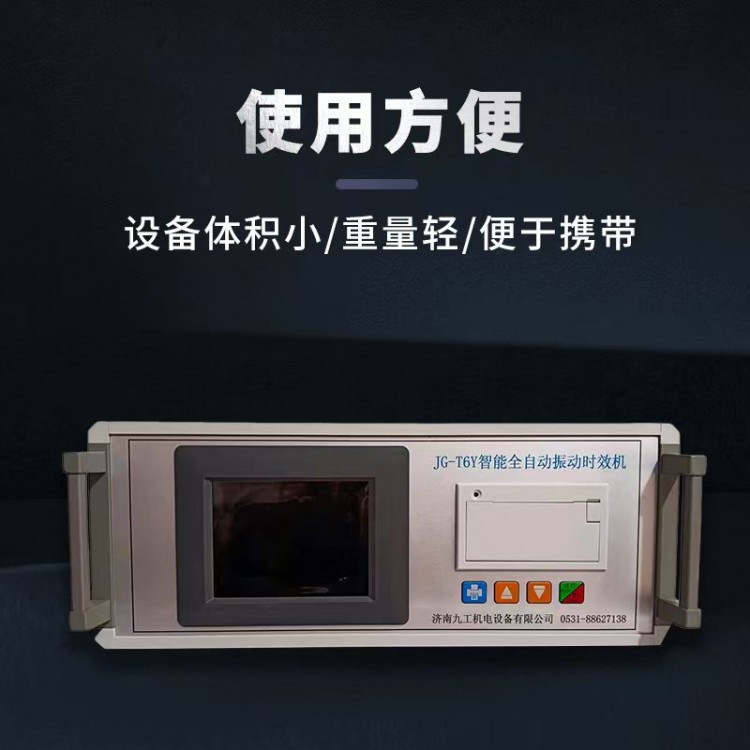
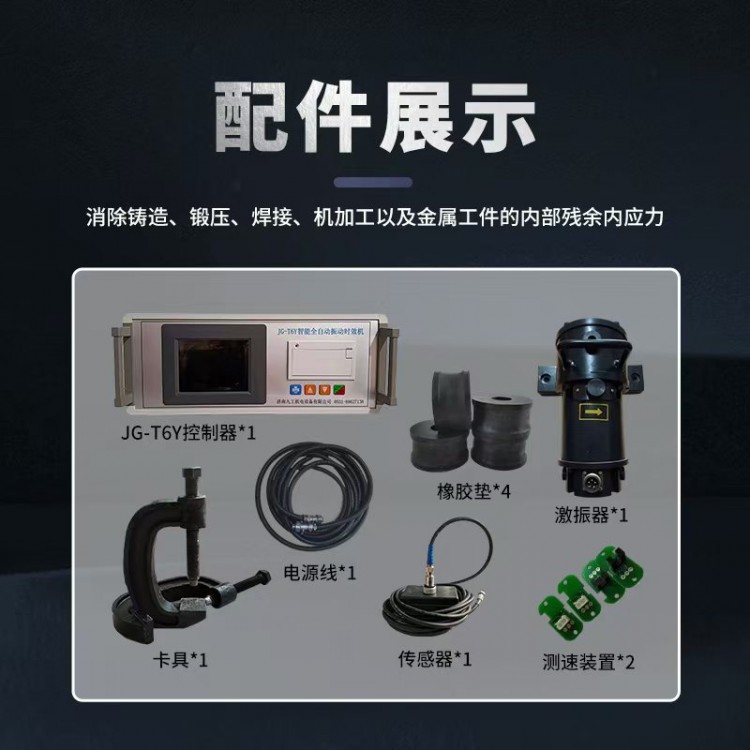
JG-T6Y Liquid Crystal Display Vibration Aging Device: Brief Function Description
★Simple to use, operation requires just 4 buttons, easy to master in a short time.
★High-definition LCD screen display, keeping you updated with real-time dynamic curves of stress changes.
★ Features include: full automatic, semi-automatic, and manual integrated operation programs, functions.
★Automatic frequency scanning, automatically confirm the effectiveness of time handling and provide revision plans.
★Should the equipment exhibit abnormal operation, it can automatically detect and provide the correct usage method.
★ Utilizes mature pulse width modulation technology with strong anti-interference capabilities.
★Automatically select timing processing points during timing processing, display curve data changes on a liquid crystal screen, and monitor in real-time.
★The time-sensitive processing result curve sections are merged for display, facilitating data observation.
★Fault Analysis features, such as issues like current overload, voltage overload, speed frequency signal failure, and circuit connection problems, the LCD screen will provide clear solutions to the problems for easy operation.
★High-speed thermal printer, capable of printing curve data for easy archiving.
★ Utilizes a high-power vibration-proof permanent magnet squirrel-cage DC motor; eccentricity is non-adjustable.
★Compact in size, the equipment can be easily moved to any location for use, offering great convenience.
Vibration Aging Process Parameters
Key process parameters for vibration aging include: excitation frequency, excitation force, effective time, and the mounting positions of the exciter and sensor. The equipment cannot predict the aging requirements of the components, nor can it determine the effective vibration modes to establish reasonable aging parameters. Only operators, based on the aging requirements, can observe the vibration modes of the components and select effective process parameters. Using manual operation, one can quickly understand the characteristics of the components, choose appropriate excitation and sensor positions, and determine the excitation frequency and force. Additionally, to meet the aging requirements for batch and simple components, the system has added a manual aging function, which can automatically generate aging curves and related data, providing a macro basis for product inspection, and the aging time can be adjusted online.
Vibration Aging Process:
1. Pre-vibration Treatment: The equipment automatically identifies the resonant frequencies of the workpiece, stores the pre-vibration a-n process curve, and the analysis program determines the excitation frequency. The process and curve will be displayed on the LCD screen.
2. Time-sensitive Processing: The equipment automatically performs, determines the processing time based on different workpieces, and stores the a-t process curve. The process and curve will be displayed on the LCD screen.
3. Post-vibration Processing: The equipment automatically scans the processed workpieces after vibration and stores the post-vibration a-n curve. The process and curve will be displayed on the LCD screen.
4. Printing Process: Print out the a-t, pre-vibration a-n, and post-vibration a-n curves for comparison, assessment, and record-keeping.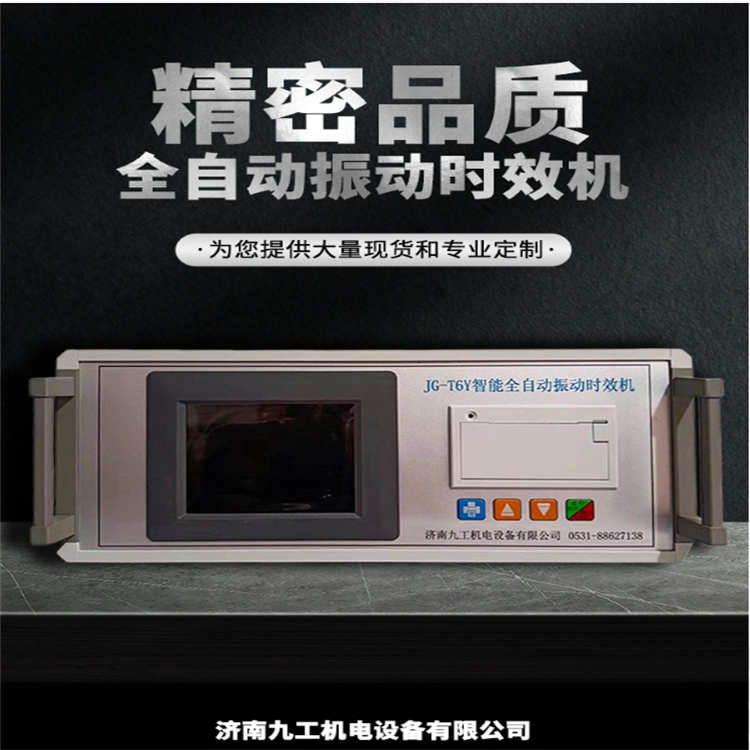
WeChat Official Account

Scan to follow Official Account