Display Screen CNAS CMA Photometric Performance Test Report Processing
I. Select a Testing Institution
Qualification Confirmation: Ensure the testing institution holds both CNAS (China National Accreditation Service for Conformity Assessment) and CMA (China Metrology Accreditation) qualifications. You can verify this by checking or consulting relevant departments to understand the scope and validity of the institution's qualifications.
Experience and Expertise: Prioritize institutions with extensive experience and capabilities in display testing. For instance, some organizations that have been long engaged in photovoltaic product testing have a deep understanding of various performance indicators of displays, with more standardized and scientific testing methods and procedures.
Service and Reputation: Understand the service quality of the testing institution, including response speed, report issuance cycle, and customer communication. Also, refer to other customers' reviews and reputations to choose institutions with good service and high credibility.

Part Two: Determine Testing Items
Common display optical performance test items include but are not limited to the following:
Optical Properties:
Luminance: The brightness of the display screen, typically measured in cd/m2 (candelas per square meter).
Contrast Ratio: The brightness ratio between the brightest and darkest parts of the display.
Perspective: The display maintains clear and accurate viewing angles from various angles.
Color Uniformity: The consistency of color across different areas of the display screen.
Primary Color Wavelength Error: The deviation of the wavelengths of the red, green, and blue primary colors of the display screen from the standard values.
Field color coordinates: Used to describe the position of white on the chromaticity chart.
Electrical Characteristics:
Grayscale Levels: The number of different grayscale levels a display can show.
Refresh Rate: The number of times the display updates the image per second, measured in Hz.
Pixel failure rate: The percentage of malfunctioning pixels on the display.
Electrical Strength: The electrical insulation performance and voltage withstand capability of the display screen.
Reliability Testing:
High-temperature Operation: Display stability under high-temperature environments.
Low-Temperature Operation: Display stability in low-temperature environments.
High-Temperature Storage: Performance changes of the display after long-term storage in high-temperature environments.
Low Temperature Storage: Performance changes of the display after long-term storage under low temperature conditions.
Humidity and Heat: Display performance and reliability under high humidity and temperature conditions.
Temperature Rise: The increase in temperature during the operation of the display screen.
Based on the specific type of display (such as LED display, LCD display, etc.), its application (like indoor display, outdoor display, splicing screen, etc.), and relevant standards and requirements, determine the specific test items needed.
III. Sample Preparation
Quantity Requirement: Typically, testing agencies will specify the required sample quantity based on the test items and methods. Generally, at least one complete display panel sample is needed. However, for certain special tests or when comparative analysis is required, multiple samples may be necessary.
Condition and Specifications: Ensure the sample is in perfect condition with no visible damage or defects, and that the specifications and model information of the sample match the actual products in production or use. If the display has special settings or operating modes, inform the testing agency in advance and prepare according to their requirements.
Labeling and Packaging: Clearly mark the product name, model, manufacturer, production date, and other information on the sample for accurate identification and record-keeping by testing agencies. Additionally, ensure the sample is properly packaged to prevent damage or performance issues during transit.
Section 4: Fill out the application form and submit the required documents
Application Form: The testing institution will provide the corresponding application form for testing. Please fill out the basic information of the display screen, test items, contact information, etc. carefully.
Product Information: Include the product manual, technical specifications, circuit diagrams (if available), and other relevant documents. These materials help the testing facility better understand the product's features and working principles, ensuring accurate testing and analysis.
Fifth, Payment of Fees
Cost Standards: The testing fees are typically determined by the number of test items, their complexity, and the charging standards of the testing agency. There may be significant differences in fees between different agencies and projects, generally ranging from a few hundred to several thousand yuan.
Payment Methods: The testing agency will inform you of acceptable payment methods, such as bank transfers, online payments, and cash payments. Pay the fees promptly as required and keep the payment receipts for record.
Section 6: Inspection Process
Sample Receipt and Confirmation: Upon receiving the samples, the testing agency will verify the quantity, condition, and specifications. Should any issues arise, they will promptly communicate with the applicant.
Test Implementation: Test personnel, based on relevant standards and testing methods, use testing equipment to measure and record the various photoelectric performance indicators of the display screen. During the test, operations and observations under different conditions may be conducted on the display screen, such as changing input signals, adjusting environmental parameters, etc.
Data Processing and Analysis: Process and analyze the data obtained during the testing phase, calculate the numerical values of various performance indicators, and compare them with relevant standards or requirements to determine if they fall within the specified range 6.
Section 7: Obtain Report
Report Content: The photovoltaic performance test report typically includes basic information of the display (such as model, specifications, manufacturer, etc.), test items and results, the standards of testing, testing equipment and environmental conditions, and the test date. The report will clearly state the numerical values of each test indicator and the conclusion of whether it meets the requirements.
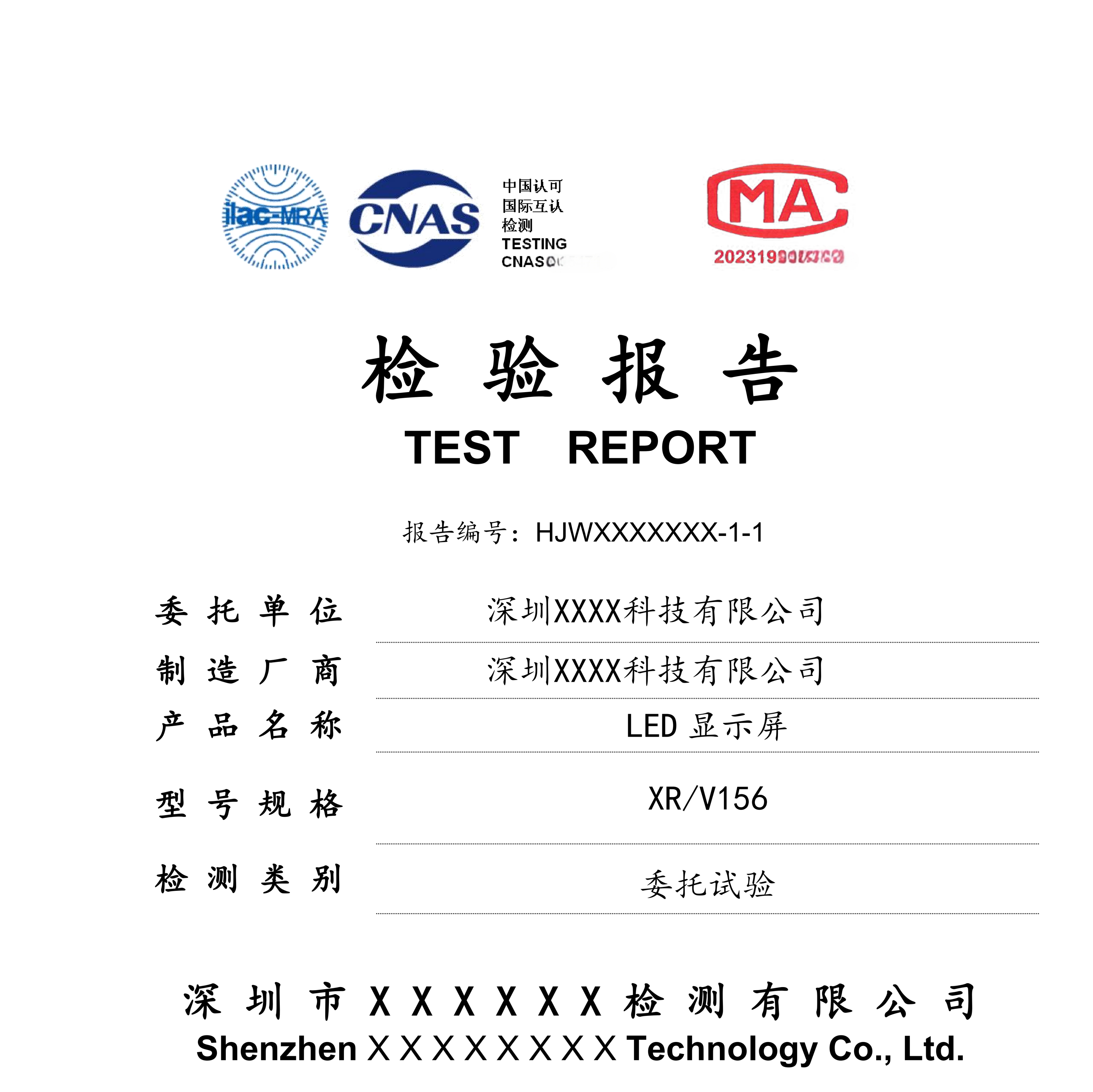
Report Format: Provided in both printed and electronic forms. Printed reports typically bear the official seal and CNAS, CMA logo of the testing institution, carrying legal validity; electronic reports are convenient for quick transmission and archiving.
Pick-up Method: According to the regulations of the testing agency, you may choose to pick up the report at the testing facility in person, or request the testing agency to deliver it via mail or other means. Upon receiving the report, carefully verify the contents to ensure accuracy and correctness.