









Deep groove ball bearing:
Basic Parameters
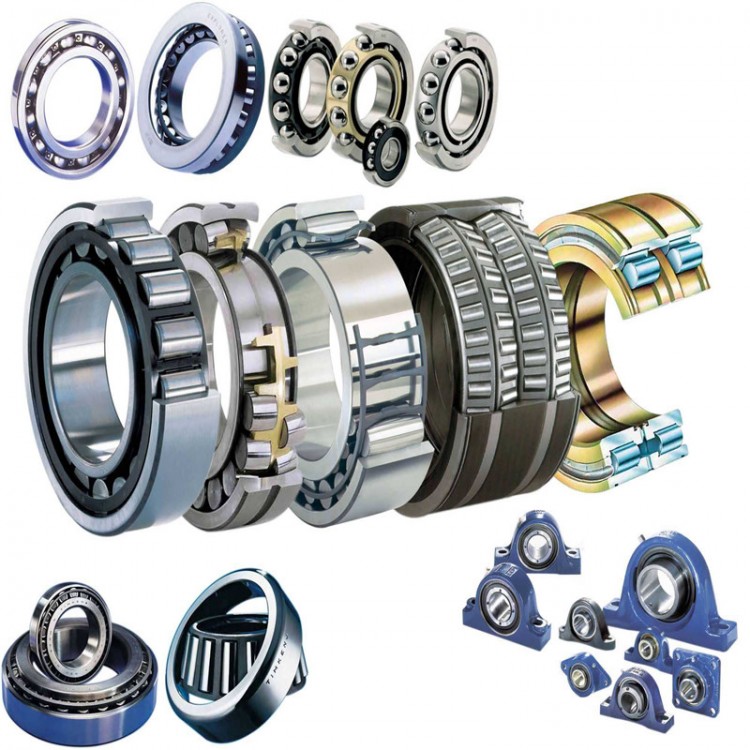
Deep groove ball bearings are a common type of rolling bearings. They consist of an outer ring, an inner ring, a set of steel balls, and a set of retainers. Deep groove ball bearings come in two types: single-row and double-row. The deep groove ball structure also includes two types: sealed and open. Open refers to bearings without a sealing structure. Sealed deep groove ball bearings are further divided into dust-proof sealed and oil-proof sealed. The dust-proof sealed cover is made of steel plate stamping and simply prevents dust from entering the bearing raceway. The oil-proof type is a contact oil seal, which effectively prevents the lubricant from leaking out of the bearing.
Single-row deep groove ball bearing type is coded as 6, and double-row deep groove ball bearing is coded as 4. It features a simple structure and ease of use, making it a widely used and commonly produced bearing type.
Operating Principle
Deep groove ball bearings mainly bear radial loads and can also bear both radial and axial loads simultaneously. When they bear only radial loads, the contact angle is zero. When deep groove ball bearings have a larger radial clearance, they exhibit the performance of " _blank" angular contact bearings, enabling them to withstand greater axial loads. The friction coefficient of deep groove ball bearings is very low, and their maximum speed is also very high.
Bearing characteristics
Deep groove ball bearings are representative rolling bearings with wide applications. They are suitable for high-speed and even extremely high-speed operation, and are highly durable, requiring minimal maintenance. These bearings have a low friction coefficient, high maximum speed, simple structure, low manufacturing cost, and are easy to achieve high manufacturing precision. The size range and form vary greatly, and they are used in precision instruments, low-noise motors, automobiles, motorcycles, and general machinery industries, making them one of the most widely used types of bearings in the mechanical industry. They primarily bear radial loads but can also withstand a certain amount of axial loads.
When selecting a larger radial clearance, the axial load-bearing capacity increases. The contact angle is zero when subjected to pure radial force. When an axial force is applied, the contact angle is greater than zero. Generally, a stamping wave-shaped retainer is used, as well as a turned solid retainer, and sometimes a nylon frame is also employed.
Deep groove ball bearings, once mounted on the shaft, can limit the axial displacement of the shaft or housing in both directions within the bearing's axial clearance range, thus allowing for bidirectional axial positioning. Additionally, these bearings possess a certain degree of self-aligning capability; they can still operate normally when inclined 2′ to 10′ relative to the housing bore, although this may affect the bearing's lifespan. The retainers for deep groove ball bearings are typically stamped steel wave retainers, while larger bearings often use turned metal solid retainers.
Deep groove ball bearings are commonly used rolling bearings. They have a simple structure and are easy to use. Mainly used to bear radial loads, but when the radial clearance of the bearing is increased, they exhibit certain performance of angular contact ball bearings, capable of bearing combined radial and axial loads. They can also bear pure axial loads when high rotational speeds are involved and thrust ball bearings are not suitable. Compared to other types of bearings with the same specification and size as deep groove ball bearings, these have a lower friction coefficient and higher maximum speed. However, they are not shock-resistant and are not suitable for bearing heavy loads.
Bearing construction
The deep groove ball bearing has a simple structure, which makes it easier to achieve high manufacturing precision compared to other types. This facilitates series production in large quantities, resulting in lower production costs and widespread usage. In addition to the basic type, there are various modified structures, such as: deep groove ball bearings with dust covers, deep groove ball bearings with rubber sealing rings, deep groove ball bearings with locking grooves, deep groove ball bearings with ball loading grooves for high load capacity, and double-row deep groove ball bearings.
Bearings Type
1. Single-row deep groove ball bearing
2. Single-row deep groove ball bearing with dust cover
3. Single-row deep groove ball bearings with dust cover and seal ring
4. Single-row deep groove ball bearing with stop slots and stop rings on the outer ring
5. Deep groove ball bearing with ball seat groove
6. Double-row deep groove ball bearing
According to the size of the deep groove ball bearing, they can be categorized as:
(1) Miniature Bearings - Bearings with nominal outer diameter dimensions of 26mm or less.
(2) Small Bearings - Bearings with nominal outer diameter sizes ranging from 28 to 55mm.
(3) Medium and Small-sized Bearings - Bearings with nominal outer diameter sizes ranging from 60 to 115mm.
(4) Large and medium-sized bearings - Bearings with nominal outer diameter dimensions ranging from 120 to 190mm
(5) Large Bearings - Bearings with nominal outer diameter sizes ranging from 200 to 430mm.
(6) Extra-large Bearings - Bearings with nominal outer diameter sizes of 440mm and above.
Deep groove ball bearings are used in gearboxes, instruments and meters, motors, household appliances, internal combustion engines, vehicles, agricultural machinery, construction equipment, engineering machinery, roller skates, yo-yos, and more.
Installation Method
Deep Groove Ball Bearing Installation Method 1: Press Fit: When the bearing inner race fits tightly with the shaft and the outer race fits relatively loosely with the bearing housing bore, the bearing can be pressed onto the shaft first using a press. Then, the shaft with the bearing attached is inserted into the bearing housing bore. During pressing, place a soft metal tube (copper or soft steel) made of a soft metal on the " _blank" bearing inner race face. When the outer race fits tightly with the bearing housing bore and the inner race fits relatively loosely with the shaft, the bearing can be pressed into the bearing housing bore first. At this point, the outer diameter of the assembly tube should be slightly smaller than the diameter of the bore. If both the bearing races and the shaft and housing bore are tightly fitted, both the inner and outer races must be pressed into the shaft and bore simultaneously. The assembly tube structure should be able to simultaneously press the ends of both the inner and outer races.
Deep Groove Ball Bearing Installation Method Two: Heat Fit: An installation method that utilizes thermal expansion to convert a tight fit into a loose fit by heating the bearing or bearing housing. This is a commonly used and labor-saving method. It is suitable for installing bearings with a large interference fit. Before heat fitting, place the bearing or separable bearing ring into an oil tank and heat it uniformly to 80-100°C. Then, remove it from the oil and quickly mount it onto the shaft. To prevent the inner ring end face from not fitting tightly against the shaft shoulder after cooling, the bearing can be retightened axially after cooling. When the outer race of the bearing is fitted tightly with a light metal bearing housing, use the heat fitting method for the bearing housing to avoid scratching the mating surfaces. When heating the bearing in an oil tank, there should be a grate at a certain distance from the bottom of the tank or the bearing should be hung with hooks; the bearing should not be placed at the bottom of the tank to prevent sediment from entering the bearing or uneven heating. The oil tank must have a thermometer to strictly control the oil temperature to not exceed 100°C, to prevent the tempering effect and reduce the hardness of the ring.
Tolerance
Standard deep groove ball bearings are of ordinary grade, all compliant with GB307.1.
Clearance space
Standard deep groove ball bearings are available in C2, standard (CN), C3, C4, and C5 internal clearance grades, all conforming to GB4604.
Retaining Rack
Deep groove ball bearings commonly use steel stamping retainers or brass solid retainers. For outer diameters less than 400mm, steel stamping retainers are used without a suffix code, while for outer diameters greater than 400mm, brass solid retainers are more commonly used without a suffix code.
Three types of bearing processing methods
The processing methods for deep groove ball bearing components are as follows:
1. Multi-process machining: General bearing production requires 20-40 processes, with some exceeding 70.
2. Molding Processing: The working surfaces of bearing parts are rotational molding surfaces, suitable for processing by molding methods.
3. Precision Machining: The majority of bearing parts require grinding processing for their surfaces, with the dimensions and geometric accuracy measured in micrometers (μm).
Deep groove ball bearings, with insufficient bearing load during operation, can cause sliding between the balls and raceways, leading to abrasion. This tendency is especially pronounced in large deep groove ball bearings with heavy ball and retainers. It is anticipated that there may be insufficient load conditions during use. Please contact the relevant personnel promptly when selecting bearings!
Causes of Rusting
In many cases, bearings can suffer from rusting, and there are numerous reasons for this. The main factors we commonly encounter in our daily lives include the following.
1) Due to poor sealing, intrusion of moisture, dirt, etc.
2) Bearings have been unused for an extended period, exceeding the anti-rust period, and lack proper maintenance.
3) The metal surface has a high roughness.
4) Exposure to corrosive chemicals, inadequate bearing cleaning, surface contamination, or contact with sweat on the bearings; failure to package or install the bearings promptly after cleaning, leading to long-term exposure to air and moisture, resulting in corrosion and contamination.
5) Environmental temperature and humidity, as well as contact with various environmental media; failure of rust inhibitors or non-compliance with quality requirements.
Suffix meaning for deep groove ball
1. CN: Standard radial clearance; typically used in combination with the following letters to indicate a narrower or offset clearance range.
? H: Narrowed gap range, equivalent to the upper half of the original gap range
Narrowed clearance range, equivalent to the lower half of the original clearance range
P: Offset gap range, consisting of the upper half of the original gap range and the lower half of the next gap range. The above letters also apply to the following gap group combinations for corresponding meanings: C2, C3, C4, and C5, for example, C2.
C2: Radial Clearance Less Than Standard Group
2. C3: Radial Clearance Larger Than Standard Group
3. C4: Radial Clearance greater than C3
4. C5: Radial Clearance greater than C4
5. DB: Single row deep groove ball bearings paired in back-to-back arrangement
6. DF: Two single-row deep groove ball bearings paired face-to-face
7. DT: Single-row deep groove ball bearings paired in series
8. Enhanced Design
9. GJN: Polyurea grease, NLGI 2 consistency, temperature range -30 to +150°C (standard fill amount)
10. GXN: Polyurea grease, NLGI 2 consistency, temperature range -40 to +150°C (standard filling quantity)
11. J: Stamping Steel Retainer Bracket
12. LHT23: Lithium-based Grease, NLGI Grade 2, Temperature Range -50 to +140°C (Standard Filling Quantity)
13. LT: Lithium-based grease, NLGI Grade 2, temperature range -55 to +110°C (standard fill quantity)
14. LT10: Lithium-based Grease, NLGI Grade 2, Temperature Range -50 to +90°C (Standard Filling Level)
15. M: Machined brass retaining bracket with ball guide. Different designs and materials are denoted with numbers following M, such as M2
16. MA: Machined Brass Retainer, Outer Ring Guide
17. MB: Machined Brass Retainer, Inner Ring Guide
18. MT33: Lithium-based Grease, NLGI Grade 3, Temperature Range -30°C to +120°C (Standard Fill Quantity)
20. N: Outer ring with stop slot
21. NR: Outer ring with stop slot and stop ring
22. N1: The outer ring side features grooves (used to accommodate the stopper device to prevent the outer ring from rotating)
23. P5: Dimensional accuracy and rotational accuracy conform to ISO tolerance grade 5
24. P6: Size and rotational accuracy meet ISO tolerance grade 6
25. P52:P5+C2
26. P62:P6+C2
27. P63:P6+C3
28. RS1: Nitrile Butadiene Rubber (NBR) Contact Seals with Steel Reinforcement on One Side
29. RSH: Contact seal made of nitrile butadiene rubber (NBR) with a steel skeleton on one side
30. RSL: Low-friction NBR (Nitrile Butadiene Rubber) seals with steel reinforcing on one side
31. RZ: Low-friction NBR (Nitrile Butadiene Rubber) sealing rings with steel skeleton on one side
32. TH: Fiber Reinforced Phenolic Resin Retainer (Card Type)
33. TN: Injection Molding Nylon Retainer
34. TN9: Injection Molded Glass Fiber Reinforced Nylon 6,6 Retainer
35. VL0241: Outer surface of the outer ring coated with aluminum oxide, insulation capability up to 1000VDC
36. VL2071: Inner ring outer surface with alumina coating, insulation capability up to 1000VDC
37. WT: Polyurea grease, NLGI grade 2, temperature range -40 to +160°C (standard filling quantity)
38. Y: Stamped copper retainer
39. Z: Dust cover with pressed steel on one side
40. ZNR: Outer ring with stop slots and stop rings; the other side of the stop slots features a stamped steel dust cover.
41. 2RS1: Contact seal rings made of NBR (Nitrile Rubber) with steel reinforcing on both sides
42. 2RSH: Contact seal rings with steel reinforcement and nitrile rubber (NBR) on both sides
43. 2RSL: Low-friction sealing rings made of nitrile rubber (NBR) with steel skeletons on both sides
44. 2RZ: Low-friction NBR (Nitrile Butadiene Rubber) sealing rings with steel reinforcement on both sides
45. 2Z: Pressed steel dust covers on both sides
46. 2ZNR: Outer ring with stop slot and stop ring, both sides with stamped steel dust cover
Common suffix for ball gap with packaging:
1. C3: Radial Clearance Larger Than Standard Group
2. N: Outer ring with stop slot
3. NR: Outer ring with stop groove and stop ring
4. Z: Dust cover with stamped steel on one side
5. ZNR: Outer ring with stop slot and stop ring, with a stamped steel dust cover on the other side of the stop slot
6. 2Z: Dust covers with stamped steel on both sides
7. 2ZNR: Outer ring with stop slot and stop ring, with stamped steel dust caps on both sides
The meaning of stainless steel suffix:
R: Outer ring with flange
2. VT378: Non-Toxic Lubricant (Accidental Contact with Food Ingredients)
3. 2RS1: Contact Seals with Steel Reinforcement on Both Sides, Nitrile Rubber (NBR)
4. 2Z: Dust covers with stamped steel on both sides
2ZR: Dust caps with stamped steel on both sides and flanges on the outer ring