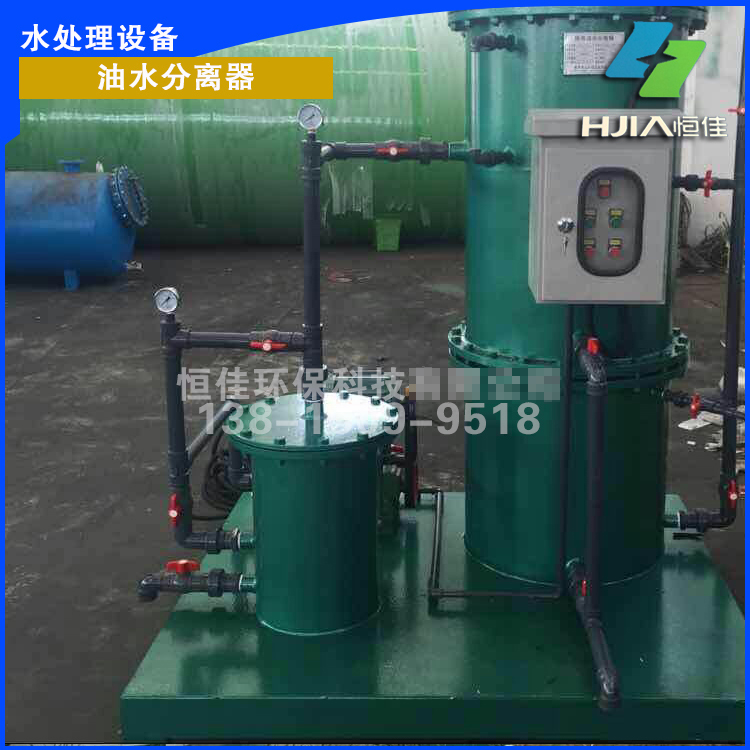





The basic principle of treating wastewater in oil separation tanks and sedimentation tanks is the same, both of which use the different specific gravity of suspended solids and water in wastewater to achieve separation. The structure of oil separators often adopts laminar flow or conical design. Oil containing wastewater enters a rectangular oil separation tank through a water distribution tank and flows slowly in the horizontal direction. During the flow, the oil rises to the surface of the water and is pushed into the oil collection tank by a oil collection pipe or a scraper installed on the tank surface, and then flows into the dehydration tank. Oil separators are often made of stainless steel materials, but they can also be built with bricks and stones on a rectangular plane, divided into 2-4 grids along the direction of water flow, but the construction investment is relatively high. In cold regions, to prevent oil solidification in winter, a steam pipe can be installed at the bottom of the oil collection pipe for heating.
Oil separators generally need to be covered and steam pipes should be placed under the cover plate for insulation, to prevent fires and oil evaporation in the oil separator, and to prevent dust and sand from entering. The specific gravity of oil in wastewater is generally smaller than that of water, and it exists in three states: ① Suspended state: Oil particles are larger, with a diameter of more than 0.1 millimeters, floating on the water surface, and easy to separate from water. In the petroleum industry, these types of oil products account for about 60-80% of the oil content in wastewater. ② Emulsified state: The dispersed particle size of the oil is small, and the diameter of the oil droplets is below 0.1 millimeters, in an emulsified state, which is not easy to float and separate from the water. This type of oil accounts for approximately 10-15% of the oil content in wastewater. ③ Dissolved state: Petroleum has low solubility in water, and the oil soluble in water accounts for 0.2-0.5% of the oil content in wastewater.
The oil separation tank product needs to be directly installed on the channel containing sewage and oil-water flow. Align the sewage outlet with the inlet of the oil-water separator with a grid, and connect it with other equipment through pipelines. The oil-water separator (oil separator) must be adjusted to a horizontal position during installation. Before the first use, the equipment should be filled with tap water, and the water level adjustment pipe should be adjusted so that the top of the water level adjustment pipe is at the same level as the upper edge of the overflow tank. The position of the inlet pipe should be kept at a certain distance from the debris separation box to facilitate the removal of the debris separation box. Introduce oily wastewater and adjust the water level control pipe again until the oil drain pipe only drains oil without draining water. If the position of the oil discharge pipe is too low, the equipment cover can be opened and the oil can be removed with tools.