








Colored asphalt concrete mixing and paving techniques
3.1 Mixing of blends. The mixing process for colored asphalt and regular asphalt blends is generally similar, but the following points should be paid special attention to:
Prior to mixing, the mixing tank of the mixing station, asphalt conveying pipelines, transport vehicles, construction machinery, and equipment should be thoroughly cleaned.
② Raw material properties should be stable, allowing the production target mix ratio to be as close as possible to the design mix ratio.
③ Due to the high specific gravity of the color powder, which serves as a coloring, dispersing, adsorbing, stabilizing, and thickening agent in the mixture, its environmental impact must be considered during addition. Before production, the amount of color powder per batch of mixture should be calculated based on the target ratio, packed in polyethylene bags, and manually assisted in the blending process.
④ The mixing temperature should be controlled between 150℃ and 170℃, with a mixing time 10 seconds longer than that of ordinary asphalt mixtures. After discharge, it is essential to promptly check for uniformity in the particle size and color.
3.2 Mixed Material Spreading
3.2.1 Prior to laying colored asphalt mix, the quality of the subgrade should be meticulously inspected to ensure it is firm, level, and clean. Additionally, the working condition of the laying and compaction machinery should be checked to prevent any work stoppages during construction due to inadequate preparation.
3.2.2 To enhance the adhesion of the surface and reduce the infiltration of rainwater into the pavement structure, the subgrade should be cleaned thoroughly before laying, and emulsified asphalt should be sprayed, with a dosage of 0.3-0.5 kg/m2.
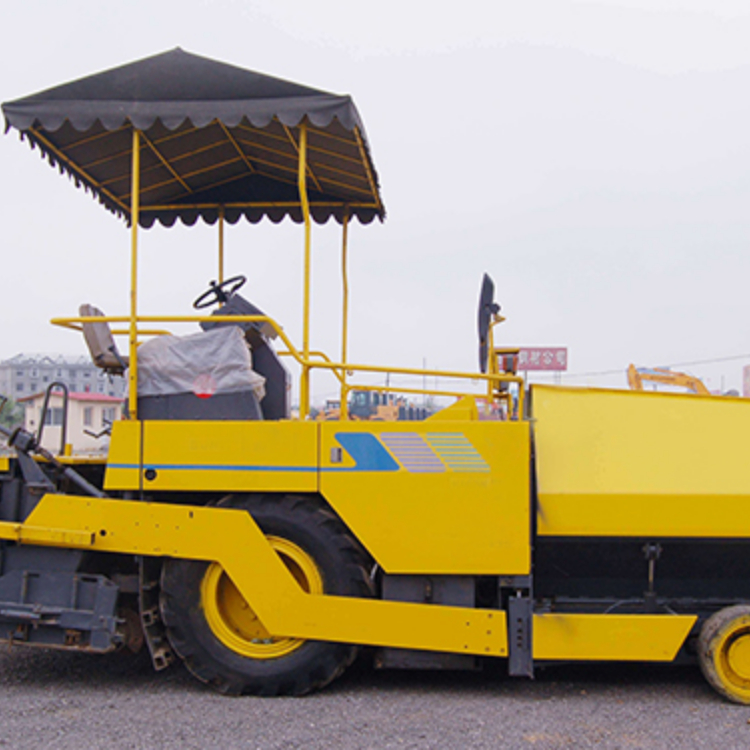
3.2.3 Upon starting the laying process, strictly adhere to the loose laying elevation and use spacers to properly elevate the ironing plate, ensuring the initial laying thickness meets the requirements.
Based on the project schedule, taking into account the production, transportation, spreading, and compaction capabilities of the mixed material, ensure continuous spreading and strictly control the working speed of the paver within the range of 2.0 to 2.5 m/min.
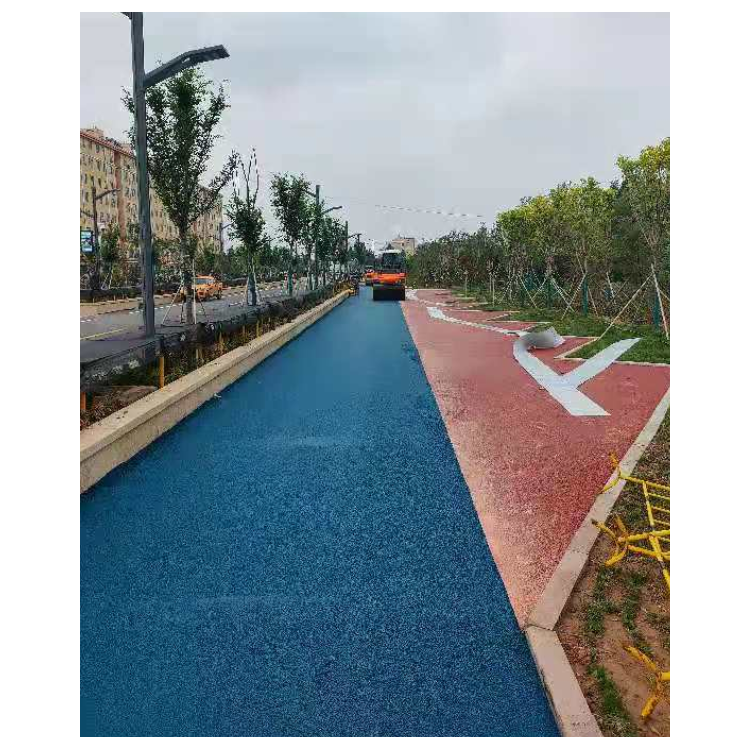
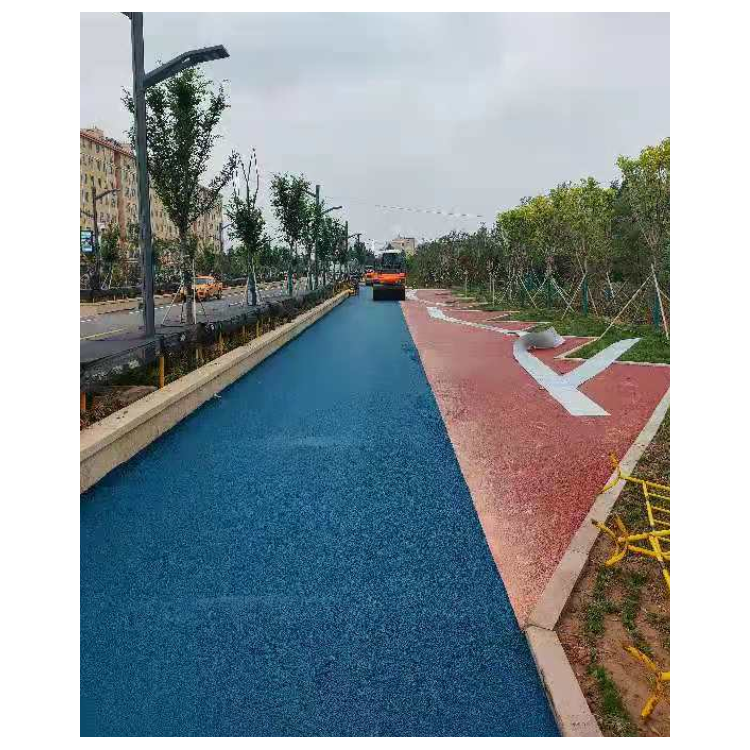
3.2.4 The mixed material should be spread in full width, formed in one continuous pass, to ensure consistent color, even particle distribution, and aesthetic appearance.碾压 should be done promptly after spreading.
3.3 Compacted Molding of Blended Material
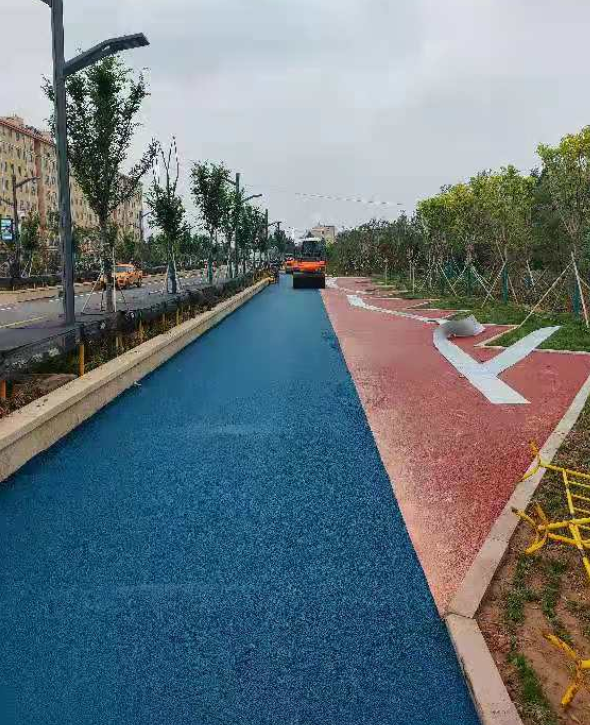
3.3.1 Compactor Selection: Choose the model, power, and number of compactors based on the project's scale and the complexity of the construction site.
Due to the black rubber tires of the tire roller causing severe contamination and sticking to the colored asphalt surface during compaction, it is not suitable for use.
3.3.2 Compaction Combination Method: The compaction of colored asphalt mixture is also carried out in three stages: initial compaction, secondary compaction, and final compaction.
Initial temperature should be controlled between 130℃ and 145℃, final temperature should not be lower than 70℃, and the rolling process should be carried out according to the principle of "close following, slow pressing, high frequency, and low amplitude".
Under normal circumstances, the rolling combination method is determined based on the results of the test section after laying. The conventional approach is:
① The initial compaction is completed by passing a heavy roller over the surface once for static pressing, followed by one pass with light vibration compaction. The initial compaction is then finished.
② The main work of double-press compaction is done by a light roller, the number of passes is determined on-site, until full compaction is achieved.
③Upon completion of the edge treatment by the light roller, and when the road temperature drops to 80°C, the final compaction begins. It is carried out by a heavy roller performing 1-2 passes of static compaction until the wheel tracks are completely eliminated, at which point the rolling is finished.
3.4 Details to Note During the Crushing Process:
3.4.1 To prevent sticking during the roller operation, you can add laundry detergent (0.15kg/m3) to the roller's water tank to provide adequate lubrication for the steel wheels, thereby avoiding sticking issues with the steel wheel roller.
3.4.2 To ensure civil construction and prevent damage to curb stones caused by the heavy roller being too close to the edge during compaction, the distance between the steel wheels of the heavy roller and the curb stone should not be less than 15 cm during compaction. The remaining area will be compacted by the light roller under the guidance of a designated person.
3.4.3 To prevent contamination of the colored asphalt surface, all debris and sand adhering to the roller's steel wheels must be washed off before compaction. Ensure the roller equipment is clean before allowing compaction to proceed. Additionally, traffic can only be reopened after the temperature has cooled to normal and the compaction process is complete.