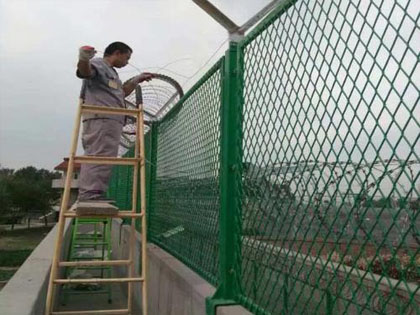
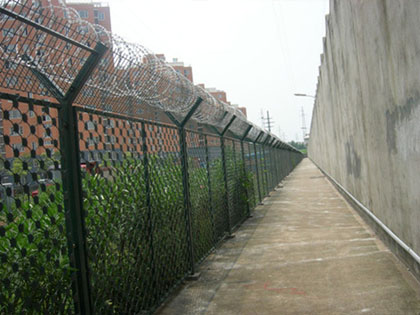
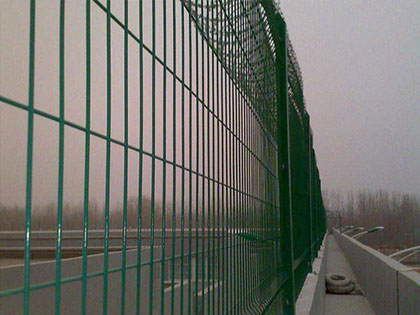
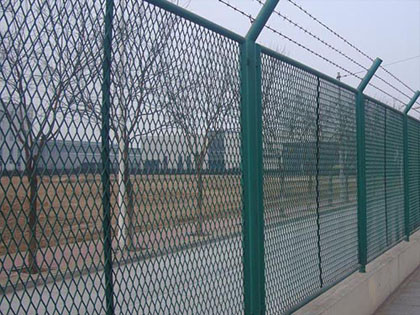
Pavilions for patrol are essential facilities in high-security areas such as prisons and detention centers, designed for military police surveillance and patrolling. Generally, isolation devices need to be installed on the pavilions to prevent climbing. To enhance the security of prisons and facilitate surveillance, isolation fences are required on both sides of the prison patrol pavilions. The prison patrol pavilion isolation fences are complemented by high-voltage shock fences and various monitoring and alarm systems.Prison security is foolproof.
One, Characteristics of Prison and Detention Center Patrol Walkway Fencing:
Prison and detention center patrol pathways serve as surveillance and deterrent features. The prison patrol pathway fences are made from large-diameter, high-strength alloy steel wires, offering anti-climbing, shock-resistant, and shearing-resistant properties, along with excellent cautionary effects. They are used in high-security areas such as prisons, detention centers, and perimeter base camps.
Prison and detention center patrol roads are equipped with blade wire mesh (razor wire rolls) at the top of the isolation fence, which serves as a deterrent and prevents climbing.,Hard material, high strength, high tensile, unique design, not suitable for touching, thus achieving good protective isolation effects. The patrol path isolation net also has the advantages of easy construction and cost-effectiveness.
Section 2: Recommended Specifications for Prison and Detention Center Patrol Path Fencing
外形尺寸: Patrol paths are an essential security measure for prisons and detention centers.* There are strict height limitations on prison walls by relevant departments, with different heights requiring different installation heights on patrol paths. Standard dimensions generally include:
2.5m x 2.5m / 2.5m x 3m / 1.5m x 2.5m / 1.8m x 3m, etc.
Pole Requirements: The poles for patrol path isolation fences need to be designed in different styles according to varying heights of walls, generally categorized as: base poles, side base poles, small base poles, etc. The raw material dimensions of the poles typically are selected as:80x80/60x60, etc. Most use posts with V-shaped columns, topped with a snake belly-style barbed wire mesh.
Mesh Styles: Welded Reinforcement, Welded Barbed, Framed, etc.
Grid Size:50mm x 150mm / 75mm x 150mm / 50mm x 50mm, etc.
Wire Diameter:4mm-6mm
Edge Size:30mm x 20mm / 30mm x 30mm / 40mm x 40mm, etc.
Surface Treatment: Galvanized, electroplating, and spraying. A combination of two or more surface treatment methods can be chosen based on different corrosion prevention requirements, which can better extend the service life.
Section 3: Installation Methods for Prison and Detention Center Patrol Walkway Fencing
Firstly, determine the distance between the two upright posts according to the length of the isolation fence for the prison functional area.
2. Once the posts are securely fastened, you can proceed to install the netting. The tools required for this include guardrail spanners, "sleeve" spanners, and anti-theft screws.
3. Install spiral-blade barbed wire at the top or side.
4. The installation procedure is basically complete. Now, it's time to check the tightness of the screws.
Prison and detention center patrol road fence applications: primarily used for overall prison perimeter protection, internal patrol road security, patrol road access isolation, and other functional isolation areas, as well as airport closures.Fence enclosures for industrial zones, development zone partition fences.