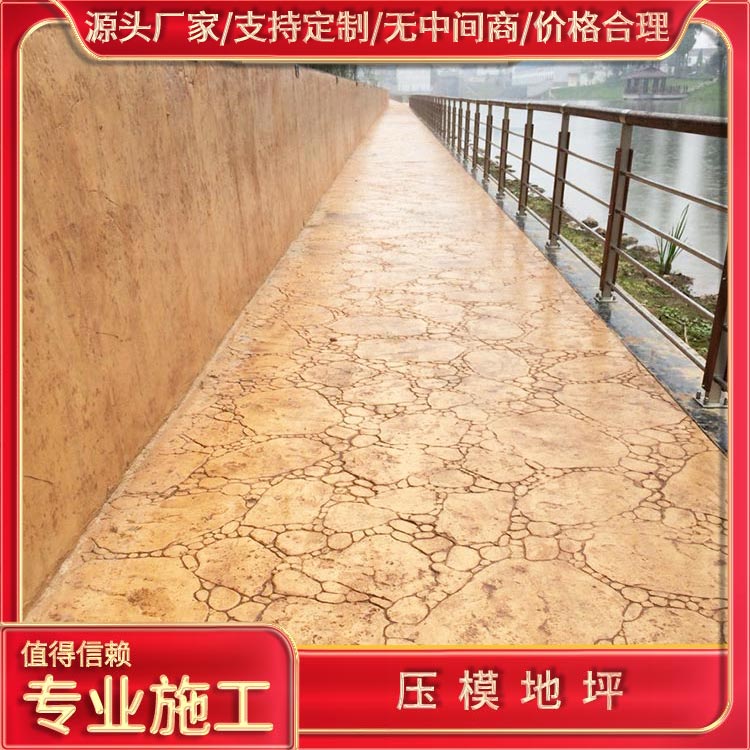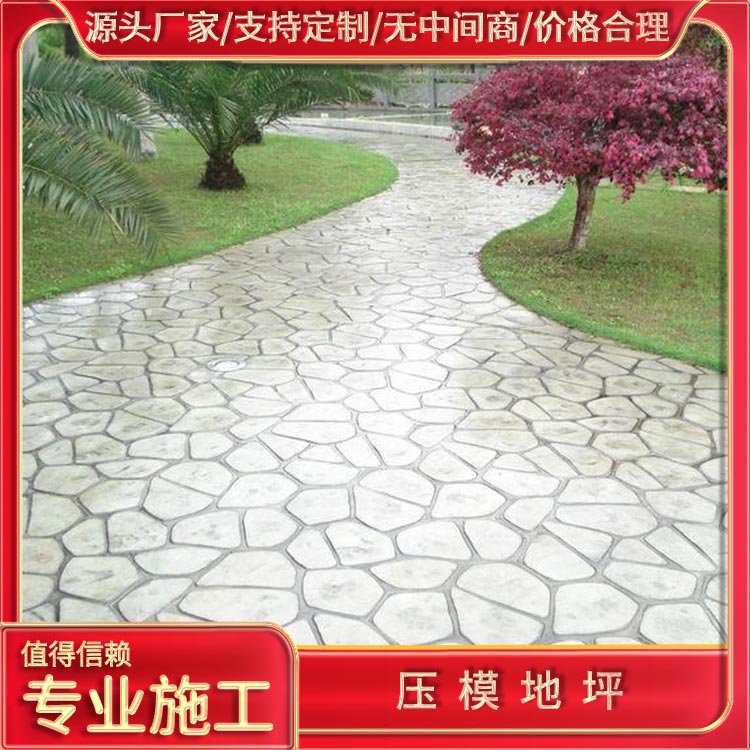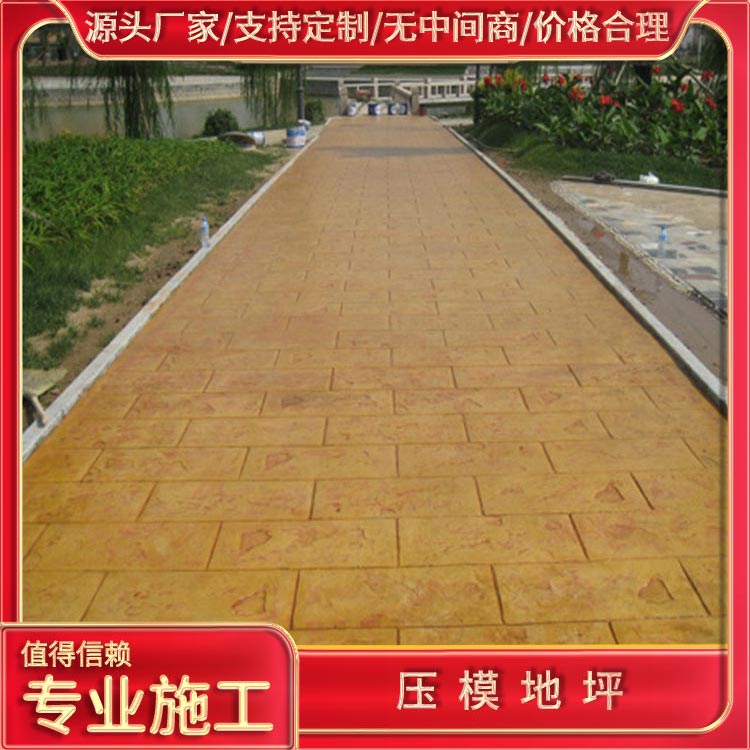

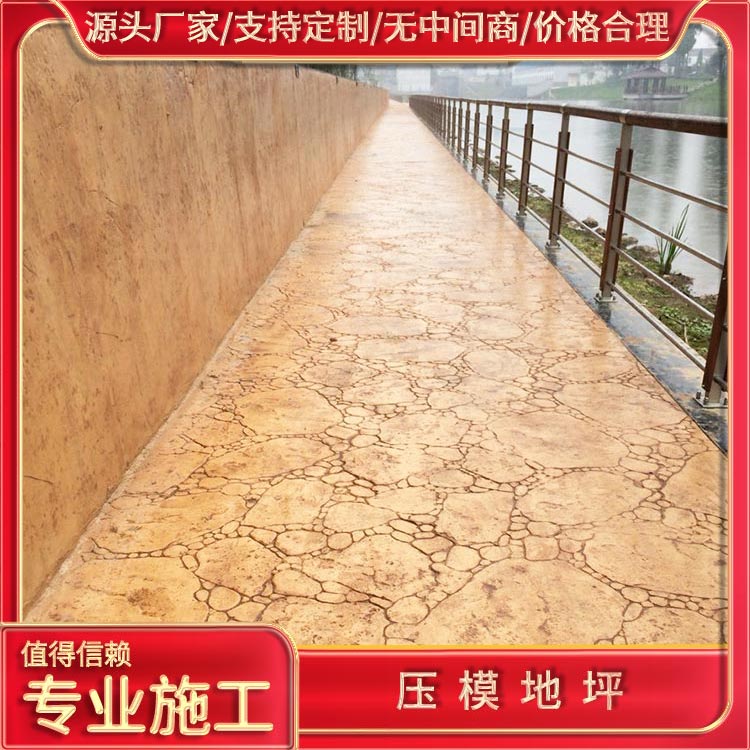

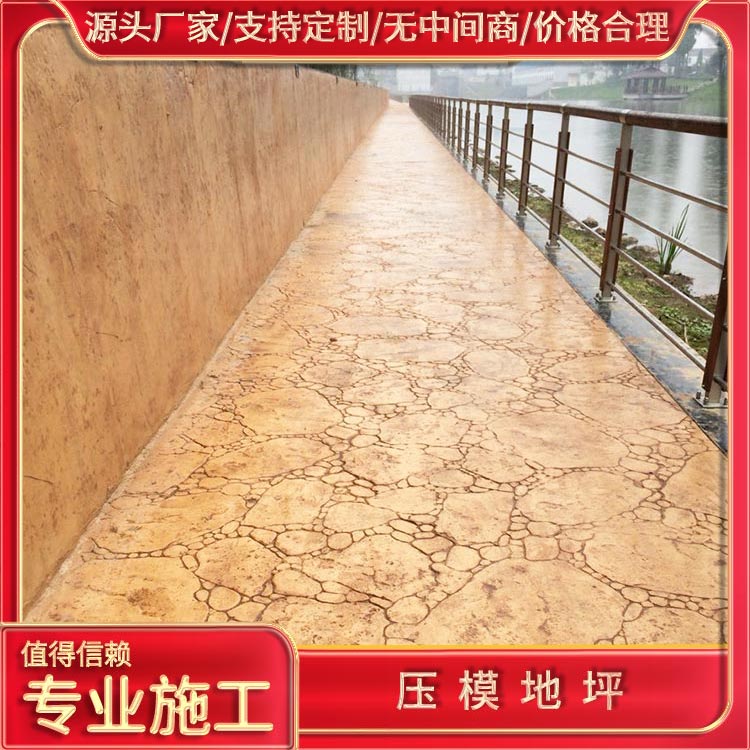
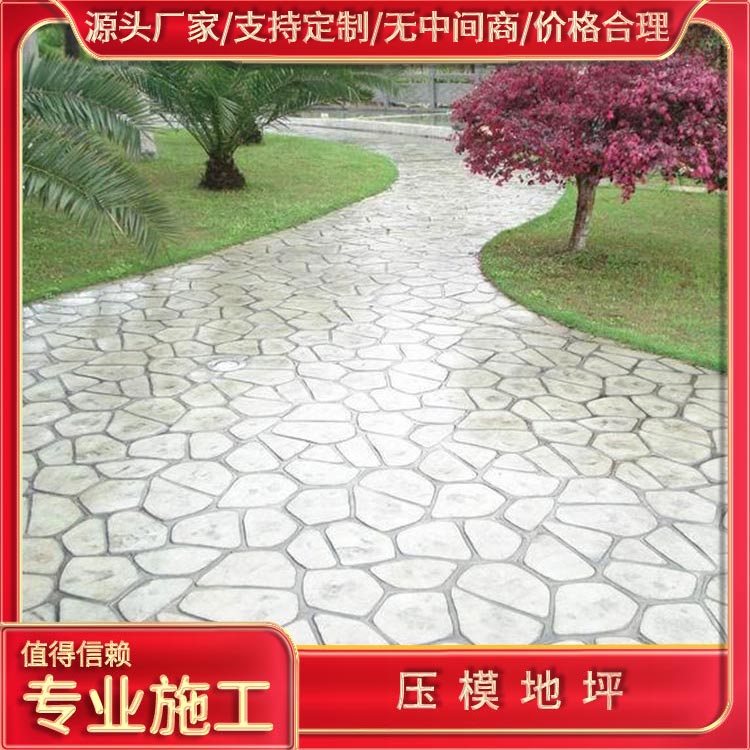
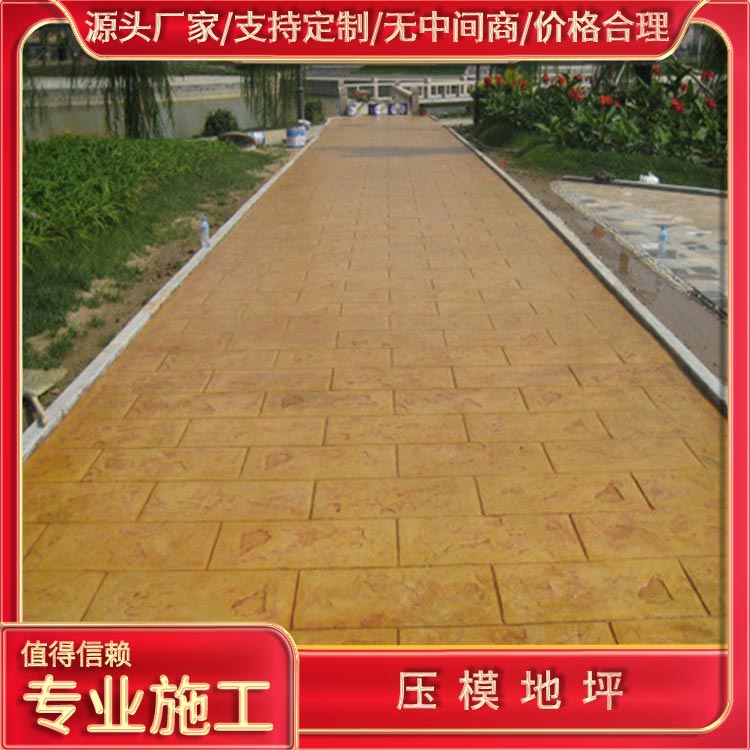










Pavement stamping, also known as patterned concrete or imprinted concrete, is a series of stamped pavements that are cast in place with unique pattern frames, forming a single unit. Made using cast-in-place concrete surfaces with custom molds and colored inks, these pavements are crafted with advanced technology and strict construction management. They feature a variety of patterns and rich color variations, offering wear-resistant, pressure-resistant, and anti-slip properties, as well as monolithic characteristics. They are versatile for various practical applications.
Product Features:
· Any combination of patterns and colors, with the entire mat laid out in one installation.
Compressive strength typically reaches three times that of ordinary concrete, with excellent wear resistance.
· Utilizes inorganic pigments for colorfastness and durability, excellent resistance to ultraviolet rays, ideal for the complex and variable temperature and humidity conditions in China.
Oilproof, waterproof, and non-slip; surface will not crack, peel, or fade.
Application Scope:
Municipal Engineering: Streets, sidewalks, road medians, themed parks, cultural squares, landscape projects.
2. Commercial: Business buildings, hotels, restaurants, bars, large shopping malls, convention centers, supermarkets, stores, parking lots.
3. Residential: Apartments, villas, residential complexes, courtyards, gardens.
4. Entertainment Venues: Parks, amusement parks, water feature pools, swimming pools.
5. Other: Industrial factories, schools, kindergartens, bus stop systems, and interior and exterior decorations for residential developments.
1. Weather conditions during the installation of stamped concrete greatly affect the quality. Construction should avoid rain, snow, strong winds, sandstorms, and freezing temperatures. Construction is prohibited at night in areas with significant day-night temperature differences. The ambient temperature should generally be above 2°C. A favorable construction environment is essential to ensure the quality of the stamped concrete. It is advisable to avoid overlapping construction with other teams and, if necessary, to implement enclosed measures at the construction site. Gravel and unprepared soil foundations must be compacted or tamped.
2. The strength of the concrete base for the embossed flooring should be ≥C25, with the water-cement ratio as small as possible and no early-strength additives in the concrete.
3. The thickness of the concrete must be consistent, with the base concrete being at least 5cm. The maximum particle size of the aggregate in the concrete should be no more than 1.5cm. For concrete 10cm or less in thickness, use a flat vibrator for compaction. For concrete thicker than 10cm, use an internal vibrator.
4. After the concrete has been vibrated, use a heavier steel long roller (the roller should be wider than the formwork floor mold by over 0.3 meters) to roll over the platform repeatedly to achieve a level surface. When rolling the platform, remove all foreign objects from the steel roller. After the concrete has been lifted, ensure the surface is free of sand and stone. In areas where the steel roller cannot be used, use hand lifting of the concrete and a leveling ruler to scrape the platform to a level surface.
5. After the concrete slab is leveled and desalination treatment is completed, the surface is hand-smoothed with an iron plate before initial setting.
Construction Process
1 Subgrade treatment: The soil should be tamped and compacted to achieve the required compaction density.
Pour concrete into the same color and mold type construction area, and smooth it with a tool. Consider the drainage slope to prevent water accumulation.
Before the concrete reaches its initial setting stage, use a trowel to smooth the concrete surface. Then, distribute the colored print material evenly over the concrete layer according to the specified amount, dividing it into two to three even applications. Smooth and finish each application using a dedicated trowel.
Evenly spread demolding agent over the concrete surface according to the prescribed dosage.
5 Arrange the specified molds on the concrete surface in a neat and orderly pattern, then proceed with the embossing process.
6 finished floors are being maintained; typically, they can be put into use after 72 hours at a temperature of 25℃.
Construction Precautions:
Construction shall be carried out according to the specified requirements. Reinforcement materials and demolding powder to be laid should be stacked and used in the order of the laying direction. Various professional construction tools and molds should also be in good working condition.
The installation of expansion joints must be in accordance with design specifications and completed within 2-7 days of laying concrete. The spacing between them should not exceed 4 meters, and the depth of the joints is generally about 2/3 of the concrete surface.
The length of concrete surface laid per shift should be coordinated with the paving work of the color mat, with reasonable coordination. The construction area per day (based on 10 hours) must be controlled at 200 m² per team, otherwise it will directly affect the construction quality.
The surface treatment of the concrete layer must be carried out in accordance with the specifications and design requirements. The surface must achieve the required level of flatness, slope, and width. Consistency in the quality of concrete throughout the same project is crucial for maintaining uniformity in the overall effect.
5 The reinforced material may clump during transportation; it must be crushed by hand before spreading again.
Before molding, research and plan the layout and lifting positions and directions of the molding molds to ensure the integrity of the pattern. Lay the first molding mold along the reference line of the layout pattern and press it vertically into the concrete. The constructor can stand on the molding mold, as the weight of the human body is sufficient to form textures on the concrete surface. If necessary, use a special tamper for clear molding molds to press the molding mold vertically into the construction surface to better produce clear and realistic patterns. Mastering the timing of the molding process is very important; surfaces of concrete that are too wet or too dry will affect the final pattern and effect.
The 7 fully formed molds must be tightly arranged to prevent the appearance of double seams. After demolding, the pressed areas must be inspected and properly repaired.
8 If encountering walls, corners, or other irregular areas during construction, you may use clear corner molds (red soft molds). However, be mindful to ensure they match and coordinate with the overall pattern.
9 The molding dies and corner dies are reusable, but an adequate number of molds (7 pieces per set) must be available to enhance construction efficiency.
The molded flooring surface after construction does not require watering for maintenance, but necessary protection measures must be taken before acceptance and delivery for use.