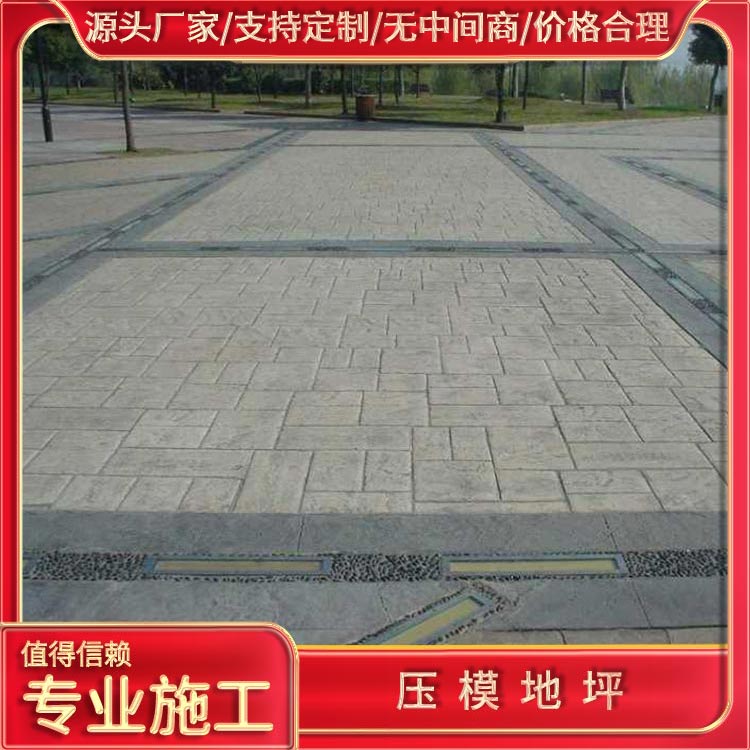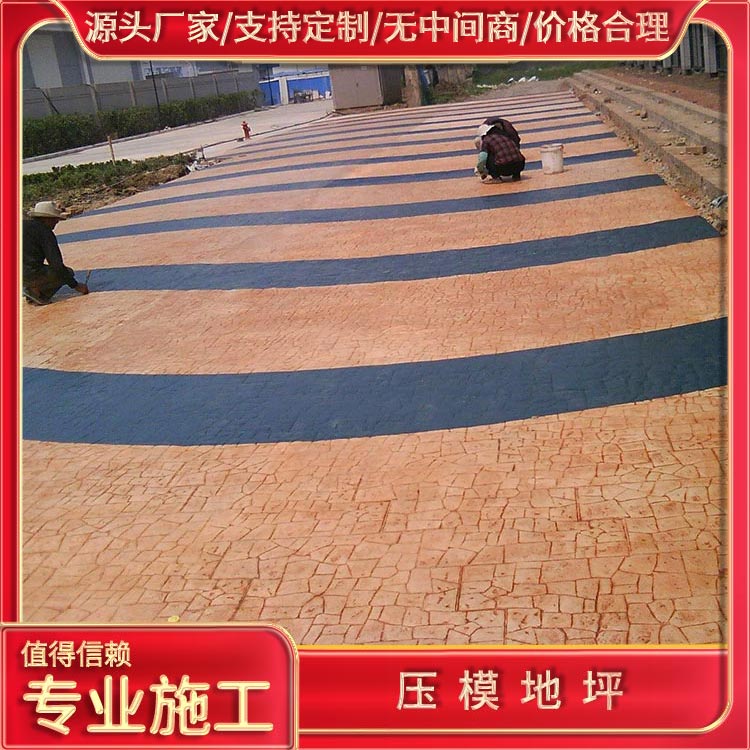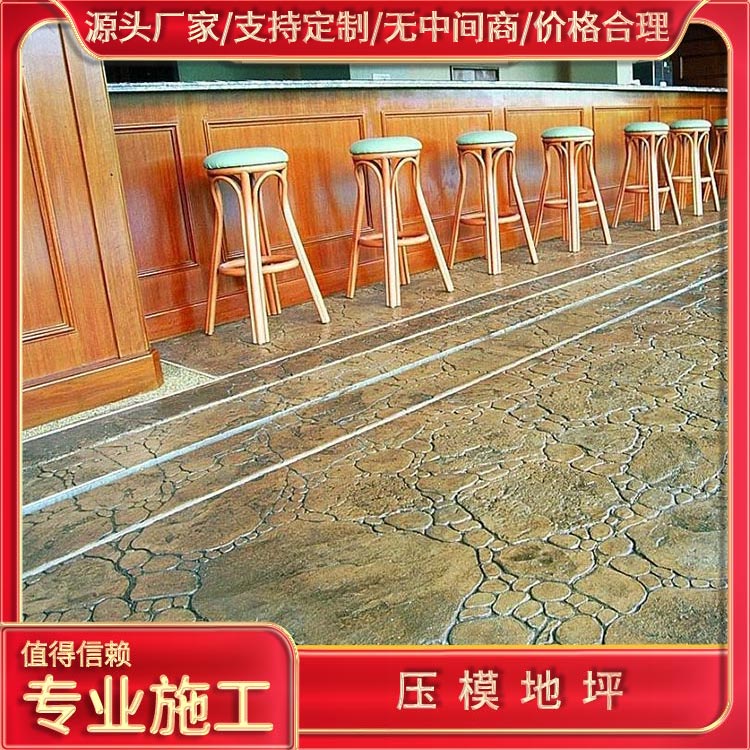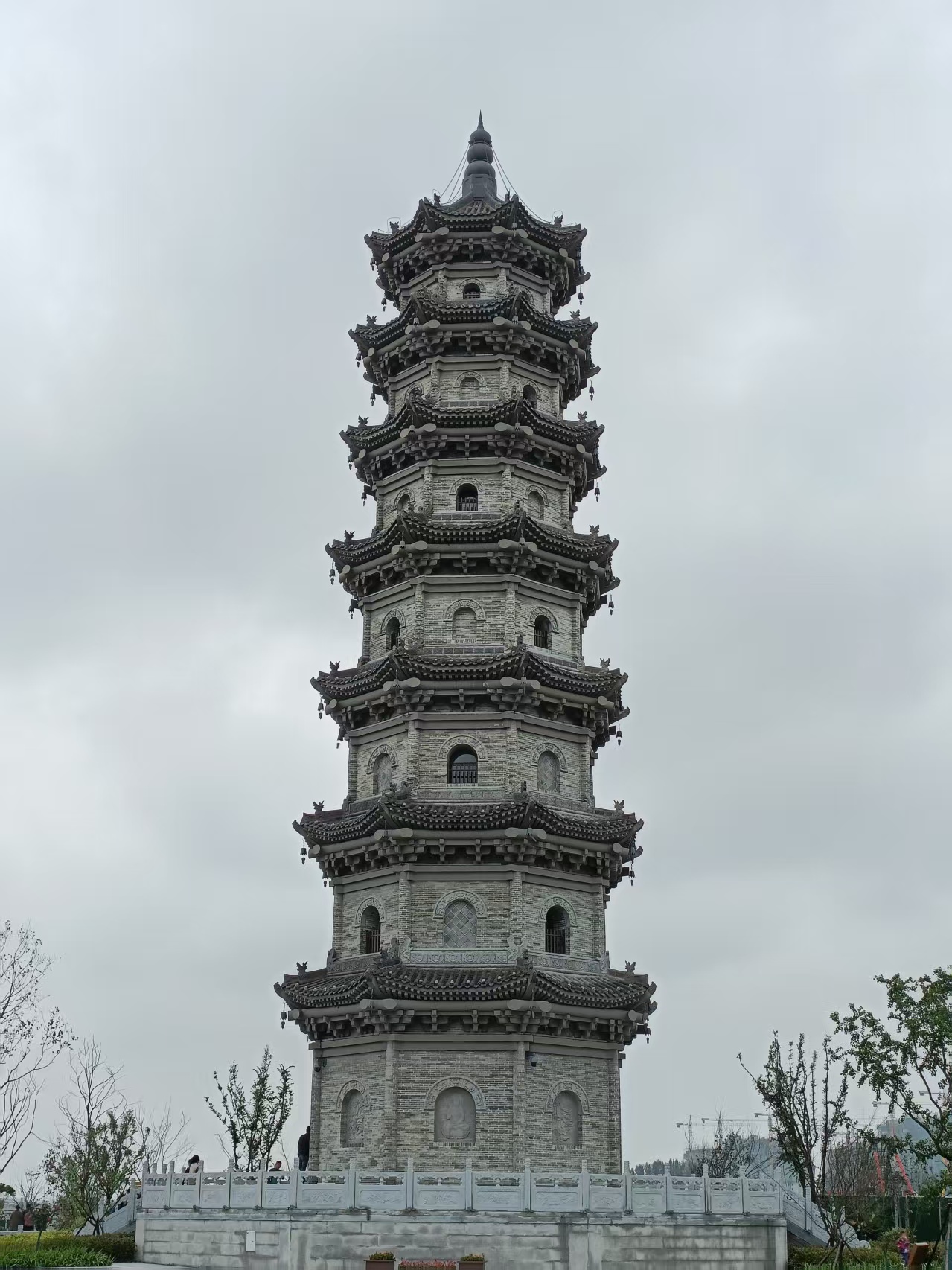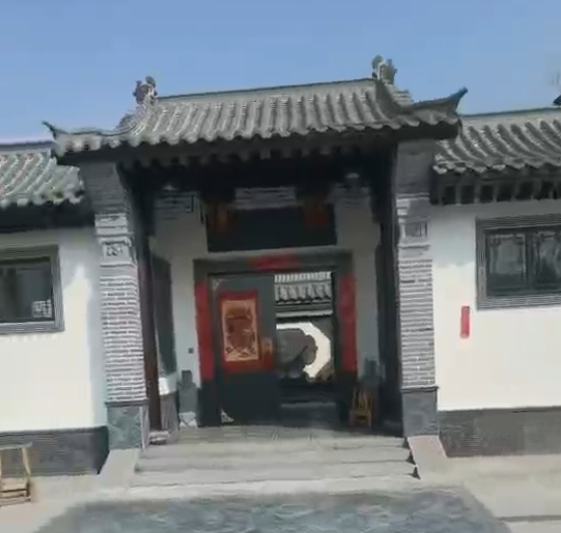

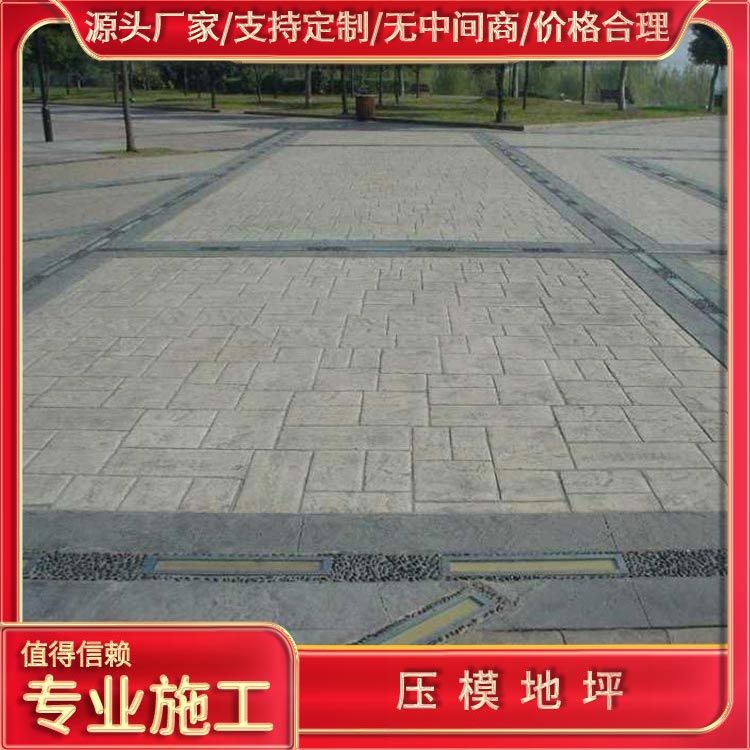


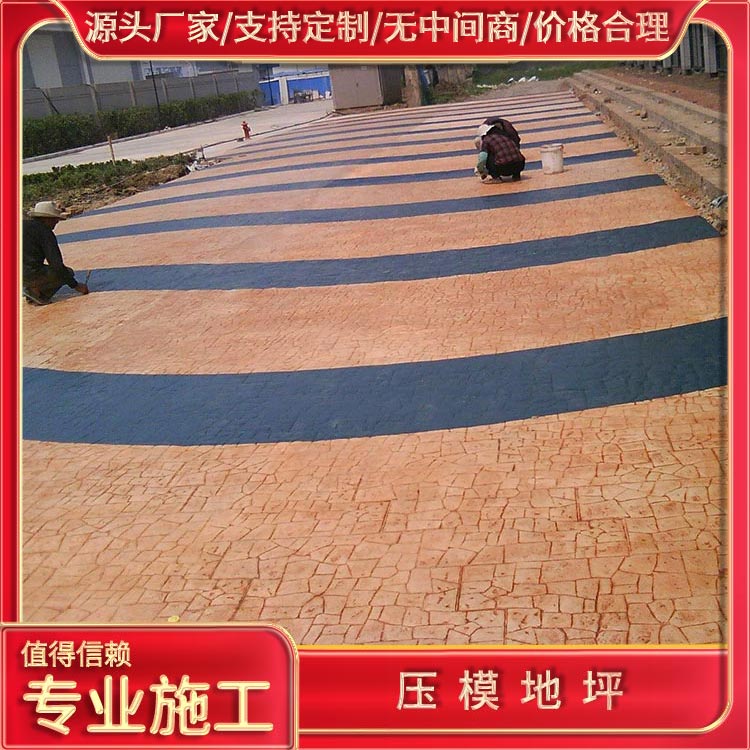
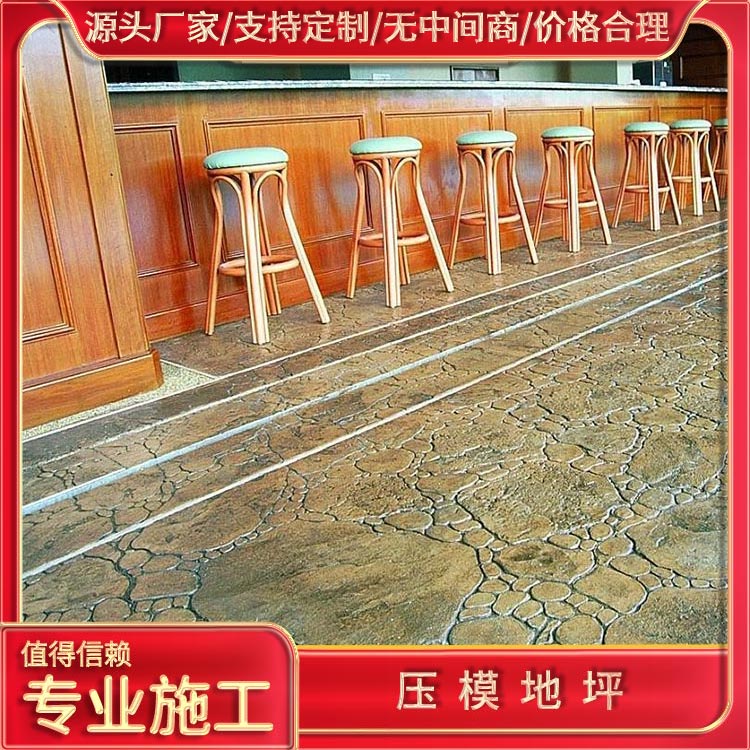









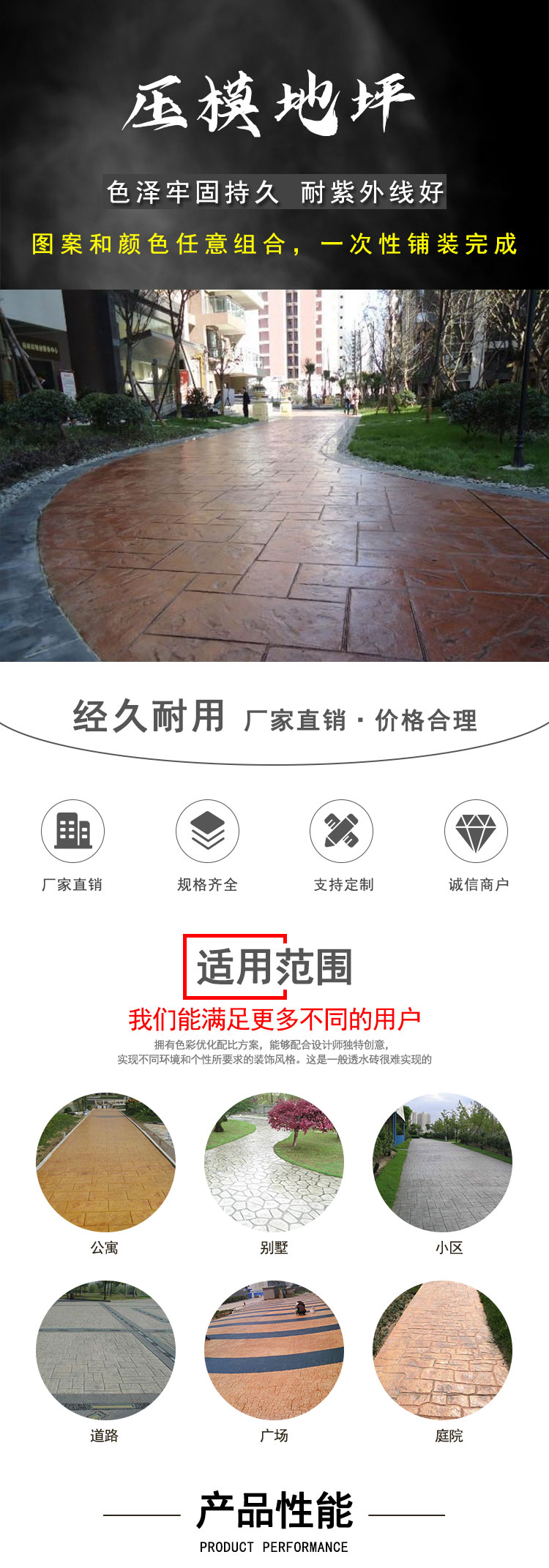
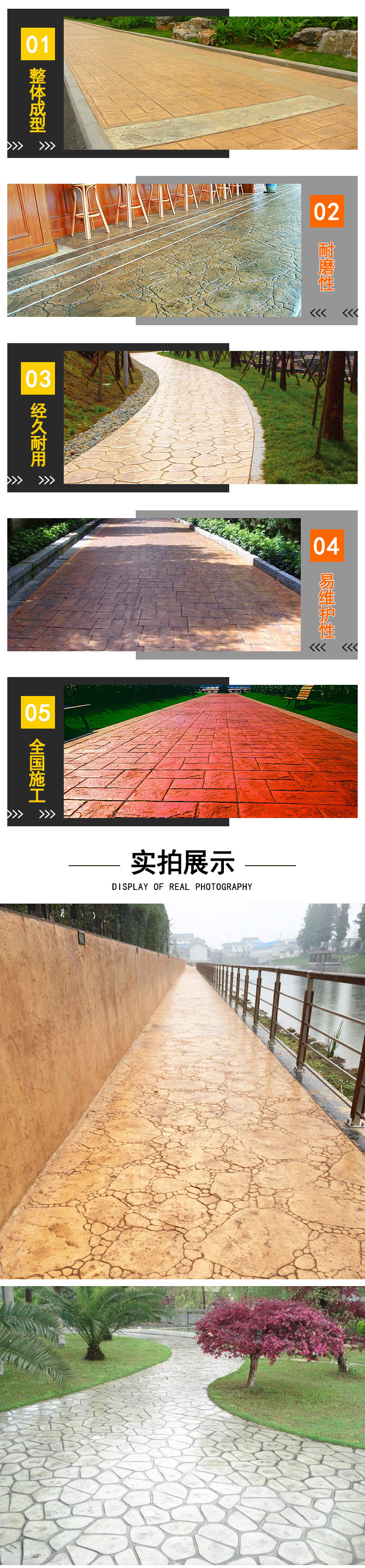

Stamped concrete, also known as patterned concrete or imprinted concrete, is a series of concrete flooring options that are poured on-site and cured with a unique pattern. These floors are crafted using precast molds with colored inks, incorporating advanced technology and stringent construction management. They feature a variety of patterns and colors, offering durability, resistance to wear and pressure, anti-slip properties, and monolithic integrity, with multiple practical applications.
Product Features:
· Patterns and colors can be freely combined, with the entire product laid out in one go for a seamless installation.
Compressive strength typically reaches three times that of ordinary concrete, with excellent wear resistance.
·Utilizing inorganic pigments, the colors are durable and resistant to ultraviolet rays, suitable for the complex and changeable temperature and humidity conditions in China.
Oil-proof, water-resistant, non-slip; surface will not crack, peel, or fade.
Application Scope:
Municipal Engineering: Streets, sidewalks, road medians, themed parks, cultural squares, landscaping projects.
2. Commercial: Office buildings, hotels, restaurants, bars, large shopping malls, convention centers, supermarkets, stores, parking lots.
3. Residential: Apartments, villas, residential complexes, courtyards, gardens.
4. Entertainment Facilities: Parks, Amusement Parks, Water Feature Pools, Swimming Pools.
5. Other: Industrial factories, schools, kindergartens, bus stop systems, interior and exterior decoration of residential projects.
1. Weather conditions during the installation of decorative paving greatly affect the quality. Construction should avoid rainy, snowy, windy, sandy, and frozen weather. In areas with significant temperature differences between day and night, construction is prohibited at night. The environmental temperature should generally be above 2°C. A good construction environment is essential to ensure the quality of the paving. It is advisable to avoid cross-construction with other work teams and, if necessary, the construction site should be enclosed. Gravel and natural soil foundations must be compacted or tamped by a roller.
2. The strength of the concrete subgrade for the embossed flooring should be ≥C25, with the water-cement ratio as low as possible and free of early-strength additives.
3. The thickness of concrete must be consistent, with the base layer concrete being at least 5cm thick. The maximum size of aggregate in the concrete should be no more than 1.5cm. For concrete less than 10cm thick, use a flat vibrator for compaction, and for concrete 10cm or thicker, use an insert vibrator for compaction.
4. After concrete vibration, use a heavier steel long roller (the roller should be at least 0.3 meters wider than the formwork) to repeatedly roll over the platform multiple times to achieve a level surface. When rolling the platform, remove any foreign objects from the steel roller. After the concrete is raised, ensure there is no sand and stone on the surface. In areas where steel roller work is not possible, use manual raising of the concrete and a level ruler to scrape out the platform level.
5. After the concrete ground platform is leveled and desalination treatment is completed, hand iron plates are used to smooth the concrete surface before the initial setting.
Construction Techniques
1. Subgrade Treatment: The surface should be leveled and compacted to achieve the specified compaction density.
Pour concrete into the same color and mold type construction area, then level it with a tool. Consider the water drainage slope to prevent water accumulation.
Before the initial setting of concrete, use a trowel to level the concrete surface. Then, apply the colored pattern material evenly in two to three layers according to the specified amount using the撒布法 (sweeping method). Each layer should be leveled and polished using a dedicated trowel.
Apply demolding agent evenly to the concrete surface in accordance with the prescribed dosage.
5 Arrange the specified mold shapes neatly on the concrete surface and make a layout, followed by the embossing process.
6 completed floorings are undergoing maintenance; typically, they are ready for use after 72 hours under normal 25℃ conditions.
Construction Caution:
Construction should be carried out in accordance with the specified requirements. Reinforcement materials and demolding powder to be laid should be stacked and used in the order of the laying direction. Various professional construction tools and molds should also be in good working condition.
The installation of expansion joints must comply with design specifications and be completed within 2-7 days of laying concrete. The spacing between them should not exceed 4 meters, and the depth of the joints is generally about 2/3 of the concrete surface.
The length of concrete surface铺设 per shift should be coordinated with the paving of the color slab, ensuring reasonable coordination. The construction area per day (based on ten hours) must be controlled at 200m² per team, otherwise, it will directly affect the construction quality.
The surface treatment of the concrete layer must be carried out in accordance with the specifications and design requirements. The surface must achieve the required flatness, slope, and width. Consistency in the quality of concrete throughout the same project is crucial for maintaining the uniformity of the final overall effect.
5. The reinforced material may clump during transportation; it must be crushed by hand before being scattered again.
Prior to molding, it is essential to research and plan the layout and orientation of the mold placement to ensure the integrity of the pattern. Lay the first mold along the reference line of the layout pattern and press it vertically into the concrete. Workers can stand on the mold, as the body's weight is sufficient to create textures on the concrete surface. If necessary, use a specialized tamper for formed molds to press the mold vertically into the work surface for clearer and more realistic patterns. Mastering the timing of the molding process is crucial; both too wet and too dry concrete surfaces can affect the final pattern and effect.
The 7 ready-molded models must be closely arranged to prevent the appearance of double seams. After demolding, the pressed areas must be checked and properly repaired.
8 If encountering walls, corners, or other irregular areas during construction, you can use the exposed edge corner mold (red soft mold). However, be mindful to ensure consistency and coordination with the overall pattern when using it.
9 The mold and corner mold can be reused, but an adequate number of molds (7 pieces per set) must be available to enhance construction efficiency.
The molded flooring surface after construction does not require watering for maintenance, but necessary protection measures must be taken before acceptance and delivery for use.