|
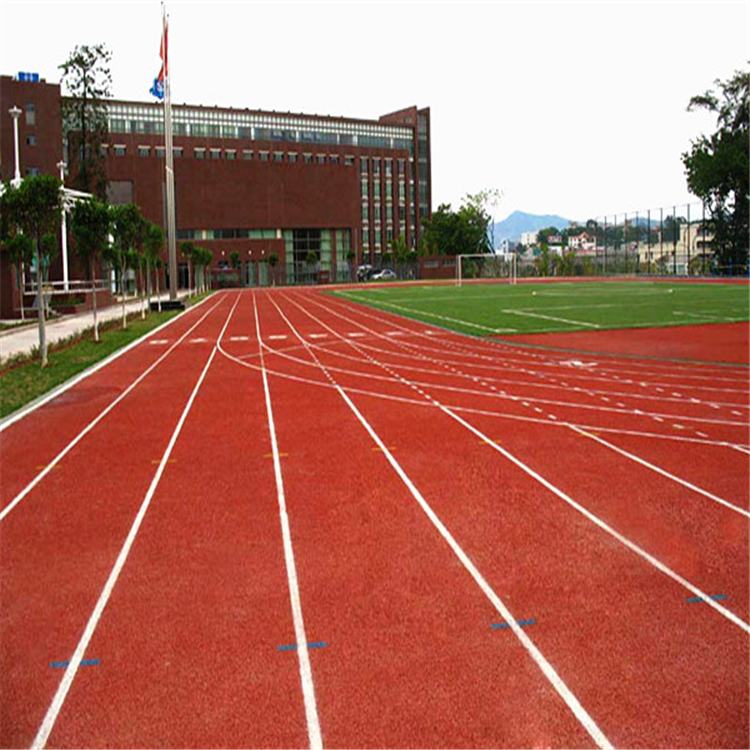
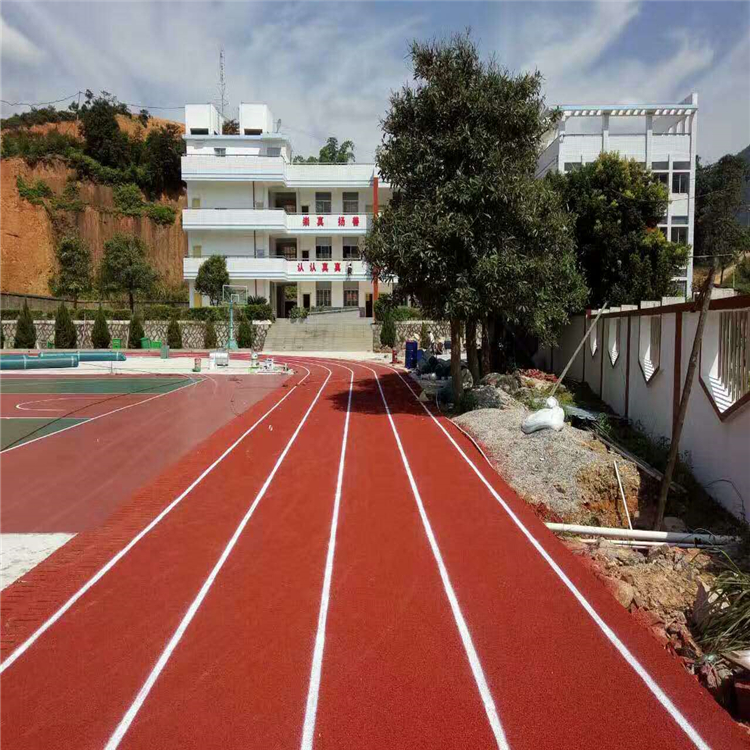
Construction technology of breathable runway
Basic processing:
1、 Basic inspection
Reinforced concrete is selected for cement concrete foundation
1. Strength is C25
2. Water retention and maintenance must last for no less than 7 days, with a total maintenance period of no less than 28 days
3. Once the pouring is completed, the surface is treated with iron trowel pressing and smoothing, without being too smooth or delicate; No exposed stones, no sand reflection, no honeycomb, rough surface, exposed stones, exposed reinforcement, cracks, etc
4. According to the standards of the International Association of Athletics Federations, the longitudinal slope of the track should be less than 1 ‰ downwards in the running direction; The transverse slope of the runway should be less than 10 ‰ towards the inner runway in the left and right directions; The longitudinal axis of the runway should face north-south.
5. The foundation of the site should be flat and compact, with an error of no more than 3mm within a radius of 3 meters
6. The principle of cutting expansion joints is to cut them into blocks of no more than 6x6m, with a width of 6-8mm and a depth of no less than 30mm
2、 Grinding seams
Grind the base surfaces on both sides of the temperature joint, with a width of 40-50mm each, into a slanted mouth with a depth of 3mm, so that the surface of the temperature joint forms a "V" shape
Tools/equipment: cement cutting machine, polishing machine
3、 Acid washing
Wet the base with clean water, evenly sprinkle and wash the base surface with dilute hydrochloric acid with a concentration of about 8%, and then rinse thoroughly with clean water, especially the temperature joint (usually rinse twice)
After washing and drying, it is required that the base cement be in its original color, without white powdery substances or floating materials. During the pickling process, the location of accumulated water should be circled and marked.
Tools/equipment: broom, water pipe, paintbrush
Bottom coat:
1、 Before primer construction
1. Avoid construction under scorching sun or high base temperatures (>450C) to ensure the permeability of the primer (construction should also be avoided in the morning when there is fog).
2. If the foundation is exposed to rain before construction, it should be dried for at least 3 days before construction can begin.
3. Construction can only proceed if the moisture content is below 7%.
Tool/Equipment: Concrete Moisture Tester
2、 Bottom coat
Nano permeable base adhesive D130, spray 1-2 times on the base surface with a dedicated sprayer (or scrape with a flat rake), and the amount of D130 used should be determined according to the strength of the cement concrete base surface
D130 should completely wet the cement floor without any whitening phenomenon. After spraying D130, the base surface must form a bright film until a bright film is formed
Tools/Equipment: Specialized Spray Pot, Flat Rake
3、 Joint filling
After the primer is cured, pour sealant into the temperature joint, slightly 2-3mm lower than the base surface. After curing, grind the raised part with a handheld sand grinder.
Tools/Equipment: Handheld sand grinder, brush
4、 Leveling and repairing accumulated water
For water accumulation with a thickness not exceeding 5mm, use P213 and surface layer special sand, with an addition amount not exceeding 30%; In areas where the depth of accumulated water exceeds 5mm, a thin layer of T210 should be applied to the accumulated water area. Then, T210 and 20-40 mesh sand should be mixed evenly at a ratio of 1:6 (weight ratio), spread flat on the accumulated water area, and compacted; If the thickness of the accumulated water is less than 2mm, it can be repaired directly with the elastic layer P213
Use a ruler or scraper to level the accumulated water, and it is recommended that the thickness of each layer should not exceed 2mm.
When repairing, pay attention to trimming the edges so that the repaired edges do not protrude above the base surface. If there is any protrusion, it needs to be polished flat after curing before proceeding with the construction of the elastic layer.
Tools/equipment: ruler, scraper, grinder
Black particle elastic layer
1、 Ingredients
Mix the single component adhesive T210 with clean black particles in a vertical mixer in a ratio of 1:7 (weight ratio)
The stirring time shall not be less than 15 minutes. When the temperature is too low, an appropriate amount of catalyst shall be added according to the small-scale test results
Tools/equipment: electronic scales, mixers, ingredient buckets, carts
2、 Spread out
Before paving, a small amount of diesel should be applied to the mechanical stainless steel temperature regulating pressure plate to prevent the substrate from sticking to the pressure plate and affecting the paving quality. During the construction of the base layer, the technical personnel should first evenly rake the substrate according to the design thickness and adjust the stainless steel temperature regulating pressure plate, and then use a paving machine for mechanical paving
It is necessary to regularly check the thickness control ruler installed on the paving machinery to ensure consistent thickness, pay attention to the temperature changes of the heating plate of the paving machine to control the quality of the paved product, maintain the same flatness and compactness, and maintain a uniform and slow speed of 9-10. The joint should be cut at a 45 degree angle with tools to ensure a firm and smooth joint
Tools/equipment: paver, trolley
Surface wear-resistant layer
1、 Ingredients
The surface layer T311 is a two-component material with a weight ratio of 1:1 between Group A and Group B. Stir evenly and then add EPDM particles of the same weight with a particle size of 1-2mm
Strictly control the ratio, and stir evenly with a mixer for no less than 5 minutes. When the temperature is low, an appropriate amount of drying agent can be added based on the results of the small-scale test
Tools/equipment: electronic scale, mixer, ingredient bucket
2、 Spray coating
Large scale spraying machine spraying, adjust the machine's discharge volume well; Simultaneously maintaining the synchronization of ingredient quantity and spraying operation quantity, spraying as needed to ensure the continuity of construction; When spraying, calculate the spraying area according to the machine's discharge volume to ensure that the spraying thickness meets the specified requirements. The spraying of the entire site should be carried out in the same direction, and after curing, another layer should be sprayed in the opposite direction
Ensure that the site quality meets the specified requirements, with each layer having a thickness of at least 1.5mm. The same batch of topcoat should be used to prevent color deviation.
Tools/Equipment: Spray painting machine, air compressor, trolley
underline
Measure according to international track and field standards. Draw each runway line and install signage and curbs.
Quality requirement: The degree is one ten thousandth.
(allowable range of 100 meter runway error+20mm)
(Allowable range of 400 meter runway error+40 millimeters)
Tools/Equipment: Marking Machine
|






 Simulated Golf
 Simulated Golf
 Simulated Golf
 Simulated Golf
 Indoor Golf
 Winter is here; what maintenance tasks are required for outdoor water quality monitoring equipment?
 HG30-E Multi-functional Calibration Instrument (Multimeter Calibrator)
 HG6503 Multi-functional Precision Calibration Instrument
 Wing Span Semi-Trailer Manufacturers, Integrated Wings Container Semi-Trailer Transport Market Trends
 Manufacturer of winged semi-trailers, integrated wing container semi-trailer transport market行情