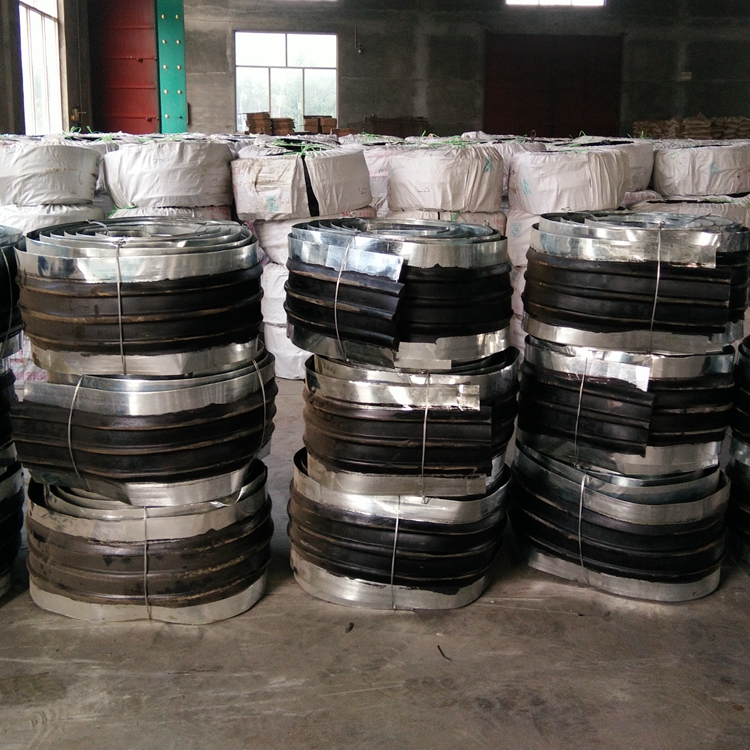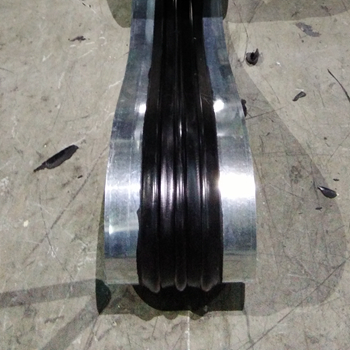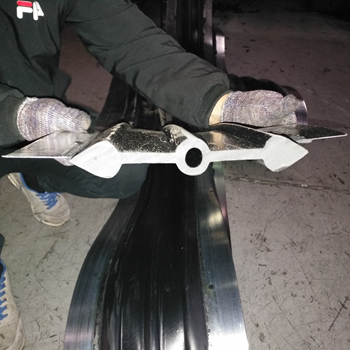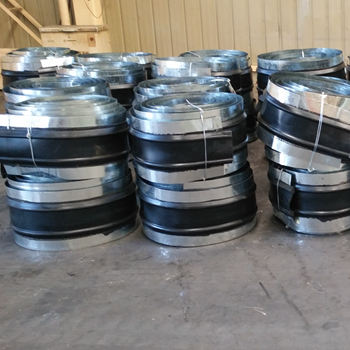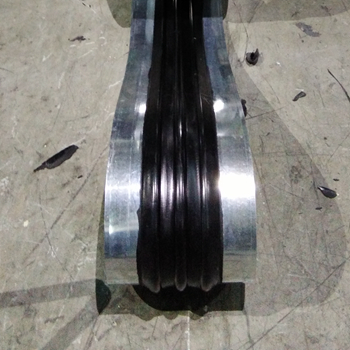

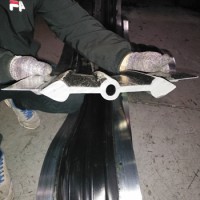
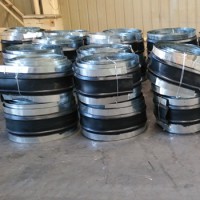







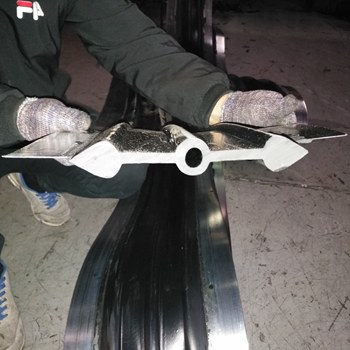

Steel edge rubber composite waterstop is a composite component composed of general stretchable rubber and galvanized steel edges on both sides. The steel edge waterstop mainly relies on the compression or tension of the rubber section in the middle between the concrete deformation joints to seal and stop water.
Generally speaking, the adhesion between concrete and rubber is poor. In conventional construction, rubber is a soft elastic material, which makes it difficult for concrete to be compacted during pouring. During the expansion, detachment, and twisting of concrete joints, rubber waterstops often loosen and fall off, resulting in leakage under high water head pressure. For joints with large deformation seams, the problem becomes even more prominent. The use of galvanized steel edged rubber composite waterstop can basically overcome the shortcomings of pure rubber bridge waterstop. Moreover, this composite waterstop also has a dual function, that is, on the one hand, it can extend the path and slow down the water seepage speed, and on the other hand, the galvanized steel edge and concrete have good adhesion, which enables the waterstop to withstand large tensile and torsional forces, thereby ensuring that the rubber waterstop will not loosen within the effective deformation range of concrete and improving the waterstop effect.
Generally speaking, the adhesion between concrete and rubber is poor. In conventional construction, rubber is a soft elastic material, which makes it difficult for concrete to be compacted during pouring. During the expansion, detachment, and twisting of concrete joints, rubber waterstops often loosen and fall off, resulting in leakage under high water head pressure. For joints with large deformation seams, the problem becomes even more prominent. The use of galvanized steel edged rubber composite waterstop can basically overcome the shortcomings of pure rubber bridge waterstop. Moreover, this composite waterstop also has a dual function, that is, on the one hand, it can extend the path and slow down the water seepage speed, and on the other hand, the galvanized steel edge and concrete have good adhesion, which enables the waterstop to withstand large tensile and torsional forces, thereby ensuring that the rubber waterstop will not loosen within the effective deformation range of concrete and improving the waterstop effect.
Material selection and requirements:
Steel edge: galvanized steel edge;
Rubber: Natural rubber, chloroprene rubber, EPDM rubber, etc. are usually selected, and it is required that the rubber can effectively bond with the steel edge.
Construction and installation: Usually, there are process holes on the edge of the steel edge. When installing and pouring concrete, the process holes are used to wrap and fix the waterstop and steel edge with thin wire to ensure that the pouring is compact and the galvanized steel edge and concrete are effectively and firmly adhered.
Rubber: Natural rubber, chloroprene rubber, EPDM rubber, etc. are usually selected, and it is required that the rubber can effectively bond with the steel edge.
Construction and installation: Usually, there are process holes on the edge of the steel edge. When installing and pouring concrete, the process holes are used to wrap and fix the waterstop and steel edge with thin wire to ensure that the pouring is compact and the galvanized steel edge and concrete are effectively and firmly adhered.