
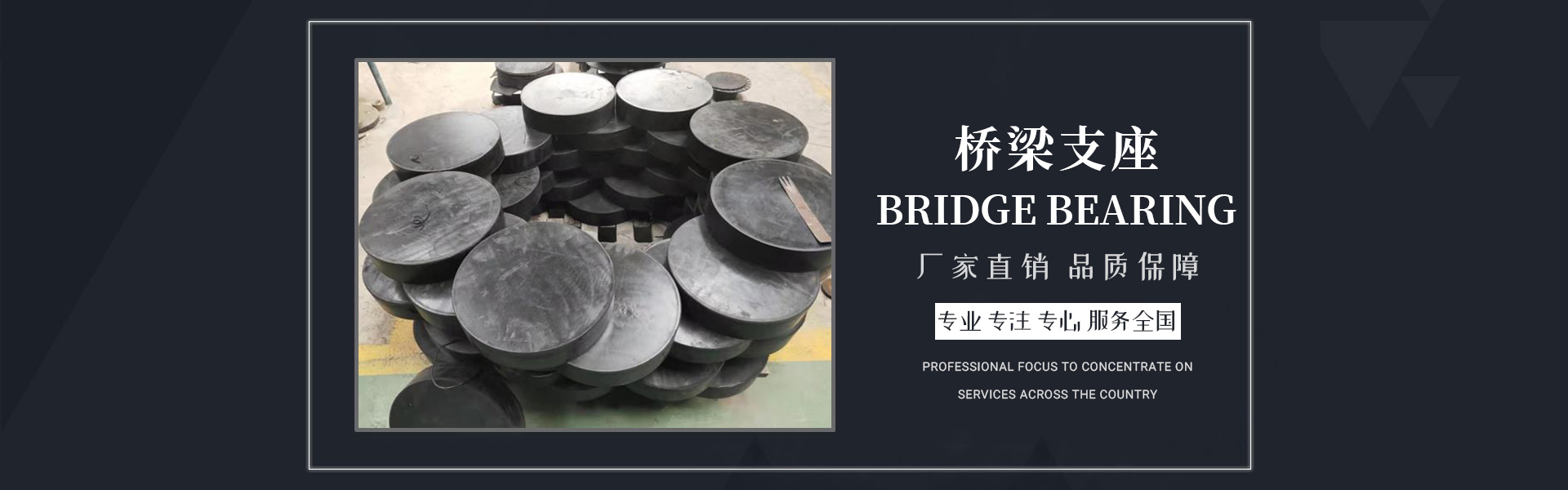



The rubber pad support has a simple structure and is widely used, typically in rectangular frames. For smaller loads, solid rubber plates can be used, but when the load is large, the rubber pad's edges bulge significantly, resulting in a higher tensile force. Therefore, fatigue strength and durability are considered, and white canvas, wire mesh, or thick steel plate spacers are often added as reinforcing layers.
Reinforced intermediate layers can constrain the lateral expansion of the rubber, resulting in a reduction of the straightening and shrinkage deformation. Subsequently, the strength of the plate-type rubber support can be significantly enhanced. However, the addition of the reinforced layer s.1h9562n and mhm2 does not significantly affect the relative shear strength. Under horizontal forces, the overall deformation of the reinforced support is essentially the same as that of an un reinforced rubber support.

Rubber bearings offer robust working performance, excellent vibration reduction capabilities, which can decrease dynamic loads on the construction and impact of bridge abutments on road bridges, and develop the stress function of road bridges. Rubber bearings generally require no scheduled maintenance, thereby reducing maintenance tasks. Rubber bearings with horizontal vibration reduction characteristics can enhance the seismic function of road bridges. International rubber supports take into account the detailed design of rolling bearing structures on aircraft, supporting point loads; they must consider the thickness to accommodate habitual horizontal movement and rotational perspectives.
The support points have moderate style and structure to ensure that the applied software will no longer experience frustration or slip. Direct contact between the support points and the actual surface can prevent the rolling bearings from malfunctioning, as the presence of a thick steel plate pre-buried under the beam may cause the rolling bearings to escape. The placement of the beam bottom support point into the thick steel plate is merely a concern for the burden, as the concrete beneath the beam is crushed. It is unnecessary. The concrete beneath the beam is typically over 30MPa, and some rolling bearings can withstand pressures exceeding 50MPa.
The rubber bearings can only bear a load of 8MPa. In other words, with the unfair concrete crushing, the rubber bearings can no longer support the point. Therefore, no thick steel plate was inserted at the bottom of the plate-type rubber support beam. The rubber compression function and cutting are very limited, and the accounting control based on theory often experiences power outages, and it is also common to see poor reduction in support points, reduced level cutting, smaller support plane specifications, and higher thickness variation. Naturally, stability must also be considered. Rubber bearings are not suitable for large-span highway bridges with wide spans.
