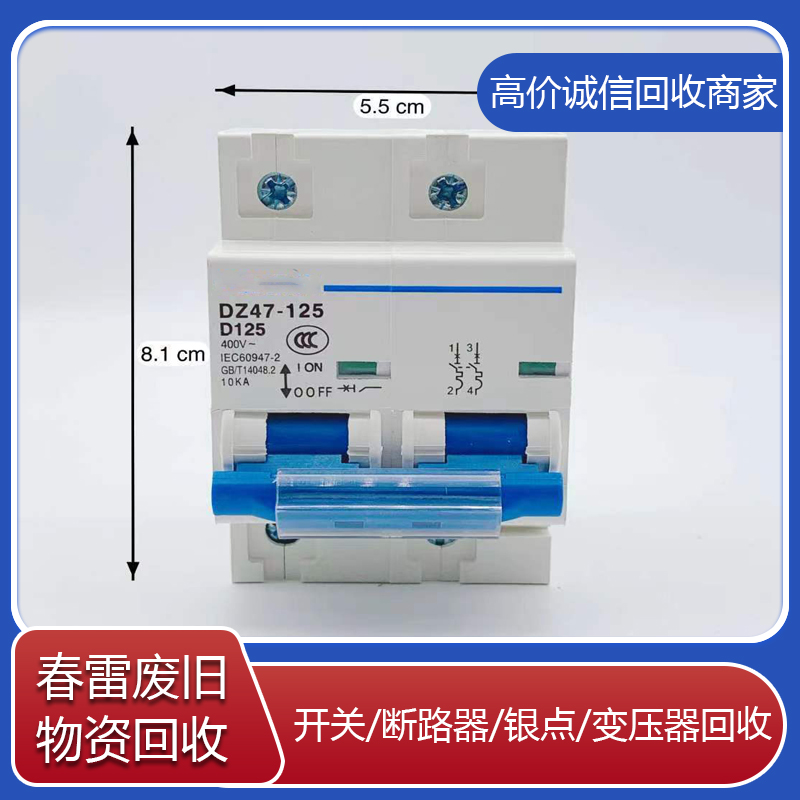
How to Choose the Right Air Switch Specifications and Models
Open circuit breakers are used as main power protection switches or branch line protection switches in residential power supply. When residential wiring or household appliances experience a short circuit or overload, they can automatically trip, cutting off the power supply, thereby effectively protecting these devices from damage or preventing accidents from escalating; generally, a two-pole (2P) air circuit breaker is used for main power protection, and a single-pole (1P) for branch protection. If the rated current of the air circuit breaker is too small, it may frequently trip, causing unnecessary power outages. Conversely, if it is too large, it may not achieve the expected protection effect. Therefore, it is crucial to correctly select the rated current capacity for home air circuit breakers. The specifications of small air circuit breakers are generally distinguished by rated current, such as 6A, 10A, 16A, 20A, 25A, 32A, 40A, 50A, 63A, 80A, 100A, etc. So, how does a typical family choose or calculate the total load current value?
1. First, calculate the values of each branch current.
Pure resistive loads, such as light bulbs and electric heaters, can be calculated by dividing the rated power by the voltage; formula: I = Power / 220V; for example, a 20W light bulb, the branch current I = 20W / 220 = 0.09A. Appliances like fans, irons, electric blankets, water heaters, heaters, rice cookers, woks, vacuum cleaners, and air conditioners are resistive loads.
Sensitive loads, such as fluorescent lights, televisions, washing machines, etc., require slightly more complex calculations, taking into account power consumption, and specific calculations must also consider power factors. For ease of estimation, the author provides a simple calculation method: generally, for inductive loads, double the power calculated from the marked load. For example, a marked 20W fluorescent light would have a branch current I = 20W / 220V = 0.09A, doubled to 0.09A * 2 = 0.18A (which is 0.03A more than the precise calculated value of 0.15A).
2. The total load current is the sum of the branch currents; knowing the branch currents and the total current allows for the selection of branch circuit breakers, main circuit breakers, main fuses, the total electricity meter, and the specifications of each branch wire, or to verify whether the specifications of the designed electrical components meet safety requirements.
3. To ensure safety and reliability, the rated working current of electrical components should generally be more than twice the required high load current; in addition, when designing and selecting electrical components, consideration should also be given to the possibility of increased power consumption in the future, allowing for future demand.