

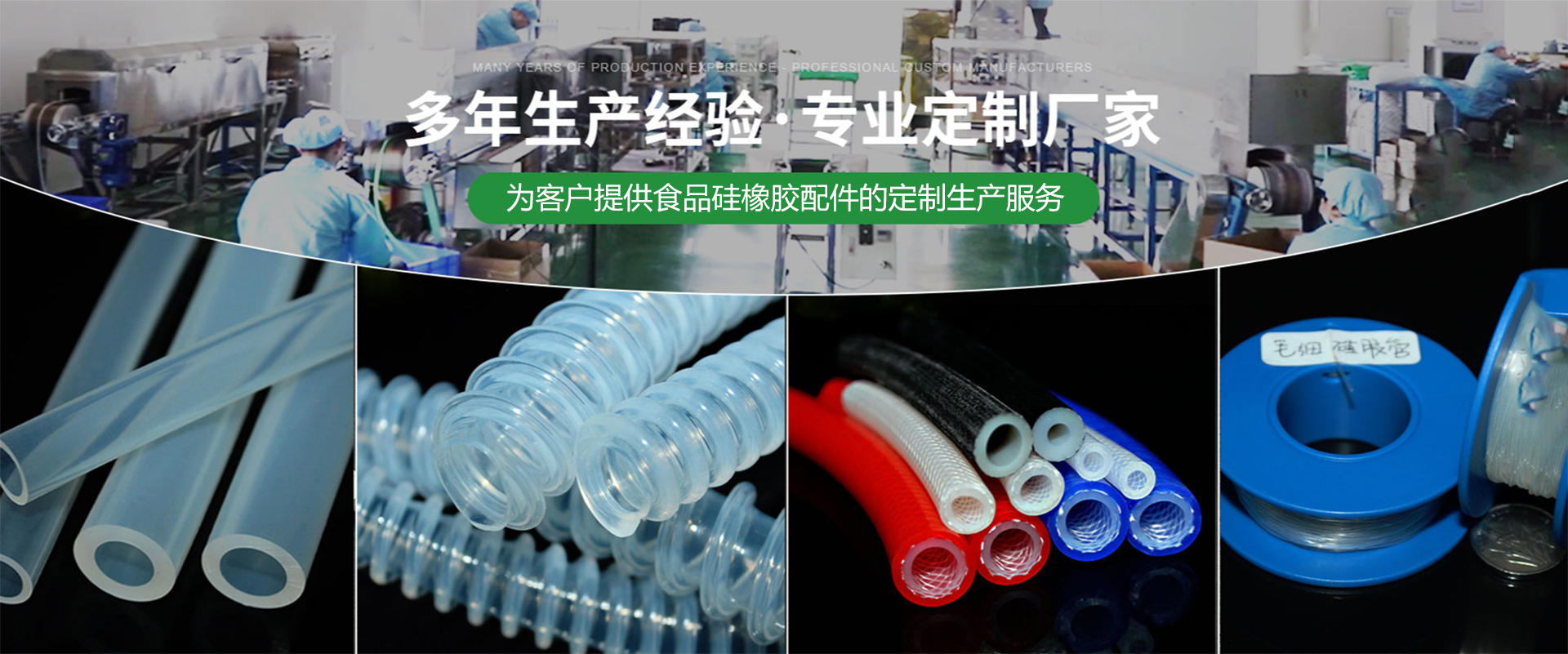


Silicone corrugated tubes are produced through a continuous extrusion process, achieving one-time molding with smooth inner walls and excellent conformability. The spiral section and thin-walled tube are integrated into one, making the tube lightweight and robust with a secure fit, and it does not kink when bent. Silicone wrapped pipes are straight tubes made by Dusseldorf welding with high-density polyethylene (HDPE) as the raw material. Not only do they solve the problem of blade disk blockage, but they also reduce the cost of later drainage, and have been widely applied.
The difference lies in:
1. Different production processes
Although both are structural pipes, silicone braided tubes are formed through a complex molding process and are also formed through a secondary wrapping, exhibiting strong electrical resistance properties. However, silicone bellows are made by mechanical and equipment extrusion, with a hole in the wall, their strength is slightly lower than that of silicone.
Strength of the Epoxy Coated Pipe.
2. Different Appearances
Since the silicone wrapped tube is formed by a propeller, there is a spiral thread due to the winding. However, the wavy tube shows a granular texture; the grains are more rounded, essentially forming a circle.
3. Varying Prices
The primary reason is the difference in production process costs; silicone wrapped tubes are priced higher than silicone corrugated tubes, yet they also outperform the corrugated tubes in various aspects.
4. Various Structures
For example, silicone-coated hoses typically require high surface pressure, while silicone corrugated hoses are generally suitable for drainage in residential areas, and can be used in low-load-bearing building environments.

Three Key Properties of Silicone Wavy Tubes:
Ring Stiffness:
The hoop stiffness indicates the pipe's ability to resist external pressure. The higher the KN/m2 value, the greater the hoop stiffness, the greater the pipe's resistance to external pressure, and correspondingly, the thicker the pipe wall.
Impact Resistance:
Using the drop hammer impact method, at 0+1°C, the actual impact rate (TIR) is less than 10% (which can be understood as 10 out of 100, but not entirely the same). Factors affecting impact resistance are similar to those affecting ring stiffness.
Ring Softness:
The flexible testing device for the ring exhibits the same hoop stiffness but with a greater compression. Upon the vertical outer diameter deforming to 30% of its original diameter, the specimen is unloaded immediately. Observations include the smoothness of the inner wall, the presence of reverse bending, any fractures, and whether the two walls separate. The elasticity of the ring reflects the pipe's resistance to deformation.
In addition to hoop stiffness, hoop flexibility, and impact resistance, national standards also require the creep ratio (reflecting the creep of the bellows after deformation under external force, affecting the product's service life) and oven test (reflecting whether the bonding strength between the inner and outer walls of the double-wall bellows is sufficient, and the stability of the structure).
