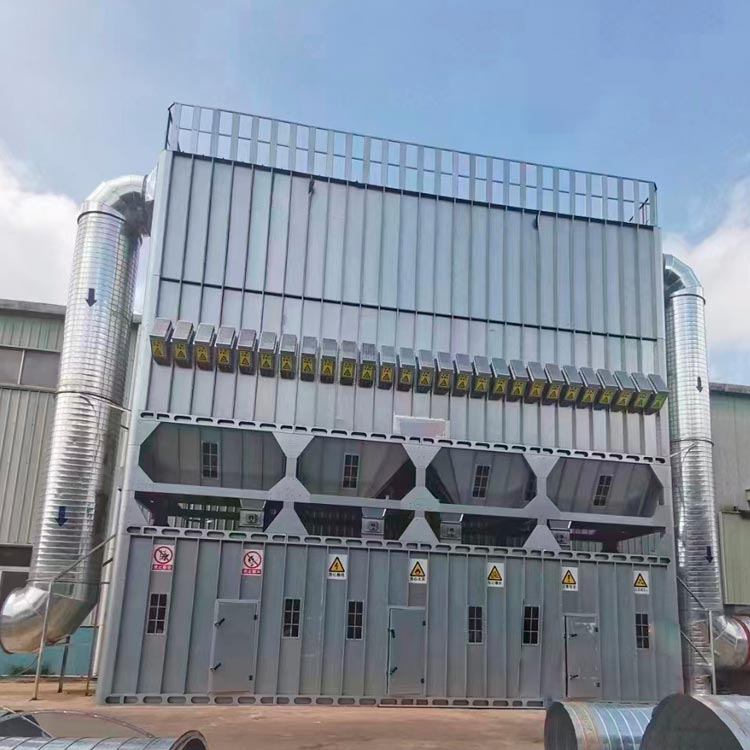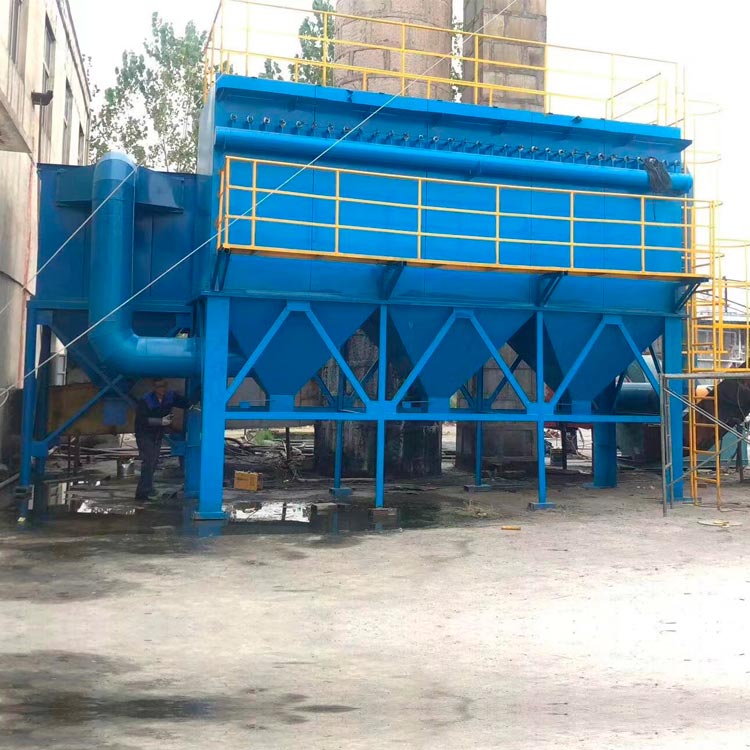

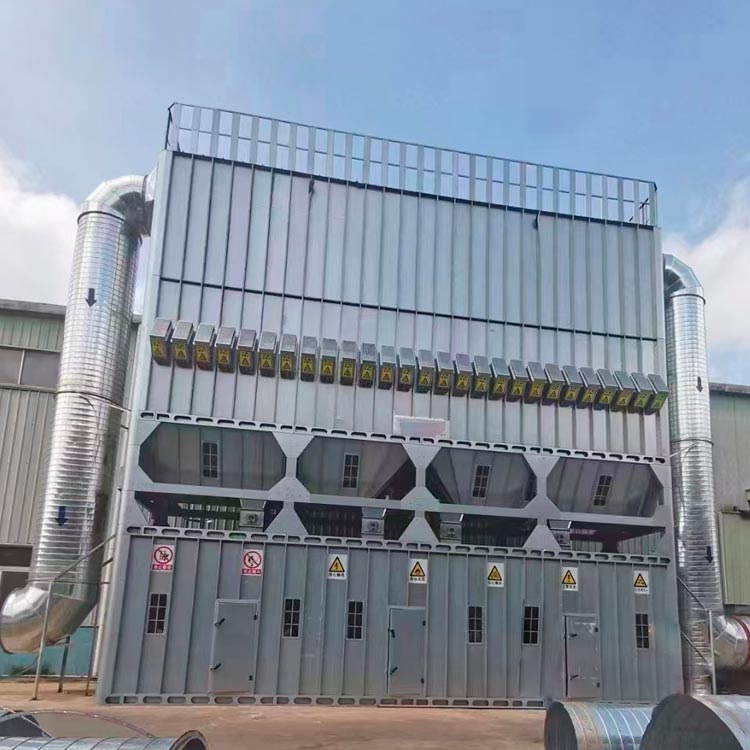
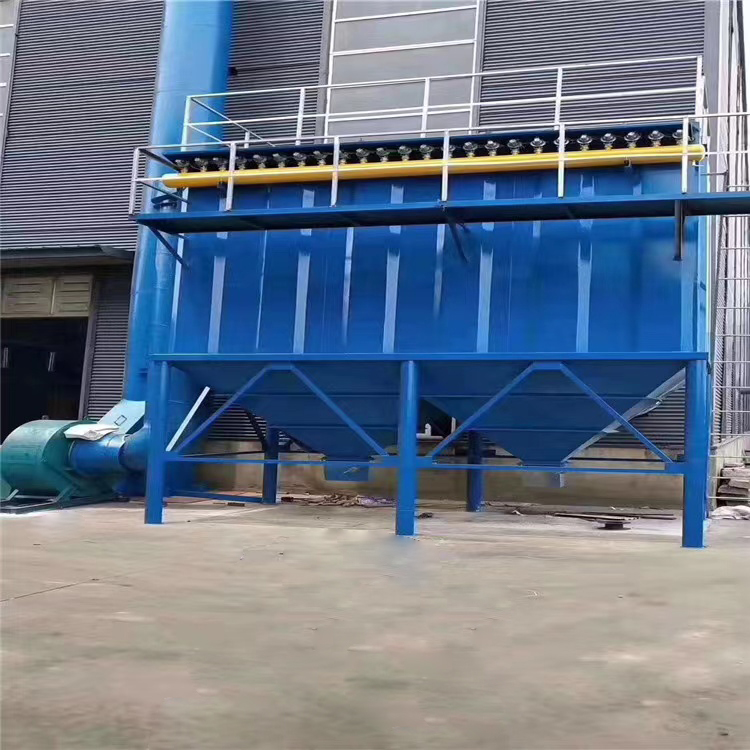
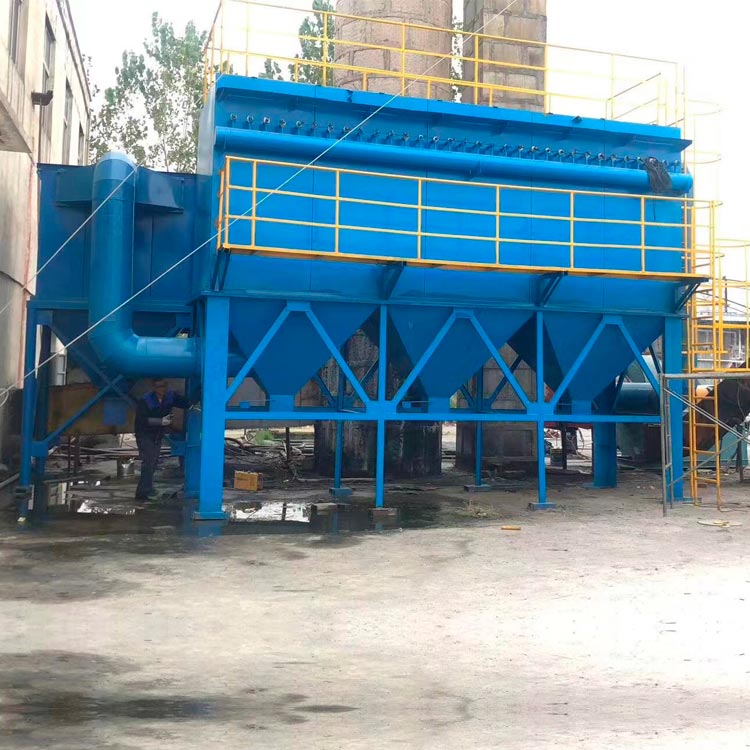
A bag dust collector is a dry dust removal device. It is suitable for capturing fine, dry, non-fibrous dust. The filter bags are made of woven fabric or non-woven felt, utilizing the filtering effect of the fibrous fabric to filter the dusty gas. When the dusty gas enters the bag dust collector, particles with large size and high density settle down due to gravity, falling into the ash hopper. The gas containing finer dust is retained by the filter material as it passes through, thereby purifying the gas.
After a period of use, due to effects like screening, collision, retention, diffusion, and static electricity, a layer of dust accumulates on the surface of the filter bag, which is known as the initial layer. After this, the initial layer becomes the primary filtration layer of the filter material, allowing larger-pored filters to achieve higher filtration rates through its action. As dust accumulates on the surface of the filter material, the dust removal rate and resistance of the dust collector increase accordingly. When the pressure difference between the two sides of the filter material is significant, some fine dust particles that have already adhered to the filter material will be forced through, causing the dust removal rate to decrease. Additionally, an excessively high resistance in the dust collector can significantly reduce the airflow in the dust removal system. Therefore, it is necessary to clean the dust collector promptly once the resistance reaches a certain level. When cleaning, the initial layer should not be damaged to prevent a decrease in the rate.
The high dust removal rate of the bag dust collector is inseparable from its dust removal mechanism. As the dusty gas enters the dust collector through the lower intake pipe and flows into the ash hopper via the guide plate, the coarse particles of dust fall into the ash hopper due to the collision with the guide plate and the reduction in gas velocity. The finer particles continue with the gas into the filter bag chamber, where they are trapped inside the filter bags due to the inertia, diffusion, barrier, hooking, and electrostatic effects of the filter material fibers and fabric. The purified gas escapes outside the bags and is discharged through the exhaust pipe. The accumulated dust on the filter bags is removed using the reverse washing method with gas, and the collected dust falls into the ash hopper, then discharged through the double-layer ash discharge valve to the conveying system. The accumulated dust on the filter bags can also be removed by using a jet pulse airflow method to achieve cleaning, with the collected dust being discharged by the ash discharge system. The good dust removal rate of the bag dust collector is also closely related to the filter material, as the performance and quality of the filter material directly affect the performance and service life of the bag dust collector. The filter material is the main material for making filter bags, and its performance and quality drive the progress of bag dust collection technology, influencing its application scope and service life.
Baghouse dust collectors include fabric filter dust collectors and granular bed dust collectors. The former typically uses filter bags made of useful fibers or inorganic fiber fabrics as the filtering layer, while the latter often employs a filtering layer composed of particles of different sizes, such as quartz sand, river sand, ceramic beads, and slag. As the powder repeatedly adheres to the outer surface of the filter bags, the powder layer continues to thicken, and the resistance value of the baghouse dust collector also increases. When the pulse valve diaphragm issues a command, the pulse valve opens during the submersion on both sides, allowing compressed air from the high-pressure air tank to flow. If there is no dust or it is reduced to a corresponding degree, the mechanical cleaning operation will cease.
The gas purification method of the low-pressure pulse bag dust collector is an external filtration type. The dust-laden gas enters each unit's filter chamber through the guide tube. Due to the sufficient and reasonable air flow through the vertical distance between the filter bag bottom and the upper opening of the air inlet in the design, combined with proper guidance and natural flow distribution, the air distribution in the entire filter chamber is even. The particles of dust in the dust-laden gas are separated by natural sedimentation and fall directly into the ash hopper. The remaining dust, guided by the duct system, flows with the air into the middle chamber filter area and is adsorbed on the outer surface of the filter bags. The clean gas after filtration passes through the filter bags and is discharged through the upper chamber and the exhaust duct.
The filter bags are cleaned by air blowing using compressed air, with the cleaning mechanism consisting of an air bladder, blowing tube, and electromagnetic pulse control valve. Each row of filter bags in the filter room is equipped with a blowing tube at the top, and a blowing nozzle is set directly below the filter bag. Each blowing tube is equipped with a pulse valve and is connected to the compressed air bladder. During cleaning, the electromagnetic valve opens the pulse valve, and the compressed air is blown through the cleaning control device (differential pressure or timing, manual control) to open the electromagnetic pulse blowing as per the set program. The compressed gas sequentially passes through each pulse valve via the nozzle on the blowing tube, drawing in several times the air volume of the喷射 gas into the filter bag, creating an air wave. This causes the filter bag to rapidly expand and vibrate from the top to the bottom, achieving an effective cleaning action that dislodges dust from the filter bag.
Advantages of Baghouse Dust Collectors:
The dust removal rate is impressive, with the dust concentration at the dust collector outlet being within tens of mg/m3. It has a high separation rate for fine dust with sub-micron particle sizes.
2. Wide range of air volume processing capabilities, from as low as a few cubic meters per minute to tens of thousands of cubic meters per minute, suitable for industrial furnace flue gas dust removal and reduction of atmospheric pollutant emissions.
3. Simple structure, easy maintenance and operation.
4. At the same dust removal efficiency, the cost is lower than that of an electrostatic precipitator.
5. Materials such as glass fiber, polytetrafluoroethylene, and P84, which are heat-resistant, can operate under high temperatures above 200°C.
6. Not sensitive to dust characteristics; unaffected by dust and resistance.