

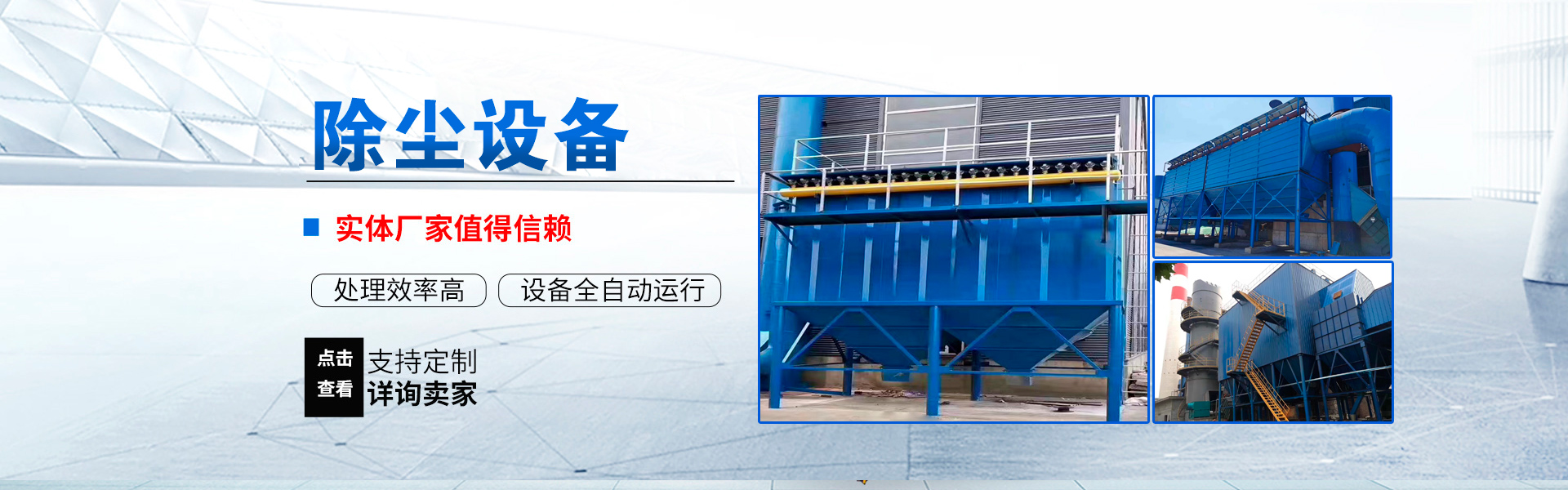


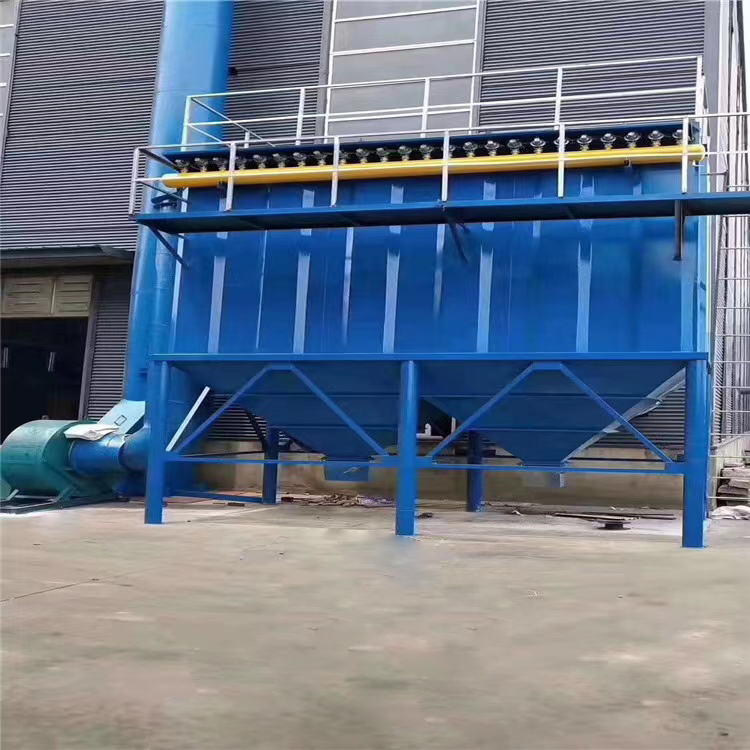
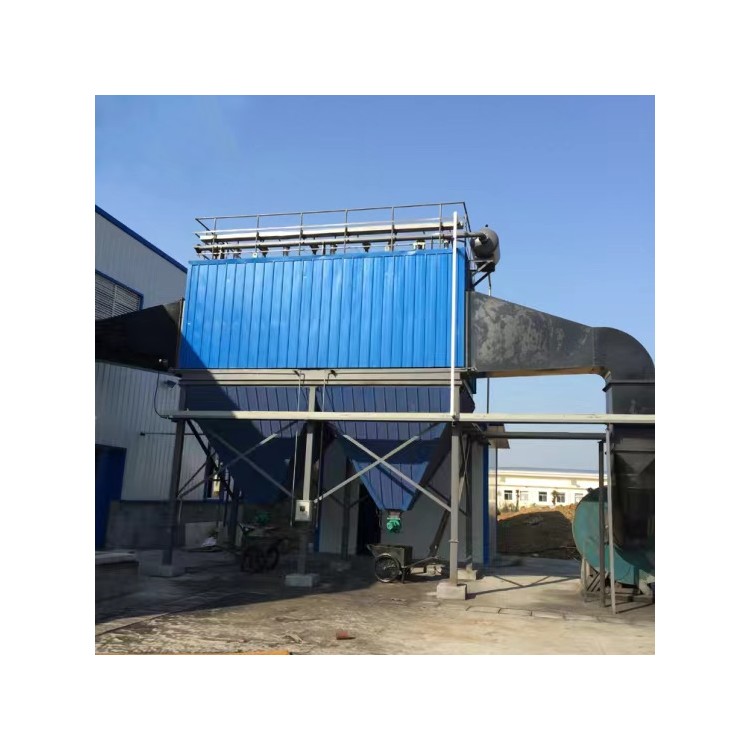
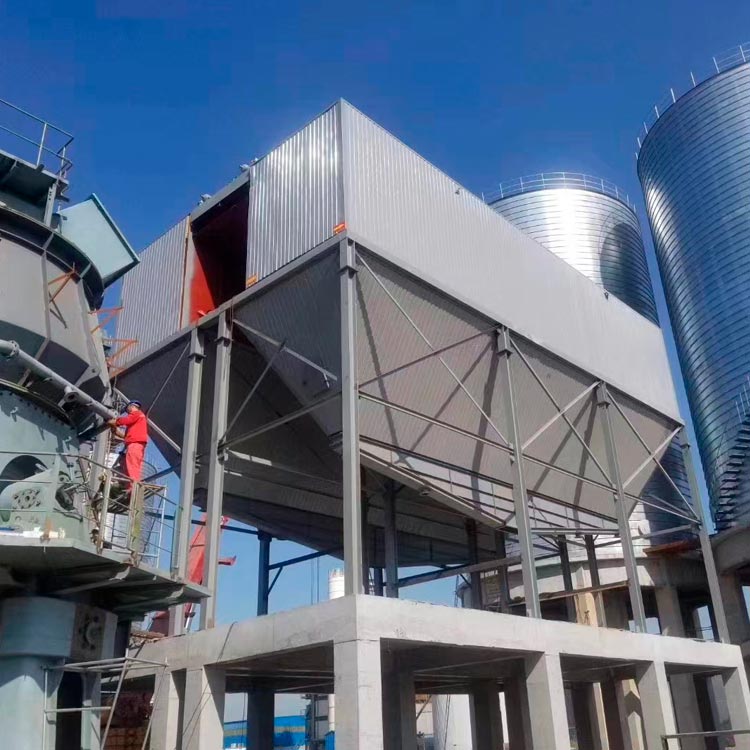
Dust removal equipment refers to devices that separate dust from flue gas, also known as dust collectors or dust removal systems. These devices utilize underground dust removal water pipes and compressed air pipelines, adding specific additives to the water, introducing wind pressure, and then passing through one-to-one equipment to complete a series of processes, producing foam, which is then sprayed onto the dust source via distributors and nozzle bracket assemblies.
Principle of Dust Removal Equipment:
Pulse Jet Dust Removal Equipment
The dust collector is mainly composed of the upper and middle housing, ash hopper, air inlet distribution pipe, support filter bags, and spray blowing device, ash discharge unit, etc. The dusty gas enters the ash hopper of each compartment through the air inlet distribution pipe of the dust collector and is separated under the guidance of the ash hopper guiding device, with large particles of dust falling directly into the ash hopper, while finer dust evenly enters the middle housing and adheres to the outer surface of the filter bags. The clean gas passes through the filter bags into the upper housing and is then discharged into the atmosphere through various offline valves and exhaust pipes. As the filtration process continues, the dust accumulates on the filter bags, and when the equipment resistance reaches the specified resistance value (usually set at 1500Pa), the offline valve of one compartment is automatically closed by the ash cleaning control device according to the differential pressure set value or ash cleaning time set value. The electric control pulse valve is then opened according to the set program, and the stop wind spray is performed. Using compressed air to spray instantly increases the pressure inside the filter bags, causing the dust on the filter bags to be shaken off (even sticky fine dust can be thoroughly cleaned) into the ash hopper, and then discharged by the ash discharge mechanism.
2. Cyclone Dust Removal Equipment
The cyclone dust collector, with the addition of a bypass, operates by having the dusty gas enter tangentially at the feed point. As the gas gains rotational motion, it separates vertically, creating a double helical motion. The dust experiences strong separation at the boundary of the helical movement, with coarser particles following the downward helical flow to the outer wall. Some of these particles are drawn out through the bypass separation chamber's central opening, while the rest are carried downward into the ash hopper. The upward helical flow aggregates finer dust particles, improving the dust removal efficiency. These finer particles are carried upwards by the upper helical flow, forming a strongly rotating upper dust ring beneath the top cover. They then enter the upper opening of the bypass separation chamber along with the upper helical flow, re-entering the cone body through the return air vent where they mix with the internal flow. The purified gas is then discharged through the exhaust pipe, and the separated dust falls into the hopper.
3. Standalone Dust Removal Equipment
Dust-laden gas enters the cabinet and is filtered by a flat bag filter. Dust is trapped on the outer surface of the filter bag, while the purified gas passes through the bag into the blower and is directly exhausted. As the filtering time increases, the amount of dust adhering to the outside of the filter bag also increases, causing the filter bag resistance to rise, thereby affecting the dust removal efficiency. At this point, the shaking mechanism is activated to dislodge the dust adhering to the filter bag surface, which then falls into a drawer and is manually removed.
4. Multi-tube dust removal equipment
Dusty gas enters the gas distribution chamber through the main intake pipe, then into the annular gap between the ceramic cyclone body and the guide vanes. The guide vanes convert the straight-line gas motion into a circular motion. The majority of the rotating gas flows downward in a spiral along the cylinder towards the cone. During rotation, the dusty gas generates centrifugal force, which throws dust particles with a density greater than that of the gas towards the cylinder wall. Upon contact with the wall, the dust particles lose their inertia and fall downward along the wall, gaining momentum from the entry velocity and gravity, into the ash outlet and into the main ash hopper. As the swirling downward outer air stream reaches the bottom of the cone, due to the conical contraction, it continues to spiral upward in the same direction along the axis of the cyclone pipe (clean gas), then exits through the ceramic cyclone body exhaust pipe into the exhaust chamber and is discharged via the main exhaust outlet.
Maintenance requirements for dust removal equipment:
1. There is a wide variety of dust removal equipment, each with different models, specifications, structural performance, and functional features. It is necessary to carefully read the instructions before use to prevent damage to the industrial vacuum cleaner due to improper use and ensure the safety of the user.
2. The operating temperature for standard industrial vacuum cleaners must not exceed 40 degrees Celsius, the workplace should not be above 1,000 meters in altitude, and there must be adequate ventilation. The environment should be free of flammable and corrosive gases, suitable for use in dry rooms.
3. Dry dust collectors must not absorb water; wet hands are not allowed to operate the vacuum cleaner. If there are large paper balls, plastic sheets, or waste materials larger than the nozzle diameter in the areas to be cleaned, they should be removed in advance to prevent clogging of the nozzle. 6. When an industrial vacuum cleaner is used to suck up liquid substances, the filter core should be removed, and attention should be paid to emptying the liquid promptly.
4. Ensure a proper grounding to ensure safe electricity usage. Standard industrial vacuums should not operate continuously for more than 8 hours at a time to prevent motor overheating and damage. However, a specially designed industrial vacuum with an advanced cooling system can operate continuously for 36 hours without interruption, making it compatible with machine tools.
5. When using an industrial vacuum cleaner with an automatic winding device, pull out the power cord to the necessary length; do not over-pull. If you see yellow or red markings on the power cord, stop pulling immediately to prevent over-extension. To rewind the power cord, simply press the button for automatic retraction.
6. Do not overextend or bend the industrial vacuum cleaner hose excessively, nor fold it back and forth frequently, as it may affect the lifespan of the industrial vacuum cleaner hose.
7. Inspect the dust removal equipment's power plug and cord for any damage; electrical leakage can burn out the industrial vacuum cleaner's motor.
8. Be cautious not to be struck when handling mobile dust removal equipment to prevent damage and air leakage in the industrial vacuum cleaner's drum, which may reduce the vacuum cleaner's suction power.
9. Store the machine in a well-ventilated and dry area when not in use. Industrial vacuum cleaners are not designed for continuous, long-term operation. Ensure the continuous working time does not exceed the machine's supported working time, avoid overloading, as this may affect the lifespan of the industrial vacuum cleaner.
10. If the dust removal equipment's main unit overheats, emits a burning smell, or the industrial vacuum cleaner vibrates abnormally and makes noise, shut it down immediately and have it repaired. Do not overuse the industrial vacuum cleaner.
