


 通过中商114认证
What is single-stage reverse osmosis and double-stage reverse osmosis?
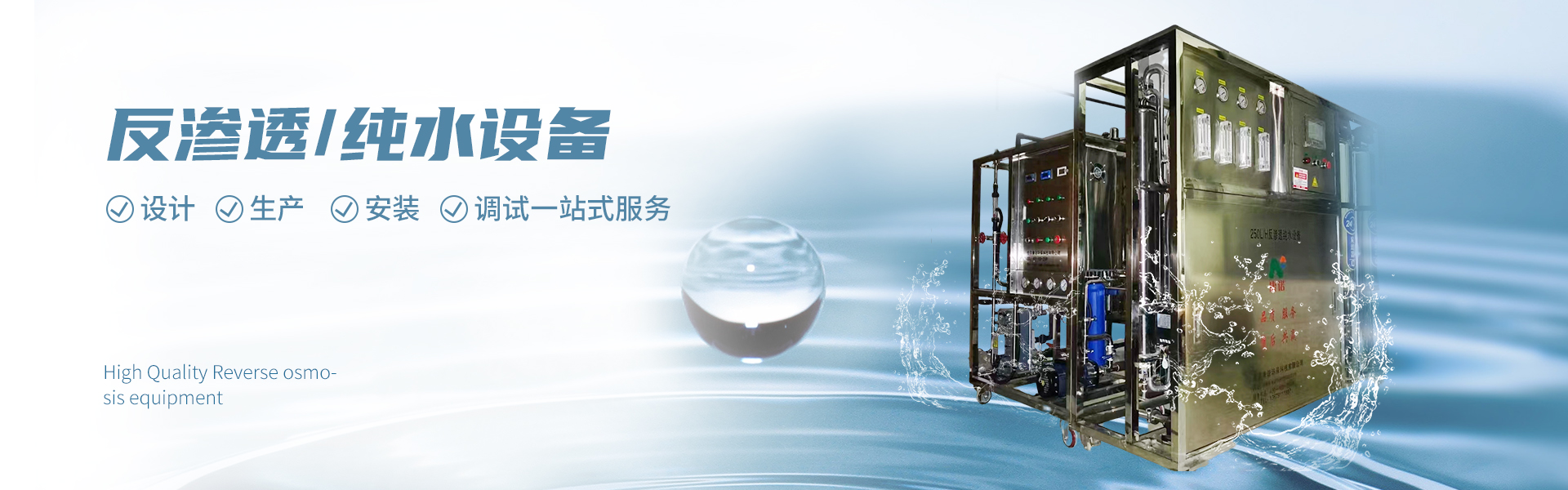
What is Single Stage Reverse Osmosis? In essence, the term "single stage reverse osmosis" is also known as "first stage reverse osmosis." A first stage reverse osmosis system involves the pretreatment system and precise filters processing the raw water, which is then sent to the reverse osmosis unit by a high-pressure pump to directly produce product water, thus referred to as single stage reverse osmosis.
In the water treatment industry, double-stage reverse osmosis, also known as two-stage reverse osmosis, differs from single-stage reverse osmosis in that it involves pressurizing raw water to the pretreatment system for coarse filtration, followed by passing through a fine filter. The water then undergoes pressure increase by a primary high-pressure pump and is sent to the primary reverse osmosis system. The water produced by this system is further pressurized by a secondary high-pressure pump and sent to the secondary reverse osmosis system, yielding the product water, known as double-stage reverse osmosis.
The Difference Between Single Stage Reverse Osmosis Equipment and Dual Stage Reverse Osmosis Equipment
1. Different appearance
Single-stage reverse osmosis equipment features a vertical pump, while dual-stage reverse osmosis equipment is equipped with two vertical pumps.
2. Different Functions
In addition to their distinct appearances, their functions also vary. Single-stage reverse osmosis equipment, also known as reverse osmosis, is a membrane separation process that uses pressure difference as the driving force to separate solvents from solutions. As it works in the opposite direction of natural osmosis, it is termed reverse osmosis.
The dual-stage reverse osmosis system utilizes pressure to force water molecules through a semi-permeable membrane that selectively allows water molecules to pass, which is the principle behind reverse osmosis water purification.
3. Different working principles
Single-stage reverse osmosis equipment and dual-stage reverse osmosis equipment operate on different principles. Generally, reverse osmosis technology is commonly used for desalinating seawater and brackish water; water softening; wastewater treatment; and purification, concentration, and separation in the food and chemical industries.
The separation process in the second-stage reverse osmosis method does not require heating and involves no phase change. It boasts numerous advantages, including low energy consumption, compact equipment size, simple technology, easy operation and maintenance, environmental friendliness, strong adaptability, and a wide range of applications.
The above is an introduction to the differences between single-stage reverse osmosis and double-stage reverse osmosis equipment. For more information on water treatment, welcome to follow Xi'an Kangnuo Environmental Protection.
