



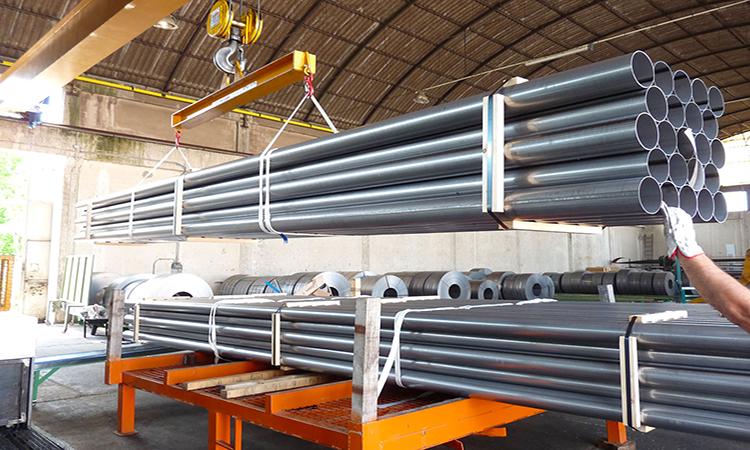
Seamless steel tubes can be made from a variety of alloys and metals, such as carbon steel, stainless steel, molybdenum, or tungsten.
The Difference Between Seamless Steel Pipes and Welded Pipes: Seamless steel pipes are extruded and stretched from billets, whereas welded pipes are made by rolling and welding steel strips into tubes.
Due to the higher level of safety measures provided by seamless steel pipes, they are more expensive than welded pipes.
Seamless steel tubes have shorter lengths compared to welded tubes, which can be manufactured in longer continuous lengths.
Seamless steel pipes generally show no signs of corrosion unless exposed to highly corrosive environments, whereas the welded areas in welded pipes are more susceptible to corrosion.
The welding area is considered uneven, thus exhibiting varying ductility, reduced corrosion resistance, and greater dimensional changes.
Seamless steel tubes eliminate any such issues, thus offering high corrosion resistance.
2. Features: Seamless steel pipes are widely used in engineering and construction applications. They are hollow steel strips without joints, primarily used for liquid transmission pipelines. They differ from ordinary steel, including a heavy-duty steel type, which boasts strong resistance to corrosion and general corrosion.
High precision is achievable for small batch production.
The diameter is smaller.
High welding strength, strong compression ability.
Steel pipes offer superior performance and are denser than other metals.
The intersection area of steel is more complex.
High-precision cold drawn products, with excellent surface quality.
3. Mechanical Properties: The mechanical properties of seamless steel pipes are a crucial indicator for ensuring the performance (mechanical properties) of seamless pipelines, which depend on the chemical composition of the steel and the heat treatment process.
In steel standards, it offers tensile properties (tensile strength, yield strength, or yield point elongation) and hardness, depending on various requirements.
Tensile Strength (σb)
During the tensile process, the stress (σ) divided by the original cross-sectional area (So) when the tensile bear is strongly applied (Fb), is referred to as the tensile strength (σb), measured in N/mm² (MPa). It indicates the capacity to withstand the destruction of metallic materials under tension.
b. Yield Point (σs)
The phenomenon of metal materials, where the sample does not increase (remains constant) and continues to elongate under tensile force, is called the yield point. If a drop in force occurs, the upper yield point and lower yield point should be distinguished. The unit of the yield point is N/mm² (MPa). Yield Point (σsu): The sample generates a high stress and forces a drop; Lower Yield Point (σsl): Stress is produced when the initial transient effects are excluded.
c. Elongation (σ)
In tensile testing, the specimen broke at a certain percentage of the specifications to increase the original gauge length, known as elongation. Σ, represented in percentage.
Sectional shrinkage rate (ψ)
During tensile testing, the percentage of the specimen that fractures at the reduced cross-sectional area is measured by the diameter reduction at the original cross-sectional area, known as the area reduction ratio. Ψ is expressed as a percentage.
d. Hardness Test
Hardness refers to a material's resistance to indentation on a hard surface. Depending on the testing method and application, hardness can be categorized into Brinell hardness, Rockwell hardness, Vickers hardness, Shore hardness, and high-temperature hardness. Commonly used in pipelines are the Brinell, Rockwell, and Vickers hardness tests.
