

A cantilever racking is a type of specialized shelving that is constructed by installing cantilevers on columns, making it particularly suitable for storing materials like steel pipes, profiles, cables, and more, with a wide range of applications. Are there height limitations for cantilever racks? How tall can they be? That's what we're discussing today!
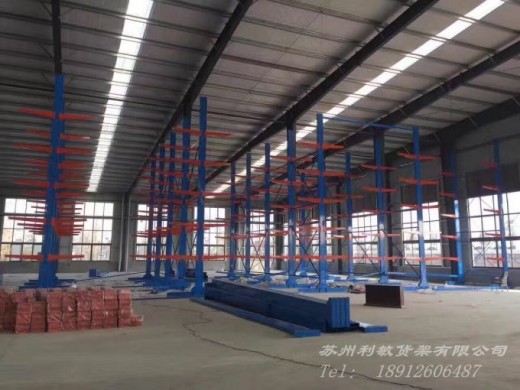
Armoured racking has height limitations, typically capped at below 6 meters, depending on the chosen storage method. When manual handling is the primary method, the racking height is limited to 2.5 meters. However, when forklift operation is the main method, the height is restricted to 6 meters. Additionally, the arm length is kept within 1.5 meters, with each arm capable of carrying up to 1000 kg. Of course, the specific dimensions and load capacity are tailored to the customer's unique characteristics and requirements, with factors like warehouse structure, material characteristics, and warehouse environment all potentially influencing the final outcome.
Overall, cantilever racking is more suitable for small spaces and low-height warehouses, with a space utilization rate of 35%-50%. It is widely used in the mechanical manufacturing industry and building materials supermarkets.
The company continues to forge ahead, setting a new standard in the retail, warehouse, and storage industry with its superior quality and reasonable pricing. We introduce innovative products and provide satisfactory goods and services to both new and old customers in various ways. We sincerely look forward to joining hands with you to create a brighter tomorrow.
As the economy surges forward, foreign-funded enterprises are flooding into the Yangtze River Delta and Pearl River Delta regions in China. This influx not only boosts local economic growth but also introduces new management philosophies and technologies. Currently, the types of racking used in corporate storage warehouses are increasingly leaning towards automation and intelligence.
The shelves are categorized into traditional and new shelves based on the development of the shelves.
Traditional shelving options include: shelf racks, bin racks, drawer shelves, cabinet racks, U-shaped racks, cantilever racks, grid racks, saddle racks, gas cylinder steel tube racks, tire racks, etc.
The new racking includes: rotating racks, mobile racks, shuttle racks, assembled racks, adjustable racks, pallet racks, entry-way racks, high-rise racks, mezzanine racks, gravity racks, and screen-hanging racks, etc.
Among our storage racking options, we offer: Light-duty storage racks, medium-duty storage racks, heavy-duty storage racks, and mezzanine racks, among others.
Has anyone noticed? The shelves have suffered severe deformation overnight—it might have gone unnoticed initially, but it was only discovered upon closer inspection. But what could be the cause of the warehouse shelves deforming and being damaged?
1. The cargo weight exceeds the shelf's load-bearing capacity.
The placement of goods exceeded the load-bearing capacity of the warehouse shelves. That is, when purchasing the shelves, the manufacturer of the warehouse shelves selects the corresponding materials based on the load capacity of the goods. However, if the weight of the goods on the shelves exceeds the maximum load-bearing weight of the shelves during actual use, the shelves will deform.
Item placement is uneven.
Uneven weight distribution can lead to shelf deformation; if, when placing goods, the weight of each layer is concentrated in the center while there is no weight distribution on the sides, it will definitely cause the shelf to deform.
3. Collision-induced deformation
Improper operation of handling equipment can sometimes lead to forklift collisions with shelves, causing warehouse shelves to deform due to driver error.
