



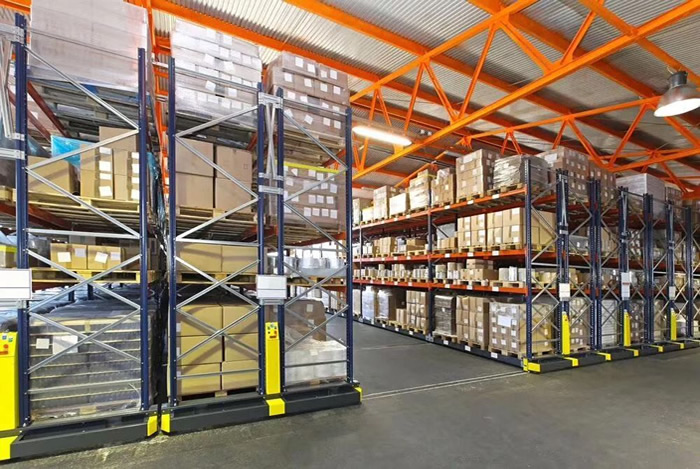
Pallet racking systems are typically manually accessed, featuring modular structures with uniformly adjustable shelf spacing. The goods are often loose items or lightly packaged goods that are not too heavy for manual handling. The height of the racks usually does not exceed 2.5 meters, as reaching higher shelves can be difficult for humans (unless an elevated work platform is used, in which case the height can be around 3 meters). The span (length) of each unit shelf should not be too long, and the depth (width) of each unit shelf should not be too deep. Based on the load capacity of each shelf, the racking can be categorized into light, medium, and heavy-duty types, with the main shelf materials being steel and wood.
1. Light-duty shelving units
Each level of the unit shelf can support a weight of no more than 200kg, with the total carrying capacity generally not exceeding 2000kg. The span of the unit shelf typically does not exceed 2m, with a depth of no more than 1m (usually within 0.6m), and the height is generally within 3m. The most common structure is the angle steel column shelf, which is light and attractive in appearance, mainly suitable for storing light and small items. With minimal investment, it is widely used in industries such as electronics, light industry, and cultural and educational fields.
2. Medium Shelves Pallet Racking
Each tier of the unit racking typically holds 200 to 800 kg, with the total capacity generally not exceeding 5,000 kg. The span of the unit racking usually does not exceed 2.6 meters, the depth does not exceed 1 meter, and the height is generally within 3 meters. If the span of the unit racking is 2 meters or less, and the tier load is 500 kg or less, a beamless medium-size shelf racking is usually more suitable; if the span is over 2 meters, a beam-supported medium-size shelf racking is generally the only option. Beamless medium-size racking offers greater adjustability in shelf spacing, is more stable and aesthetically pleasing, and better integrates with the environment, making it ideal for warehouses with high cleanliness requirements; beam-supported medium-size shelf racking, on the other hand, has a stronger industrial character and is more suitable for storing metal structural products. Medium-size shelf racking is widely applicable across various industries.
3. Heavy-duty pallet racking
Each level of the unit shelf typically supports a load of 500 to 1500 kg, with a span of generally 3 meters or less and a depth of up to 1.2 meters. The height is not restricted, and these shelves are usually combined with heavy-duty pallet racks. The lower levels are usually shelf-style for manual handling, while the sections above 2 meters are typically pallet racks, accessed by forklifts. They are primarily used for operations requiring both full-pallet storage and retrieval, as well as individual items, and are commonly found in large warehouse supermarkets and logistics centers.
