

Unit Load Racking, generally refers to shelves used for placing pallets, storage bins, and other containers. Operationally, these shelves are typically handled by forklifts. During the design phase, we usually calculate the maximum storage capacity of the racks. Customers can use this design quantity to plan their warehouse storage methods.
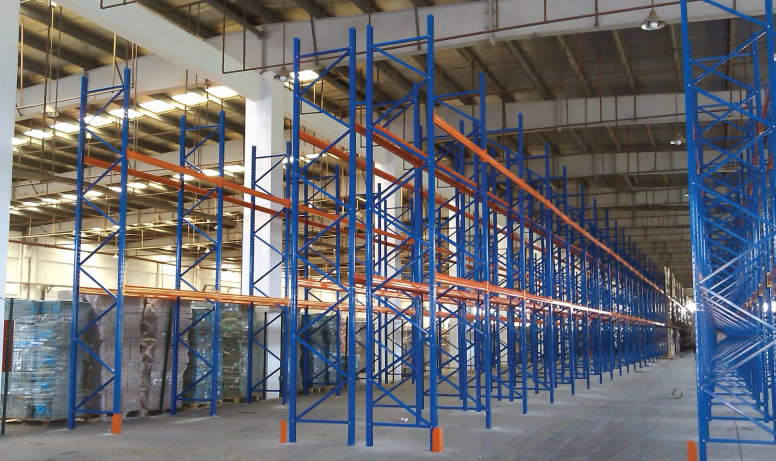
Common types of racking include:
One Heavy-Duty Shelving Unit
Heavy-duty shelving is a commonly used type of position shelving, and it is currently the most widely applied in the industry.No content provided for translation.A versatile type of racking system. Among all shelving systems, heavy-duty racks have the lowest cost but also the lowest storage efficiency. They are suitable for warehouses with a diverse range of goods.
Two-aisle货架
The through-aisle racking requires a single type of goods and allows for a last-in, first-out system. This type of racking has stringent requirements for forklifts, as the vehicle width must not exceed certain limits to fit into the storage aisles. Through-aisle racking offers high storage density, but during storage operations, it necessitates a slow entry into the aisles, resulting in lower efficiency.
Three Gravity Shelving
Gravity-assisted shelves are a type of passive automated storage system where goods slide down from above due to gravity. They have specific requirements for the material of the trays and are relatively expensive. However, they offer efficient first-in, first-out storage.
Four:穿梭式货架
The shuttle racking system is an automated storage system where the shuttles serve as the storage machines, working in tandem with forklifts. It represents the future direction of the rack storage industry, enabling the first-in-first-out principle. To achieve higher storage efficiency, more shuttles are required.
Five: Push-Back Shelves
Push-back racks, also known as rear-push racks, involve pushing loaded carts to the back using forklifts. These racks are generally less commonly used.
