



 通过中商114认证
Bridgehead Backfill Foam Concrete Construction Plan
Project Overview
Project Name:
Application: Pipeline Backfill
Design Requirements: Dry density less than 400 kg/m³; Strength not less than 1 MPa
Construction Techniques
The production process of foam concrete is as follows:
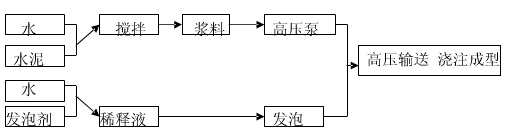
The production process of foamed concrete includes: foam preparation, foam concrete mixture preparation, casting and shaping, curing, and inspection. Base cleaning → Determine thickness and high/low points according to design drawings and technical instructions → Produce foamed concrete → Cast and shape in accordance with the construction sequence → Cure → Inspect and maintain finished products.
Section II: Requirements for Foamed Concrete Mix Proportions and Raw Materials
Material Ratio:

The raw materials for foam concrete production include foaming agents, cement, and water, etc.
1) Foaming Agent: The quality of the foam is determined by indicators such as tensile strength, expansion ratio, and bleeding rate; the tensile strength of the foam refers to its ability to withstand destruction in the air within a specified time, often measured by the sinking distance per unit time; the expansion ratio is the multiple of the foam volume over the foam agent solution volume, and the bleeding rate is the volume of the foam agent solution produced after the foam is destroyed. The foam quality meets the following criteria for use in producing foamed concrete: ① The sinking distance of the foam after 1 hour is no more than 10mm; ② The bleeding rate after 1 hour is no more than 80ml; ③ The expansion ratio is at least 20 times. 2) Cement: Ordinary 32.5 silicate cement. 3) Water: Tap water or well water (freshwater); it is strictly prohibited to mix water containing acidic substances with the foaming agent to avoid chemical reactions that may affect the foaming agent's performance.Three Construction Conditions
Construction site cleared; no wood planks, steel pipes, rebar, bricks, or other debris present.
The crane or tower cranes, and other large construction equipment are operating normally and available for our use to transport equipment and materials.
Water (50 m³/h) and electricity (380V) are abundant, with temperatures above 5°C and no rain, snow, or other natural disasters.
Construction is conducted according to the contract and relevant technical specification documents.
Construction Deployment
Labor Deployment: Based on the characteristics of the project, our engineering department has conducted on-site inspections of the construction site, carefully verified the amount of construction work, and understood the construction timeline of the general contractor, taking into account the difficulty level of the project. The following labor force has been arranged for the construction, details are shown in the table below:
Labor Force Arrangement and Division of Labor Schedule
Two, Deployment of Construction Equipment Based on the project scope and construction timeline of this project, our company has arranged the equipment and machinery as follows:

Five Construction Schedule
In accordance with the client's design requirements, the construction task must be completed within the specified timeframe.
Safety Operations and Civil Construction
(1) Prior to workers entering the construction site, they must undergo a safety and technical briefing, sign off on it, and the content should be comprehensive, complete, and targeted.
(2) Equipment used for foam concrete construction: Foam concrete machinery, water pipes, pumps, shovels, measuring tapes, ropes, buckets, etc. After all equipment is delivered to the construction site, it should be inspected, adjusted, and confirmed to be free of malfunctions by a professional technician before proceeding with the construction.
(3) Construction power lines must meet the requirements, must be elevated, and cannot be dragged on the ground at will. Metal poles should not be used when elevated.
(4) Operators handling cement should wear dust masks and change them frequently; two people should assist with the material handling.
Do not place lumpy cement into the mixer to prevent jamming the blades and causing excessive motor load, which may lead to motor burnout.
(6) Workers must wear proper safety helmets and work rain boots, along with other protective gear.
(7) The use of cranes or tower cranes must be supervised by professionals from the general contractor.
(8) Foam concrete workers are prohibited from using elevators or crane baskets to ascend or descend stairs. Before construction, the general contractor should entrust their mechanical maintenance staff to thoroughly inspect the crane cables and fall protection devices, and replace them as needed.
Six - Quality Inspection and Testing
1. In accordance with the roofing acceptance specifications and the Q/NHT001—2007 corporate standard.
2. Inspection (see also Q/NHT001-2007 Corporate Standard)
Seven Finished Product Protection
Natural curing for 2-7 days required before the surface can be used and the subsequent process can be initiated.
