



 通过中商114认证
Section 8: Acceptance Standards for Bubble Mixed Lightweight Soil
8.1 Quality Inspection
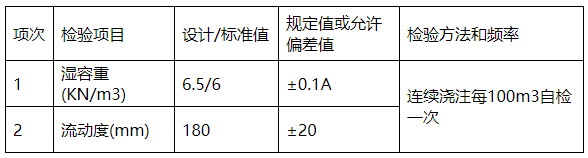
When placing foam concrete, it is necessary to inspect the wet unit weight and fluidity of the foam concrete mixture.
Process Inspection Items
On August 2nd, samples of bubble-mixed lightweight soil were taken and specimens were prepared according to the testing procedure. The specimens are 10cm x 10cm x 10cm cubes, and the prepared specimens should be sealed and insulated. In addition to design requirements, the compressive strength after curing should be tested after 28 days.
8.3 Acceptance of the Quality of Bubble-Mixed Lightweight Soil
8.3.1 Quality Acceptance Actual Measurement Projects
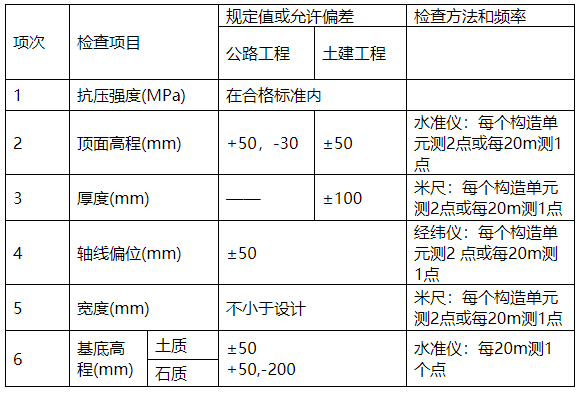
8.3.2 Appearance Quality Requirements:
The baffle is smooth and vertical with even gaps, featuring a pleasing linearity and the settlement joints are continuously straight from top to bottom.
(2) The surface honeycomb area of filling shall not exceed 1% of the total area.
Surface cracks on the built-up structure that are non-bearing in nature should not exceed 5mm in width.
(4) Full auxiliary works, such as drainage, are in place, with reasonable disposal of domestic waste and construction debris.
Nine: Comparison of Bulk Density Data for Several Main Civil Construction Materials

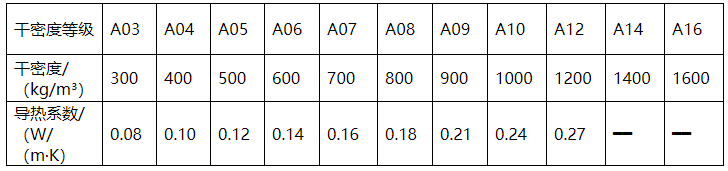
The dry density of the bubble-mixed lightweight soil should comply with the specifications in the table, with an allowable error of +0.5%; the thermal conductivity should not exceed the specified values in the table.
Bubble-mixed lightweight soil dry density and thermal conductivity:
Section 10: Security Assurance Measures
10.1 Security Assurance Measures
Prior to the project's commencement, the project management department prepared an implementable safety technology construction organization design. For high-altitude work with complex technology, high construction risks, and frequent accidents, as well as for steel pipe support installation and removal, and large height difference excavation and filling projects, a special safety construction organization design was formulated. We strictly adhere to the "Five Simultaneities" principle of safety production, implement safety technology measures, and ensure construction safety.
10.1.2 Implement a hierarchical safety technology briefing system. The management department organizes relevant personnel to conduct written and detailed safety technology briefings for engineering projects or specialized tasks. All participants in the safety technology briefing must sign and keep the records. The project management department's full-time safety officer is responsible for supervising the implementation of safety measures and maintaining proper documentation.
10.1.3 Strengthen safety education and training at construction sites.
10.1.4 Strictly Adhere to the Safety Inspection System
10.2 Safety Measures for the Construction of Bubble Mixed Lightweight Soil
During the casting of foamed lightweight soil, construction personnel must wear work shoes (usually waterproof boots), protective gloves (usually rubber gloves, non-penetrating gloves), long-sleeve shirts, and safety helmets.
10.2.2 Important Precautions for Handling and Using Foaming Agents: Ensure proper ventilation in handling and operation areas, and personnel must use protective equipment during transportation and use to prevent direct contact. Avoid foaming agents coming into contact with strong acidifiers; personnel must wash their hands and face after handling or using the foaming agent; foaming agents must be stored in well-ventilated areas.
10.2.3 The foaming agent is non-flammable and non-ignitable when in contact with water, so it is less affected by light and heat shocks under normal storage conditions, allowing for outdoor placement.
Eleven: Environmental Protection Measures
Before the start of the 11.1 project, checks and audits are conducted on construction equipment, pollution prevention facilities, and the construction methods employed.
On November 2nd, ground washing materials including cement, cement slurry, and mechanical cleaning wastewater, foaming agents, and other suspended or dissolved substances are treated by sedimentation in a sludge well before being discharged to prevent untreated discharge. Fuels, oils, and pigments are stored in appropriate safe containers and placed at designated locations to prevent accidental leakage into waterways.
At 11:30 a.m., we maintain the drainage system on the construction site to prevent the flow of wastewater, sewage, cement slurry, and any other suspended or dissolved materials into the adjacent land area, and to prevent waste accumulation on the site or in neighboring locations.
11.4 Post-separation construction waste material shall be disposed of at designated treatment sites; other non-contaminated construction waste material unsuitable for reuse will be disposed of at designated storage sites.
On November 5th, when formulating construction plans, methods, dust control measures, and during the construction process, full consideration was given to the environmental air pollution caused by cement dust and other particulates.
On November 6th, no dumping of food boxes, domestic waste, and other refuse at any location near the construction or living areas is permitted;集中处理 should be conducted.
Bubble-Mixed Lightweight Soil Applications
Bubble-mixed lightweight soil can address numerous issues plaguing road engineering.
Reduce Load and Soil Pressure
● Road bridge abutment backfill replacement
Effectively resolves post-construction settlement and bridge jump issues caused by insufficient preloading of soft foundation road sections.
● Widening Roadway Embankment Under Construction
Our new solution effectively addresses the deformation issues between old and new roadbeds, while also saving land acquisition costs and preventing demolition.
Road embankment on the steep sections of the district
The technology can avoid construction challenges associated with excessive filling and excavation, while also conserving land and protecting the natural geographical and geological environment.
● Bridge Span Reduction
By using cast-in-place foam lightweight soil to construct bridge abutment backs, it resolves soil pressure and the slope issue of the abutment front cone slope. This optimizes the bridge abutment into a simple single-row pile column bridge abutment and reduces the bridge span increased due to the slope of the cone slope, significantly lowering the construction cost.
● Earth Cover Reduction for Underground Large Span Structure Engineering
By using bubble mixing lightweight soil to reduce the upper load of the structure, ensuring structural safety.
Utilizing the self-leveling characteristic of lightweight soil mixed with bubbles, it is suitable for filling voids and narrow spaces, thereby avoiding the缺陷 of conventional fillers not being fully compacted. Voids formed in goaf areas, karst regions, construction foundation pits, and collapsed tunnels, as well as gaps around underground pipelines, can all be filled with bubble lightweight soil.
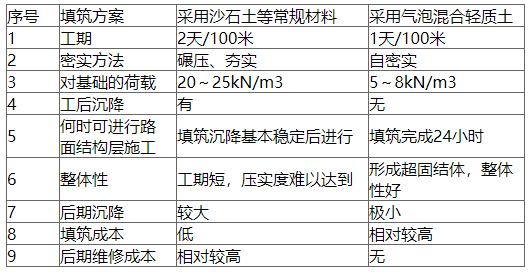
Comparison of Standard Backfill and Air-Entrained Lightweight Soil Backfill Solutions
Bridge pier backfill completed
The bridge jump problem is a world-wide unresolved challenge, with 70% of road maintenance costs spent on repairs at road-rail transition sections. The primary cause of bridge jumps is insufficient bearing capacity of the foundation and excessive fill material volume in the subgrade. Traditional solutions, which involve increasing the bearing capacity of the foundation, are not only difficult to address the root of the problem but also come with issues such as extended construction periods and high costs. The application of foamed concrete has effectively resolved the bridge jump problem.
Foamed lightweight soil for cast-in-place use in the replacement filling of bridge abutments on soft foundation road sections takes advantage of its lightness and self-standing properties after curing to optimize conventional construction methods as follows:
Optimized double-row pier abutments to single-row pier abutments:
b. Significantly reduces the intensity of soft soil treatment. The optimized approach boasts fewer settlements and uneven settlements, completely eliminates post-construction settlements of the embankment fill material itself, avoids bridge-head jump car diseases, and greatly reduces post-construction maintenance costs for the embankment.
B: The bubble mixed lightweight soil has the following advantages when used for treating jump-up at the bridge head of an old road:
The conventional pavement overlay method involves adding a new layer directly on the existing road surface to reduce the difference in elevation caused by settlement. However, due to the increased load, the total settlement after maintenance further increases, inevitably leading to the need for the same pavement overlay repair at a later time, creating a恶性 cycle of post-construction maintenance and settlement. The foam lightweight soil replacement method involves replacing the original subgrade fill soil with foam lightweight soil during the first post-construction maintenance. As a result, the subgrade soil is in a state of overconsolidation, thereby completely eliminating subsequent post-construction settlement, eliminating the need for further pavement elevation repairs, and permanently solving the problem of bridge-end jumping.
2. Road Widening Project
With economic growth and increasing traffic volumes, many roads in our country require widening. Foam concrete boasts characteristics such as lightweight, excellent fluidity, and the ability to stand on its own after curing, offering the following advantages for road widening projects:
a. Can be filled vertically, saving land use and reducing demolition; widening on the basis of the old road requires almost no new land acquisition.
b. Significantly reduces the earthfill load, minimizing differential settlement between old and new subgrades on soft soil road sections, as well as the settlement and damage to buildings near the subgrade.
c. Pipeline transportation minimizes the required construction area, barely affecting existing traffic.
d. Short construction timeline, delivering early returns to investors.
3. Roadway embankment on steep mountainous sections
When road routes pass through steep mountainous sections, lightweight concrete construction offers the following advantages:
a. Reduce the load, decrease the roadbed's sliding torque, and enhance the roadbed's anti-slide stability; avoid the high difficulty and cost associated with the anti-slide design and construction of the roadbed.
b. Mitigate the stability issues caused by excessive filling and the drawback of occupying a large land area.
c. Avoid the high costs of high边坡support and the environmental destruction caused by excessive excavation.
Bridge Span Reduction
When the overpass bridge spanning the road is high, the conventional construction method addresses the issue of the slope length in front of the bridge abutment by typically designing the number and length of bridge spans based on the net distance between the two slope feet in front of the abutment. As a result, the total length of the bridge is often much greater than the required width of the road spanned. A problem that could be resolved by a single span bridge now requires two to three spans. If thin-walled bridge abutments are used, due to the high backfill and the pressure of the soil, there is a quality risk associated with the bridge abutments. To resist the soil pressure, it is inevitable to significantly increase the cost of the pile foundation and the abutment body of the thin-walled bridge abutments.
2. Application of Bubble-Mixed Lightweight Soil in Subway Tunnel Load Reduction
Cast-in-place foamed mixed lightweight soil typically has a bulk density of 5~10 KN/m³, offering high strength, strong stability, lower cost, and no fire or oil contamination risks. It requires no special requirements for other pipelines, allowing pipelines to be directly laid in the backfill layer. The construction process is simple, requiring no additional connection components, and does not disturb the box structure. Therefore, it has been widely used as a lightweight filling material for subgrade in civil engineering projects such as municipal and high-grade highways, and has achieved success.
6. Application of Bubble-Mixed Lightweight Soil in Backfill Grouting
Compared to regular concrete, using bubble-mixed lightweight soil for backfill grouting offers advantages such as simplified construction, quick backfilling speed, high backfill compactness, low buoyancy on pipes, and overall lower costs.
7. Application of Bubble-Mixed Lightweight Soil in Tunnel Lining
A foam concrete layer is set between the primary lining and secondary lining of the tunnel. The performance specifications required for the bubble mixed lightweight soil are: compressive strength of 0.4~0.7 Mpa, porosity of 68%, and bulk density of 800 kg/m³.
