



 通过中商114认证
What is Bubble Mixed Lightweight Soil?
Bubble mixed lightweight soil is a new type of thermal insulation material with a large number of sealed air holes, formed through the foaming system of a foaming machine, where foaming agents are fully foamed mechanically. The foam is then uniformly mixed with cement slurry and either cast in place or molded using the pump system of the foaming machine. It is naturally cured to achieve its properties.
Based on the characteristics of the engineering structure and load requirements, the design unit has organized experts to conduct multiple optimization and comparison arguments for various lightweight materials such as EPS, lightweight fly ash, and ceramic aggregate concrete. Under the premise of meeting all design indicators, a comprehensive assessment has been made of their economy, environmental friendliness, and construction feasibility. It has been verified that using bubble-mixed lightweight soil for load reduction backfilling, lightweight foam concrete has high water absorption capacity. When using rapid-hardening cement as the cementitious material, it can significantly reduce its water absorption rate, enhancing the load reduction effect of bubble-mixed lightweight soil in engineering applications.
Bubble Mixing Lightweight Soil Process
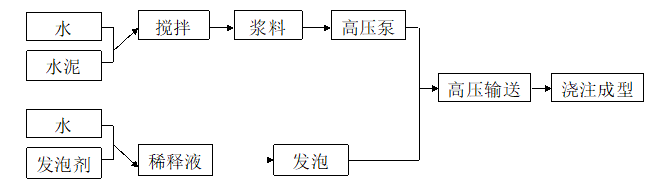
2.1 The production process of Bubble Mixed Lightweight Soil includes foam preparation, foam concrete mixture preparation, casting and shaping, curing, and inspection.
2.2 Bubble Mixing Lightweight Soil Process in the 2.2 Soft Soil Expressway Widening Project:
Survey and Staking → Excavation of subgrade (excavation for construction of air-entrained lightweight soil cross-section) → Pre-fabrication of first layer retaining panels → Installation and inspection of first layer air-entrained lightweight soil formwork → Design and fabrication of air-entrained lightweight soil mix proportions → Casting first layer concrete, installation of steel mesh → Pre-fabrication of second layer retaining panels → Installation and inspection of second layer concrete formwork → Casting second layer concrete, installation of steel mesh → …… → Filling and acceptance of subgrade slope earth and stone.
Bubble-mixed lightweight soil equipment should possess the following characteristics:
3.1 High foaming rate, strong stability, and capable of preparing bubble mixed lightweight soil fillings for various specific gravity requirements.
3.2 High production efficiency: approximately 60 cubic meters of bubble mixed lightweight fill material is produced per hour, meeting the needs of large and medium-sized filling projects.
3.3: The effective horizontal conveying distance is far, exceeding 600 meters, allowing for delivery to all filling surfaces.
3.4: Equipped with an automated measurement and control system, it effectively ensures the uniform and stable consistency of the pulp.
3.5: Strong continuous construction capability, compatible with bulk cement tanks to ensure a continuous supply of cement.
3.6 The foamed lightweight soil used for road and bridge filling has the following requirements for the foaming agent:
3.6.1 Foam Stability: Foams produced by high-quality cement foaming agents have a tough liquid film with good mechanical strength, making them resistant to bursting or excessive deformation under paste compression. Additionally, they possess self-retaining water properties, which prevent the loss of moisture on the liquid film due to gravity and surface tension. This allows the foam liquid film to maintain its thickness and integrity over a long period, thereby keeping the foam from bursting for extended periods. Foams with excellent stability have a liquid film that is less prone to rupture within the paste and less likely to form interconnected pores.
3.6.2 Bubble Uniformity: The diameter of the foam produced cannot be completely identical, but it should be basically close, ranging between 0.1-1mm.
3.6.3, Exudation Rate: After the foam is self-made, it gradually exudes water outward. A low exudation rate of the foam ensures a better number of bubbles within the foam and the porosity of the mixture of light soil with the bubbles, thereby guaranteeing the density of the bubble-light soil mixture.
3.6.4 Negative Effects of the Binder: Binders are the primary source of strength in aerated lightweight soil. Some foam generators produce very stable foam, but when binders are added, they can reduce the strength of the aerated mixture, even causing it to lose strength. Therefore, it is essential to choose foam generators that do not negatively affect the binder.
Section IV: Proportion of Bubble-Mixed Lightweight Soil
4.1 The foam concrete mixture used for filling is made with a high cement ratio, with the filling material having a density of less than 700 kg/m³. The cement ratio must not be less than 70% of the total material volume. When the density is below 500 kg/m³, the normal temperature cement ratio should be approximately more than 90% of the total material volume.
In the construction formula for 4.2 bubble mixed lightweight soil, it should not be designed or designed minimally with lightweight aggregates, as they can affect the initial setting of the slurry. With higher quantities, they may even cause form collapse. Therefore, the maximum addition of lightweight aggregates in bubble mixed lightweight soil, which is below A07, should not exceed 20% of the cement amount; below A09, not more than 40%; and below A12, not more than 50%.
4.3 It is recommended to use P042.5 ordinary hydrochloric cement or higher, and at the same time, an accelerator should be added to the cement to adjust the setting time of the cement slurry, ensuring that the hardening time of the cement paste coincides with the stability time of the foam.
Poly carboxylate superplasticizer dosage is generally between 1.0% and 2.5% of cement, offering a water-reduction rate of up to 30%-40%. It saves 25% of cement while maintaining strength, reduces 25% of cement without increasing cement usage, and can enhance concrete strength by over 30% without increasing cement dosage.
4.5 Commonly used accelerators in our country are inorganic salts, mainly including sodium aluminates, calcium aluminates (fluorochloric acid), and silicates. After the accelerators are added to the concrete, the concrete can achieve initial setting in 5 minutes, final setting in 10 minutes, and develop strength within 1 hour. The strength increases by 2-3 times after 1 day, and it decreases over time, with the 28-day strength being approximately 80%-90% of that without the accelerator. Higher temperatures enhance the accelerating effect more significantly, and an increased water-cement ratio in the concrete reduces the accelerating effect. The water-cement ratio of concrete with accelerators is generally around 0.4. The addition of accelerators tends to increase the drying shrinkage of concrete and decrease its elastic modulus, shear strength, and bonding strength. Therefore, when constructing road and bridge embankments using bubble mixed lightweight soil, adding polycarboxylic acid water-reducing agents, calcium aluminates, and fluorochloric acid accelerators to the slurry can speed up the setting of the bubble mixed lightweight soil slurry, ensuring uniform distribution of internal air voids and a reasonable microstructure. This results in a low-density embankment with good compressive strength. By adjusting the bubble content in the bubble mixed lightweight soil, the dry density can be controlled between 300 and 1200 kg/m3, and the strength can be regulated between 0.3 and 5 MPa (the main application range of strength in engineering is 0.3 to 1.5 MPa).
Section 5: Performance Indicators of Bubble-Mixed Lightweight Soil in Subgrade Construction
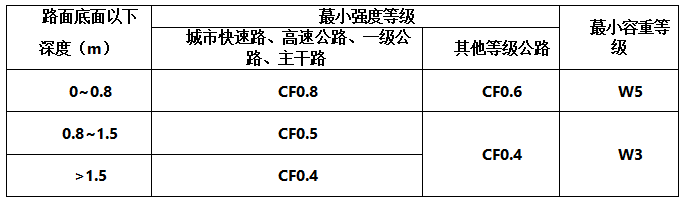
When calculating backfill at depths below water level, refer to the following table:

Section VI: Construction Requirements for Bubble Mixed Lightweight Soil
6.1 Cement should be selected as general-purpose silicate cement or sulfate aluminate cement with a strength grade of 42.5 or higher. The general-purpose silicate cement should comply with the current national standard for "General Silicate Cement" GB175, and the sulfate cement should comply with the current national standard for "Sulfate Aluminate Cement" GB20472.
6.2 The water should comply with the current industry standard for concrete water, JGJ 63.
6.3 The foaming agent has no environmental impact; the quality of the bubble clusters in the foaming agent test should meet the following specifications:
6.3.1 Bubble cluster density should be 48 kg/m³ to 52 kg/m³.
The settling distance of the standard bubble column after 1-hour static rest should not exceed 5mm.
6.3.3 The泌水量of the standard bubble column after 1-hour settling should not exceed 25 ml.
6.4 The added materials should include fine aggregates, admixtures, and additives, with particle sizes not exceeding 4.75mm.
6.5 The construction of the lightweight soil with bubble mixing will be carried out using pipeline pumping. During pouring, the outlet of the pouring pipe should be level with the pouring surface, with the maximum height difference not exceeding 1 meter. The single-layer pouring thickness of the bubble-mixed lightweight soil, except for narrow areas which can be controlled at ≤1m, should be controlled at 0.3~0.8m for other areas.
6.6 The浇注 area per piece of 6.6 Bubble Mixed Lightweight Soil should be determined based on the equipment's capacity and the thickness of the pour, ensuring that the pouring work is completed before the initial setting of the Bubble Mixed Lightweight Soil. The upper pour layer should only be poured after the lower pour layer has fully set.
When the embankment height h is equal to or greater than 2.0 meters, the bubble-mixed lightweight soil terraces are divided into three layers: the first terrace's top elevation is: original ground elevation + (h - 1.4) / 2; the second terrace's top elevation is: original ground elevation + (h - 1.4); the third terrace's top elevation is: road surface elevation - road structure layer. When the embankment height h is less than 2.0 meters, the bubble-mixed lightweight soil terraces are divided into two layers: the first terrace's top elevation is: original ground elevation + (h - 1.4); the second terrace's top elevation is: road surface elevation - road structure layer.
6.8 Avoid construction during rainy weather. When encountering heavy rain or prolonged light rain, take anti-rain measures for the unhardened surface. When pouring the upper layer again, remove and clean the surface that has been defoamed by rain. Avoid disturbing the aerated lightweight soil before it solidifies.
After the 6.9 bubble mixed lightweight soil construction is completed, promptly cover it with a plastic film or geotextile, and maintain for at least 7 days. During the maintenance period, avoid people walking on it and prohibit stacking items to prevent damaging the bubble structure and affecting quality.
Key Technical Points for Constructing Lightweight Soil with Bubble Mixing
7.1 Technical Requirements
Bubble-mixed lightweight soil differs from other construction materials, primarily due to its technical requirements, which set it apart from other lightweight concrete. These distinctions are a key factor in determining the unique applications of bubble-mixed lightweight soil.
7.1.1 Dry Density
Dry density is the most important physical property indicator for bubble-mixed lightweight soil, serving as the foundation for mix ratio design. The selection and dosage of materials are all based on the technical requirements of its dry density. Dry density is divided into two types: air dry density and absolute dry density. Air dry density refers to the density of concrete after natural drying in the air; absolute dry density refers to the apparent density of concrete when dried to constant weight at a temperature of 105-110°C, commonly abbreviated as dry density. Ordinary concrete typically uses air dry density, whereas bubble-mixed lightweight soil, affected by the porosity and water absorption of its foaming agent and lightweight filling material, generally uses absolute dry density.
The dry density reflects the theoretical dry quality of foamed concrete after completion of curing, including the total dry material of all basic constituent materials and the total non-volatile matter in the product (which includes chemically bound water and gel water). It should be determined according to the specific application requirements of different projects. Generally, the dry density of bubble-mixed lightweight soil ranges from 500 to 1200 kg/m³.
7.1.2 Strength
Foam concrete strength includes compressive strength, flexural strength, and impact strength. For most load-bearing products, the emphasis is primarily on compressive strength, while for certain board products, the focus is on flexural and impact strength. The design of each product should be tailored to the specific indicators based on the variety and technical requirements of the product. In strength design, the dry density should be the foundation, meaning that the strength values should be designed to meet the product's technical requirements while ensuring the dry density. It is particularly important to note that the strength should be based on the performance requirements of products at this density level, rather than盲目 pursuing high strength by referencing dense concrete. To ensure the necessary strength of foam concrete, its mix strength should be greater than 3% to 10% of the strength standard value, providing excess strength.
7.1.3 Thermal Conductivity Coefficient
Most aerated lightweight soils are used as thermal insulation materials, thus the thermal conductivity is a key indicator for them. The design of thermal conductivity should be based on dry density. Generally, there is a correlation between the thermal conductivity of aerated concrete and its dry density; lower dry density usually corresponds to lower thermal conductivity. To ensure the expected thermal insulation effect, considerations to reduce thermal conductivity should be incorporated into the mix ratio design, particularly in terms of material selection and proportioning.
7.1.4 Water Absorption Rate
Water absorption is a crucial technical indicator for evaluating the durability and physical properties of aerated lightweight soil. Virtually all the destructive processes affecting the durability of concrete are closely related to water, and this is especially true for aerated lightweight soil. Firstly, after absorbing water, it can reduce its frost resistance; the more water absorbed, the poorer the frost resistance. Secondly, various harmful substances can be transported by water to infiltrate the interior of the concrete, eroding it from within and causing damage. Thirdly, when water enters the aerated lightweight soil, if the external humidity decreases, it will seep out from the soil under the effect of evaporation, carrying a large amount of dissolved salts and alkalis, leading to surface cracking and white frost, thus shortening its service life. Fourthly, after absorbing water, its strength decreases and its insulation property is reduced.
The aerated lightweight soil has numerous internal air pores. If the bubble state is interconnected, it is more absorbent. The water absorption rate can be controlled between 10% to 25%, while for thermal insulation purposes, it can be maintained between 5% to 10%.
7.1.5 Dry Shrinkage Value
Due to the low density and numerous internal voids of the foamed lightweight soil, it is more prone to drying shrinkage. To minimize cracking and deformation, the drying shrinkage should be controlled within the technically permissible range. Generally speaking, a drying shrinkage value of 0.6 to 1.0 mm/m is permissible.
1.6.7 Cement Mix Ratio
Cement is the primary source of strength in foam concrete and a key influencing factor. Since foam concrete is mostly cured at room temperature and contains a large amount of foam, insufficient cement can lead to mold collapse, necessitating an increased cement ratio. However, to maintain a low dry density of foam concrete, it is essential to minimize the cement ratio while meeting product performance requirements. Generally, the cement content should account for 70% to 100% of the total dry material.
1.7.7 Lightweight Aggregate Ratio
The characteristics of lightweight aggregates include a high porosity, which results in most having high water absorption rates and a low density. Consequently, the amount added significantly impacts the product's water absorption and density, as well as its thermal conductivity.
1.8.7, Water-to-material ratio
During actual production, the foam concrete may use a water-to-material ratio instead of a water-to-cement ratio. The water-to-material ratio is the ratio of the total water volume to the mass of various dry materials and is an important technical parameter in the design of foam concrete. The water-to-material ratio must not only meet the requirements of cement hydration but also facilitate mixing and casting, ensuring ease of casting without compromising stability.
7.2: By adding appropriate additives to the slurry, the coagulation speed of the slurry is increased, ensuring that the microstructure state of bubble mixing with lightweight soil solidifies within a shorter period of time.
7.3: Developed a new type of bubble-mixed lightweight fill construction equipment to enhance filling speed.
7.4 Increase the stability of the foaming agent; the foaming agent for filling construction must have high stability to prevent compression deformation and collapse when used at a large single-filling height.
7.5 The foamed lightweight soil has no polluting effects on the natural environment such as soil, water, and air; simultaneously, its application in filling construction projects can prevent the environmental damage caused by excessive filling and excavation, which is of great significance for protecting the natural ecological environment and boasts evident environmental advantages.
