




 通过中商114认证
Pressure tanks utilize the compressibility of air to store, regulate, and pump water volumes. Combined with pumps, control cabinets, instruments, valves, and other components, they form complete compressed air water supply systems. They are characterized by easy construction and installation, facilitating expansion, reconstruction, and demolition of projects. Compared to water tanks and towers, they are less prone to water contamination, making centralized control easier. They are particularly suitable for water supply in seismic zones, concealed engineering, temporary structures, and buildings where high-level water tanks are not suitable due to artistic requirements.
Pressure vessels are widely used in scenarios such as central air conditioning circulating water pressure stabilization, steam supply expansion systems, heating system circulating water topping up and pressure stabilization, fire water supply topping up and pressure stabilization, variable frequency water supply pressure stabilization, boiler topping up, and pressure gauge water supply, etc.
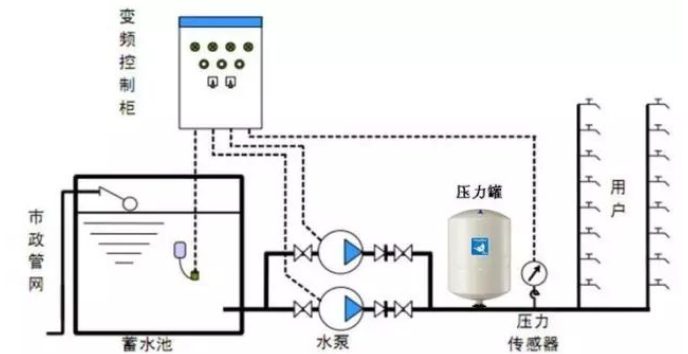
The air tank is a prerequisite for the pump to enter sleep mode.
Pressure Vessel – Utilizing Robert Boyle's Gas Law:
PV/T = n; (P - pressure, V - volume of gas in the pressure vessel, T - temperature)
The principle that at certain temperatures, the product of gas pressure (P) and volume (V) equals a constant is utilized, taking advantage of the negligible compressibility of water. By applying external force, water is stored in tanks, causing the gas to compress and pressure to rise. When the external force is removed, the compressed gas expands, expelling the water. It is well-known that it is challenging to achieve a completely leak-proof valve at the end of a residential water distribution network. Therefore, water supply equipment or systems in pressureless tanks are maintained at system pressure by the pressure of water from the network itself. Since the compressibility of water is much less than that of gas, even small leaks in the network can cause a significant drop in pressure, leading to frequent pump startups. If the power frequency pump supplies water directly to users, a pressure tank is necessary to mitigate frequent pump startups. With the application of variable frequency technology, equipment controls the supply of water to the pump as needed (variable constant pressure). At zero flow, variable frequency control ensures the pump operates at a low speed to maintain "constant pressure" in the network. Leveraging this, variable frequency water supply equipment without a pressure tank requires a pump to run continuously for 24 hours or to frequently start up to ensure network pressure. Therefore, the pressure tank is a prerequisite for ensuring the normal rest of the pump and extending its sleep time.
The volume of the pressure tank determines the duration of the pump's sleep mode.
2.1. The volume of the pressure tank determines the water supply to the pipeline network within certain pressure ranges. With a fixed pipeline leakage flow rate (L/S), the size of the pressure tank dictates the duration between pump restarts. Larger tanks result in longer intervals. Therefore, selecting a slightly larger pressure tank can extend the pump's downtime.
2.2. Properly Understand the Size of the Pressure Vessel
Overly large pressure vessels can increase capital investment, inconvenience in maintenance, and longer inflation times. For example, the variable frequency constant pressure value for the domestic water supply network is P1=0.5MPa, with a lower pressure limit (pump restart pressure) P2=0.35MPa. Under normal conditions, assuming a network leak of 5L/h, with the pump not operating at night for 7 hours (22:00-05:00), the total leak would be 35L. Therefore, if the regulating water volume of the pressure vessel within the pressure range of P1-P2=0.15MPa is greater than 35L, it can ensure the pump remains dormant for 7 hours. Hence, a pressure vessel with a regulating water volume of around 35-50L is a suitable choice. If a pressure vessel with a regulating water volume significantly exceeding 50L (within the aforementioned pressure range) is used, although the pump's intermittent operating time is longer, once it exceeds 7 hours, it enters the water usage phase, and extending the sleep time becomes irrelevant. In comparison, a small pressure vessel with the same intermittent operating time as a large volume pressure vessel is sufficient, so there's no need for an excessively large pressure vessel.
