


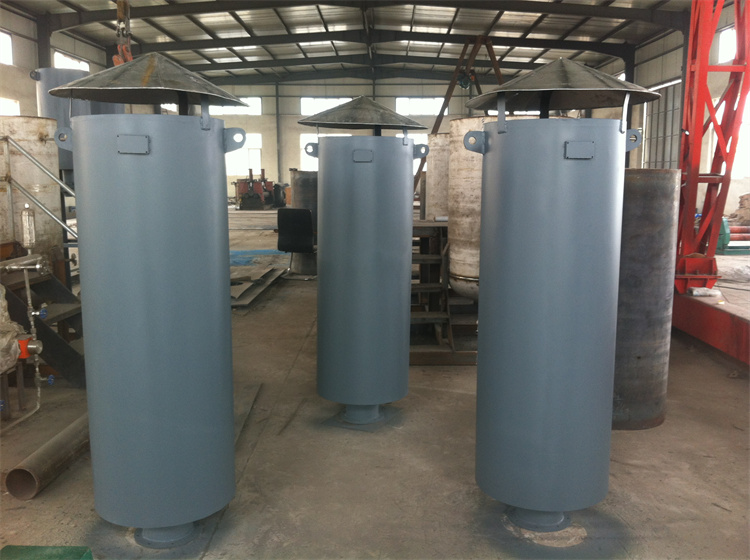
Low-pressure steam exhaust silencer
I. Overview
The noise emitted from the steam exhaust of steam boilers and other thermal equipment far exceeds the values specified in our country's "Hygiene Standard for Noise in Industrial Enterprises" (see Appendices 1 and 2). To address this, our factory's innovative steam silencer series is primarily used for effectively silencing steam exhaust from boiler turbines and other thermal equipment in power generation, chemical, metallurgical, and textile industries. Many industrial and mining enterprises use a large number of low-pressure steam boilers with pressures of 0.13Mpa and below, and there are also substantial low-pressure thermal installations in power station systems, such as back-pressure turbines, deaerators, auxiliary vacuum pumps, low-pressure steam pipelines, continuous blowdown expansion tanks for boilers, and regular blowdown expansion tanks. These equipment are equipped with lightweight and easy-to-install steam exhaust silencers as required by the exhaust pipes. Guanghe Power Equipment designs TDb type back-pressure turbine steam exhaust silencers, TDy type high-pressure deaerator steam exhaust silencers, and other series of noise reduction products to cater to different silencing requirements, meeting the operational needs of users.
Section II: Applications and Product Features of Low-Pressure Steam Exhaust Mufflers:
Low-pressure steam exhaust silencers are suitable for various low-temperature, low-pressure thermal installations, such as back-pressure turbines, deaerators, auxiliary vacuum pumps, low-pressure steam pipelines, continuous blowdown expansion tanks for boilers, and periodic blowdown expansion tanks. These equipment are equipped with exhaust silencers that are lightweight in structure and easy to install, as required by the exhaust pipes. Guanghe Power Equipment designs exhaust silencers for different noise reduction needs, including back-pressure turbine exhaust silencers and high-pressure deaerator exhaust silencers, which can meet the operational requirements of users.
The TD series low-pressure steam exhaust silencers utilize a through-hole expansion and pressure reduction principle combined with sound absorption, replacing small-hole injection with through-hole expansion to ensure smooth exhaust flow. The composite sound-absorbing and sound-insulating cover and panels effectively absorb remaining mid-to-high-frequency noise. The PD series low-pressure steam exhaust silencers are composed of metal-wrapped through-hole expansion and pressure reduction pipes and small-hole emission shells. The expansion and pressure reduction pipes distribute the steam flow, thereby reducing noise and preventing sound recurrence. The small-hole emission shells are small components with numerous holes, machined from stainless steel, which push the broadband exhaust noise into the ultra-high frequency range, where it is less sensitive to the human ear, and accelerate the attenuation of sound. Guanghe Power Equipment's power equipment, including the low-pressure steam exhaust silencers, boasts the following advantages:
1. The exhaust muffler has a lightweight and compact structure, easy to install.
2. Reduce noise without affecting the exhaust gas flow.
3. The exhaust silencer's noise reduction meets the requirements of the "Noise Hygiene Standards for Industrial Enterprises," reducing the outlet noise by 30-36 decibels (A-weighted).
Order Selection Guidelines
Our exhaust silencer series is meticulously designed to meet the specific steam emission requirements of our customers. To achieve optimal noise reduction, it is essential that the product aligns with the emission target, steam parameters, and emission volume. Therefore, when ordering a silencer, the following parameters must be provided:
For thermal power plants, please provide the turbine model, boiler capacity, steam pressure, and temperature.
②Applicable Use (e.g., for superheated steam exhaust from boilers or steam drum exhaust, etc.)
③ Emission Rate T/H
④ Original exhaust pipe outer diameter, wall thickness;
⑤ If you require our factory to perform installation design, please provide the original exhaust pipe installation diagram.
