







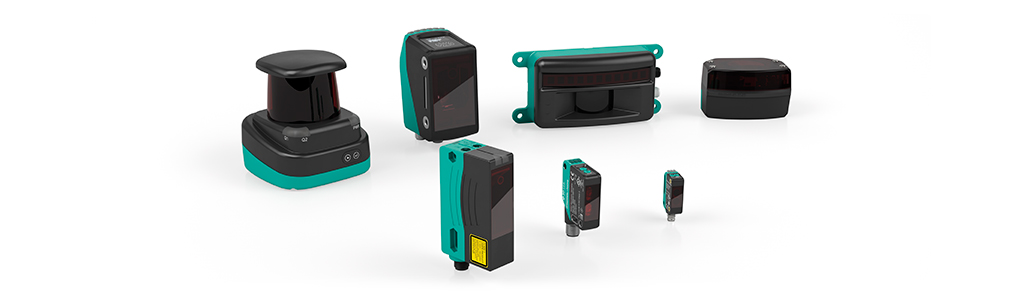
Beam-type photoelectric sensor
The transmitter and receiver on the beam-type photoelectric sensor are aligned in opposite directions. This approach has the advantage that the light beam directly reaches the receiver, thus enabling long detection distances and high excess gain. These sensors can reliably detect almost any object. The incident angle, surface characteristics, and object color will not affect the sensor's operational reliability.
Reflective type photoelectric sensor
Transmitters and receivers are aligned within the housing, making the reflective photovoltaic sensor easy to install. Simply place the reflective plate on the opposite side and align the sensor with it. Standard models with polarizing filter functionality combine the installation advantages of the reflective plate system with reliable detection performance, enabling the detection of reflective objects at greater distances. The reflective photovoltaic sensor can detect transparent objects, making it an ideal choice for reliably detecting transparent materials.
Diffuse-type photoelectric sensor
Diffused photodiode sensors are particularly easy to install as they only require one device and no reflective panel. These sensors primarily operate at close range and offer high switching accuracy, capable of reliably detecting very small objects. Sensors with background suppression functionality can only detect a specific area in front of the sensor. They ignore any objects outside of that area. Sensors with background suppression are also insensitive to interference objects in the background, ensuring detection accuracy even under interference. Sensors with background analysis capabilities are always used in applications with a fixed background within the measurement range, allowing the fixed background to be used for calibrating the sensor.
Switch sensor with core measurement technology
Switch sensors utilizing measurement core technology are based on the Baumer-developed multi-pixel technology (MPT). Consequently, multiple operational modes and switching points can be easily set within a single triangular measuring photoelectric sensor. These photoelectric sensors can be configured as background suppression photoelectric sensors, background analysis photoelectric sensors, and operate in a window mode. Additionally, the sensor is equipped with standard IO interfaces.Ink interface, allowing users to easily integrate them into various applications.
Fiber Optic Sensor
For applications where sensors cannot be directly installed due to space constraints or extreme temperatures, fiber optic sensors and cables are the preferred solution. Smaller fiber optic beams are the ideal choice for detecting small objects.
Slot Sensors and Slot-type Photogate Sensors
This device offers fast response times, making it an ideal choice for detecting tiny objects at a distance. They are commonly used to detect objects on vibrating and swinging conveyors. Slot-type photoelectric sensors are capable of handling challenging counting and monitoring tasks, such as detecting unguided objects in free fall.
