


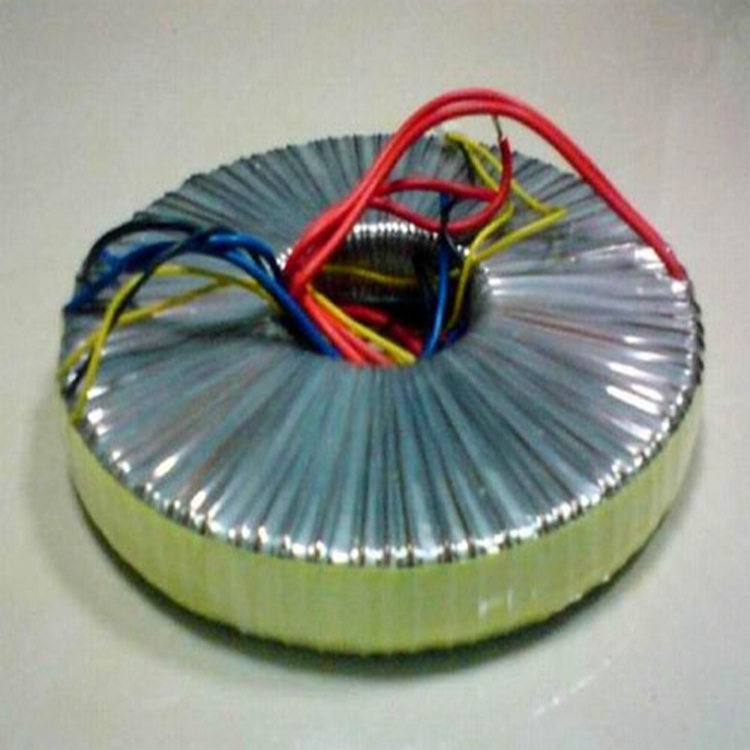



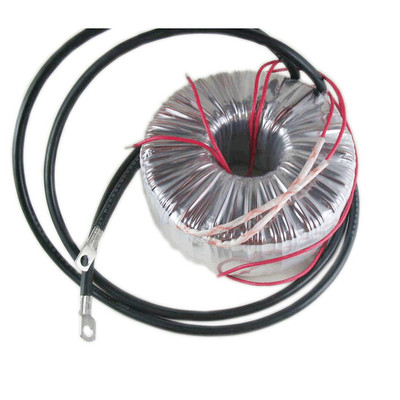
Medical grade circular transformers for electrical equipment should prevent the basic insulation, auxiliary insulation, and reinforcing insulation from overheating during any output winding short circuit or overload.
Electrical insulation between the primary winding and other windings, shielding, and core of the power supply transformer, assuming that a dielectric strength test has been conducted in accordance with Chapter 20 of the assembled equipment, no further testing should be repeated.
The dielectric strength of the inter-turn and inter-layer insulation of the primary and secondary windings of the power transformer, after the moisture treatment (refer to 4.10), should be tested through the following experiments:
—— Any transformer with a rated voltage of any winding not exceeding 500V, shall have voltage applied to both ends of the winding equal to five times the rated voltage of the winding or five times the upper limit of the rated voltage range of the winding, while the frequency is not less than five times the rated frequency.
—— Any transformer with a rated voltage of any winding exceeding 500V, apply a voltage of twice the rated voltage of its winding or twice the upper limit of its rated voltage range, while the frequency is not less than twice the rated frequency, across the two ends of the winding.
However, in the aforementioned two cases, if the rated voltage of the winding in question is considered as the reference voltage U, the stress on the inter-turn and inter-layer insulation of any winding of the transformer should ensure that the voltage appearing on the winding with a higher rated voltage does not exceed the voltage specified for basic insulation in Table 5.
Therefore, the test voltage on the primary winding should be correspondingly reduced. The test frequency can be set to the one that generates approximately the same magnetic induction value as during normal operation.
Insulation between the opposite poles of the network power section (see 20.1A-f), if it is safe to short-circuit one of the creepage distances and electrical clearances alternately without posing a safety hazard, then the requirement for a small creepage distance and electrical clearance may be waived.
The operation of the protective device should not be considered a safety hazard.
——Creepage distance for slots or air gaps less than 1mm wide should only consider their width (see Figures 39-47).
The electrical clearances required between live parts should not apply to the air gaps between switch contacts of thermostats, thermal circuit breakers, overload release devices, microswitches, etc., or to air gaps that vary with the movement of the contacts, where the nominal values have been proven to be sufficient between the current-carrying components of these devices.
— When estimating creepage distance and electrical clearances, the role of the insulating lining within the metal casing or cover should be taken into account.
—Only electrical clearances should serve as insulation between live parts and between accessible parts of the application and those not protected against grounding, if the parts are kept rigid due to relative positioning and located by molding, or if the gaps cannot be reduced due to deformation and movement of the parts in design.
If limited movement of certain parts is normal or possible, it should be considered when calculating small gaps.
c) No general requirements
Measurement of creepage distance and electrical clearance
Measurements are to be taken in accordance with the rules referenced in Figures 39 to 47 to verify compliance.
For equipment with a power input socket, measure by inserting a suitable connector. For other equipment equipped with a power soft cord, measure by connecting the specified large cross-sectional area power wire, and also measure without connecting the wire. Place the moving parts in an unfavorable position, and tighten the nuts and non-circular head screws to an unfavorable position.
