

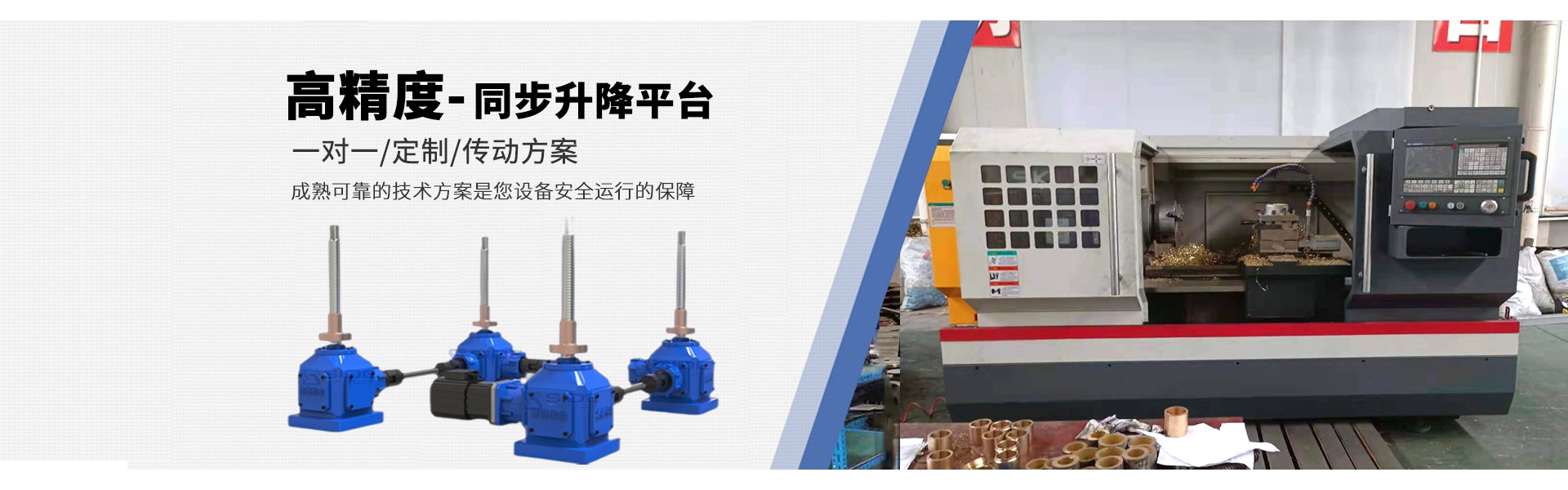

The screw jack consists of a screw extruder, screw cap, bearing steel ball, prestressed tensioning strip, reverser, and dirt-resistant device. Its function is to convert rotational motion into uniform linear motion, transforming roller bearings from a dragging posture to a rotating one.
Due to their relatively low friction resistance, ball screws are widely used in various industrial equipment and instrumentation. Ball screws are commonly employed transmission devices in machine tools and precision machinery, serving to convert rotational motion into linear motion or torque into continuous axial force. They also possess characteristics of processing, versatility, and efficiency.
First, adjust to the installation accuracy indicator value within.
When using the fixed non-adjustable side support control module, adjust the screw cap diameter to maintain a certain clearance with the workbench screw cap seat inner diameter.
3. When using the workbench as a standard, adjust the management height of the square pivot control module with a thin sealing ring. For the flange-type pivot control module, adjust the screw cap diameter to match the inner diameter of the workbench screw cap, maintaining a certain clearance.
Install on the workbench and base:
Insert the ball screw nut onto the nut bracket and temporarily tighten it. (Position the nut in the center of the ball screw shaft.)
2. Temporarily affix the pivot control module for the fixed and fulcrum sides to the stationary seat.
3. After positioning the mobile workbench and the fixed side support control module, securely tighten the pivot control module onto the stationary base.
4. Once securely fastened, move the workbench to the vicinity of the schedule endpoint station adjacent to the fixed side, and securely fasten the workbench to the screw cap support.
