

1Major Technologies and New Developments in Ammonia Nitrogen Treatment in Wastewater
1.1 Blow-off method
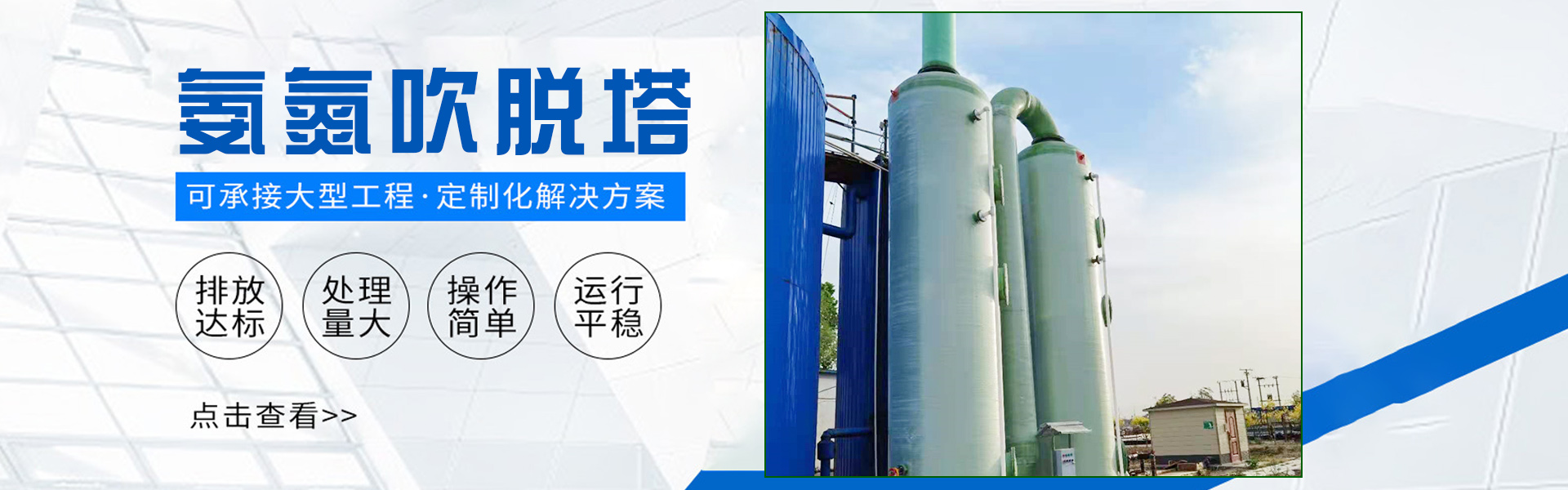
The吹脱法 is a process used to remove ionized ammonia from wastewater.(NH4+)AdjustingpHThe value is converted into ammonia in molecular form, which is then blown out by the air or steam introduced. The main factors affecting the blowing-off efficiency are:pHValue, water temperature, water distribution load, gas-liquid ratio, sufficient gas-liquid separation space.
NH4++OH-→NH3+H2O
Wastewater from industries such as steelmaking, petrochemicals, fertilizers, and organic chemicals often contains high concentrations of ammonia. As a result, steam stripping is commonly used for treatment, and the recovered ammonia helps offset the high costs associated with producing steam. Lime is generally used to improve...pHSteam is more effective in controlling scaling than air, and using caustic soda can significantly reduce the degree of scaling. The blowing off method typically employs a packed tower, characterized by a highly filled layer within the tower to facilitate thorough gas-water contact through the use of a packed tower with a large surface area, thereby enhancing the mass transfer process between gas and water. Common fillers include Raschig rings, polypropylene Pall rings, and polypropylene hollow spherical balls. Hu Yuliang and others investigated the static blowing off effect of a portion of high-concentration ammonia-nitrogen wastewater produced during the production of iodoamphetamine in a certain factory. The results show that: whenpH=10~13Temperature:30~50At ℃, the ammonia nitrogen stripping rate is70.3%~99.3%。
The ammonia stripping process is commonly used for the pretreatment of high-concentration ammonia-nitrogen wastewater. This treatment technology boasts stable ammonia removal, simple operation, and ease of control. However, issues such as improving stripping efficiency, avoiding secondary pollution, and controlling the formation of scale in the production process are all considerations for the ammonia stripping process.
1.2 Chemical Precipitation Method(MAPPlease provide the Chinese content you would like translated into American English.)
Chemical precipitation is a method used in...NH4+Ions are added to wastewater.Mg2+Please provide the Chinese content to be translated into American English.PO43-There is no Chinese content provided. Please provide the news content to be translated.NH4+Magnesium Ammonium Phosphate, an Insoluble Double SaltMgNH4PO4·6H2O(AbbreviationMAP)Crystallization, through precipitation, achievesMAPRecovered from wastewater. Chemical precipitation is particularly suitable for treating wastewater with high ammonia-nitrogen concentration.90%The above denitrification efficiency. Magnesium ammonium phosphate is an excellent slow-release compound fertilizer for crops when there are no toxic or harmful substances in the wastewater.
In processing, ifpHValues are too high, prone to cause someNH3Evaporate. It is recommended to reduce the sedimentation time and moderately lowerpHValue, to reduceNH3Volatilization. Precipitant usage.MgONo Chinese content provided.H3PO4This not only helps prevent the introduction of other harmful ions,MgOIt can also serve as a neutralizer.H+The Role of Ions. The research findings by Zhao Qingliang and others indicate:pH=8.6At the same time, addition ofNa2HPO4No Chinese content provided.MgCl2Please provide the Chinese content you would like translated into American English.6518mg/LDecreased65mg/L。
The chemical precipitation method for treating high-concentration ammonia nitrogen wastewater is simple and efficient. However, the residual concentration of ammonia nitrogen in the wastewater is still relatively high.;Additionally, concerns include the dosage of the chemical, the disposal of sludge, and the pollution caused by chlorides and phosphates introduced by the chemical addition.
