

Why Use Helical Gears in Worm Gearbox Assemblies
This is due to design, manufacturing, or deformation, and may also involve some progressive changes along the entire tooth surface. This will result in regular vibrations, each generating not only a significant load on the gears but also noise. Another drawback is that it is sometimes achieved by aligning two pairs of teeth during the contact time. The additional strength cannot be decomposed or utilized, as the stress is limited by the bending conditions of a single tooth throughout the cyclic process.
Helical gears can be viewed as a cylindrical gear made up of a set of thin gears with suitable teeth. In this manner, each component's contact occurs at different parts of the tooth profile, thereby creating an effect of compensating for the errors of each small gear. This compensation is determined by the wheel. The elasticity of the teeth is highly effective. As a result, gears with teeth that have errors less than 10mm can compensate on average, allowing them to work stably under load as gears with an error of 1mm. Because at any given moment, approximately half the time (previously about 1.5 times the overlap) there will be two tooth shapes, which brings other benefits in terms of strength. Therefore, stress can be established based on 1.5 times the width of the teeth, rather than just the tooth width.
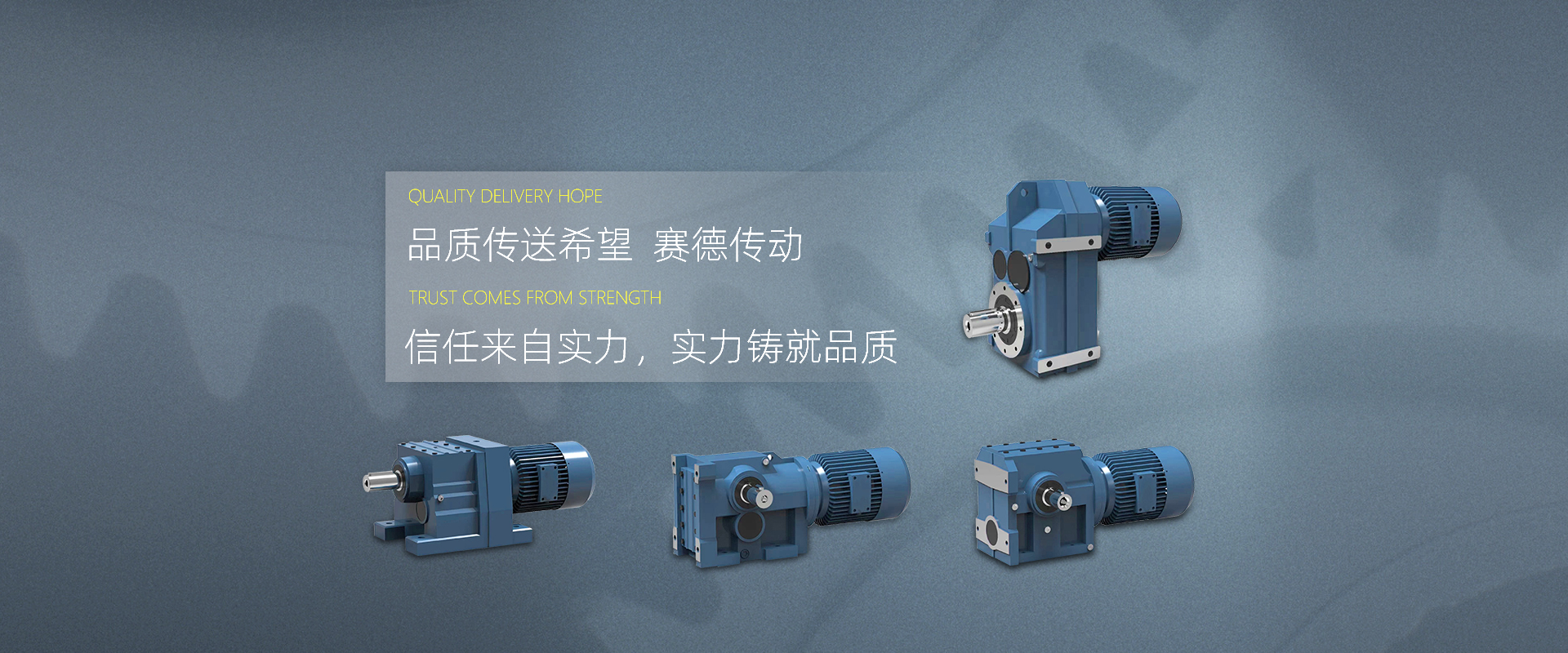
Manufacturing and assembling a large number of fine spur gears is difficult and uneconomical, so they are made into integral gears with teeth running along the spiral direction. Unlike spur gears, helical gears do not generate unwanted forces. However, their advantages in vibration and strength far outweigh the disadvantages of slightly increased thrust and manufacturing costs. Therefore, inWorm Gear ReducerIn the manufacturing process, bevel gears have replaced spur gears. Axial bevel gear reducers, K series spiral bevel gear reducers, S series bevel worm gear reducers, F series parallel shaft bevel gear reducers.
Note 1: What is a spur gear: A spur gear refers to a gear in which the teeth are parallel to the shaft. We only discuss the theory of parallel shaft gear transmission. Therefore, any cross-section perpendicular to the axes of the two gears is completely identical.
