



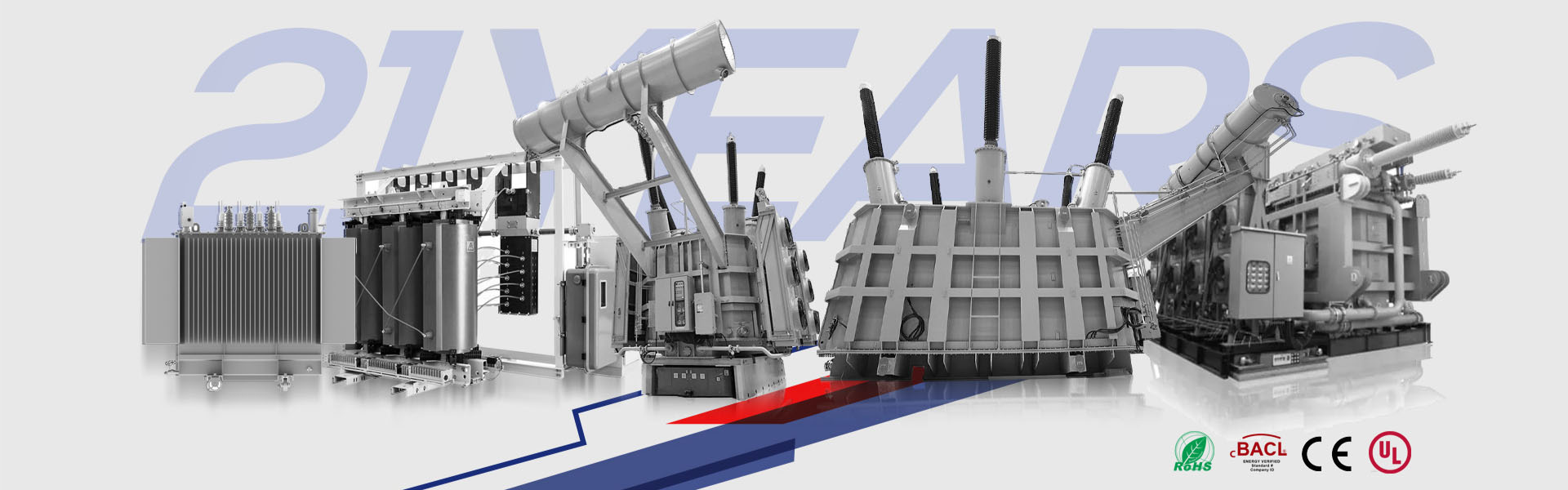

The S11 transformer has a complex structure, composed of numerous components. Continuously improving the efficiency of the S11 transformer is a direct purpose of its use. The S11 transformer's structure is intricate, with many parts. How much do you know about these parts? Let's take a look together:
The S11 transformer is composed of an iron core (or magnetic core) and windings, with the windings having two or more turns. The winding connected to the power source is called the primary winding, while the remaining windings are referred to as secondary windings. It is capable of transforming alternating voltage, current, and impedance. A simple iron-core S11 transformer consists of an iron core made of soft magnetic material and two windings of unequal turns wrapped around the core.
The core's function is to enhance the magnetic coupling between the two coils. To minimize eddy currents and hysteresis losses within the core, it is made of stacked silicon steel sheets coated with paint. There is no electrical connection between the two coils, which are wound with insulated copper wire (or aluminum wire). One coil connected to an AC power source is called the primary coil (or primary winding), while the other coil connected to an appliance is referred to as the secondary coil (or secondary winding). Actual S11 transformers are complex and inevitably involve copper losses (heating due to winding resistance), iron losses (heating of the core), and leakage flux (magnetic flux lines closed through air). For the sake of simplification, this discussion only introduces the ideal S11 transformer. The conditions for the ideal S11 transformer to be valid are: neglecting the leakage flux, ignoring the resistance of the primary and secondary coils, disregarding the core losses, and neglecting the no-load current (current in the primary winding when the secondary winding is open-circuited). For example, a power S11 transformer operates nearly as an ideal S11 transformer when running at full load (secondary winding outputting rated power).
The S11 transformer is a stationary electrical appliance designed based on the principle of electromagnetic induction. When the primary coil of the S11 transformer is connected to an AC power source, alternating magnetic flux is generated in the core, represented by φ. The φ in both the primary and secondary coils is the same and is a harmonic function, expressed as φ = φm sin ωt. According to Faraday's law of electromagnetic induction, the induced electromotive forces in the primary and secondary coils are e1 = -N1 dφ/dt and e2 = -N2 dφ/dt, where N1 and N2 are the number of turns in the primary and secondary coils, respectively. From the diagram, it can be seen that U1 = -e1 and U2 = e2 (the physical quantities of the primary coil are denoted by a subscript 1, and those of the secondary coil by a subscript 2), with their complex effective values being U1 = -E1 = jN1ωΦ and U2 = E2 = -jN2ωΦ. Let k = N1/N2, which is the turns ratio of the S11 transformer. From the above equation, we can derive U1/U2 = -N1/N2 = -k, indicating that the ratio of the effective voltages of the primary and secondary coils of the S11 transformer is equal to their turns ratio, and the phase difference between the voltages is π.
Here are various components and key structures of the S11 transformer for your reference. The S11 transformer needs to continuously improve efficiency, ensuring safety and stability. The general issues to be aware of with the S11 transformer are as follows. For any other questions about the S11 transformer, please contact our manufacturer. Our technical team will assist you promptly!
