


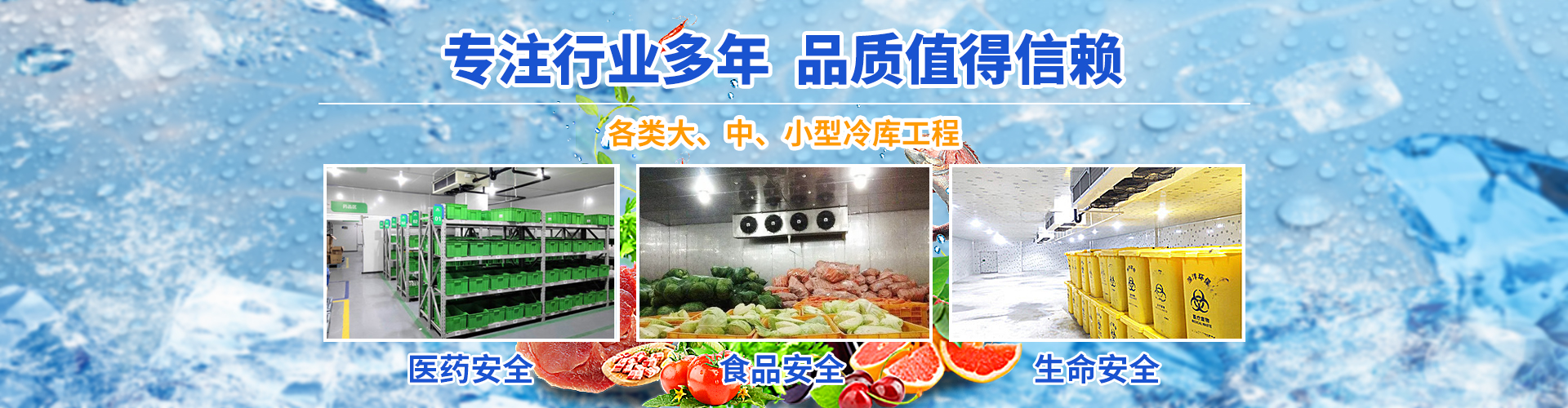

Refrigerated warehouses are a common tool nowadays, used in places like food factories, fruit and vegetable storage facilities, hotels, supermarkets, and more. They serve as storage locations for preserving agricultural products, their function being to maintain a stable and constant low-temperature environment.Insulation performance is often referred to as thermal preservation. A well-insulated cold storage room can minimize the leakage of cold energy produced by the cold storage unit outside the room. Conversely, it means to reduce the heat leakage from outside the cold storage into the room as much as possible. This is a major difference between cold storage and ordinary buildings.
The cold storage is primarily used for the freezing and refrigeration processing of food, medicine, and machinery. It maintains a certain low temperature indoors through artificial refrigeration. The construction company ensures the wire diameter meets requirements, configuring wires based on the performance of each electrical appliance. The joints are sturdy, and maintenance conduits are necessary, ensuring correct wiring. The wire enters the evaporator junction box through a hole, requiring silicone sealing. For lighting, if the voltage is 36V or above, a grounding wire is required. The electrical cabinet of the cold storage construction unit must have a three-phase five-wire system with a reliable grounding. The walls, floors, and flat roofs of the cold storage building are insulated with a certain thickness of thermal insulation material (used in industry and construction) to reduce heat transfer from the outside. To minimize the absorption of solar radiation, the outer walls of the cold storage are generally painted white or light colors, making the cold storage building structurally distinct from typical industrial and residential buildings.
Matter exists in three states: gas, solid, and liquid, which can transform into one another under certain conditions. When a liquid transforms into a gas, it absorbs a significant amount of heat, a process known as "liquid vaporization heat absorption." Refrigerators utilize this principle by using liquid vaporization to cool. The refrigerator is powered by an electric motor, which drives the compressor to perform work on the refrigeration system. The system employs a refrigerant with a low boiling point, absorbing heat during evaporation to achieve cooling.
Within the throat of the cold storage, there is a refrigerant called Freon or Environmental Protection Refrigerant, commonly known as "snow seed" refrigerant. Companies installing cold storage facilities should be cautious of hard objects that may collide or scratch the storage body, as this can cause dents and rust on the storage panels, which may severely reduce the local thermal insulation performance. Cold storage construction companies determine the size of the cold storage (length × width × height) based on the tonnage of goods stored, daily loading and unloading volumes, and the size of the building. They also specify the door size and opening direction. The installation environment for cold storage should be clean, dry, and well-ventilated. One commonly used type is difluorodichloromethane, an odorless and colorless gas with a boiling point of 29°C. When Freon is in a gaseous state, it is compressed by the compressor, then flows through the throat to the condenser on the back of the refrigerator (category: heat exchange equipment), where it is condensed by the heat exchanger (the temperature rises after the substance is compressed). The condensed Freon then becomes a liquid, causing the refrigerator's interior to cool down. After vaporization, the Freon is compressed back into the condenser outside the refrigerator for heat dissipation and reverts to a liquid, repeating the cycle continuously, pumping the heat inside the refrigerator to the outside.
