

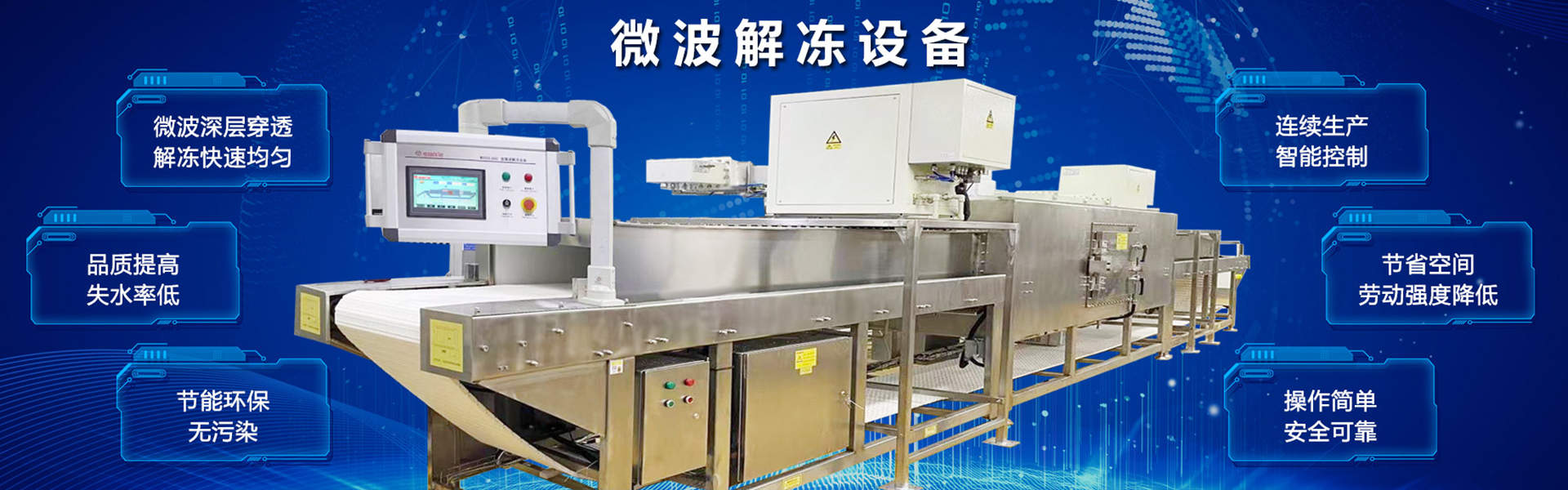

Frozen food is extensively used internationally, as well as in the domestic canning, meat processing, and Chinese fast-food industries. In recent years, the market has also embraced small-packaged products, making defrosting a crucial step in food processing.
"Thawing refers to the process of raising the temperature of frozen food from deep-freeze status to a value below zero, typically around -5°C, at which point the food can be sliced or portioned. To thaw, the temperature must be raised to room temperature or above 0°C, allowing the food to脱离 its frozen state. Microwave technology offers numerous distinct advantages over conventional methods. For instance, it significantly reduces processing time, is easy to control, maintains high product quality, preserves color and freshness, minimizes nutrient and moisture loss, has low bacterial content, offers low cost, reduced energy consumption, occupies less space, and improves working conditions and the environment."
Microwave Thawing Process: Quick-freezing food to around -20℃; then microwave thawing (heating to -4℃ to break crystals) followed by placing in an air-conditioned room at -1℃ for 6 hours. The food is then ready for processing.
So, microwave defrosting must be a high-energy, rapid heating process.
