


Advantages and disadvantages of conventional meat defrosting machines, such as microwave defrosting equipment, high-voltage static defrosting, low-temperature high-humidity defrosting, and radio frequency defrosting.
Principle of thawing.
Microwave Defrosting: Place the frozen product inside the microwave tunnel curtain. Under the high-frequency radiation of electromagnetic waves, polar molecules vibrate and collide elastically with surrounding molecules. Frictional heating warms the product from the inside.
2. High-voltage static defrosting: Place frozen products in a high-voltage static field (such as 30KV), with the field set in a low temperature environment of about 1-4°C, utilizing the effects of the high-voltage electric field to defrost food.
3. Low Temperature High Humidity Thawing: Utilizing enclosed spaces, circulate high humidity air in a low-temperature environment to form a high humidity airflow, accelerating the thawing process.
4. Radiofrequency Thawing: Radiofrequency thawing involves placing the product to be thawed between two parallel electrodes that emit alternating radio waves.
2. Application Fields
High-pressure static defrosting: Used for defrosting frozen meat, seafood, and for preserving fruits and vegetables.
2. Low-Temperature, High-Humidity Thawing: Used in the food processing industry for meat products (pigs, cows, sheep), poultry, and seafood.
3. Radio Frequency Thawing: Meat (pork, beef, lamb), poultry (chickens), fish (fish, shrimp) etc.
4. Microwave Defrosting: Meat (pork, beef, lamb), poultry (chicken), fish (fish, shrimp), seafood, etc.
3. Analyze the defrosting effects.
Microwave Thawing
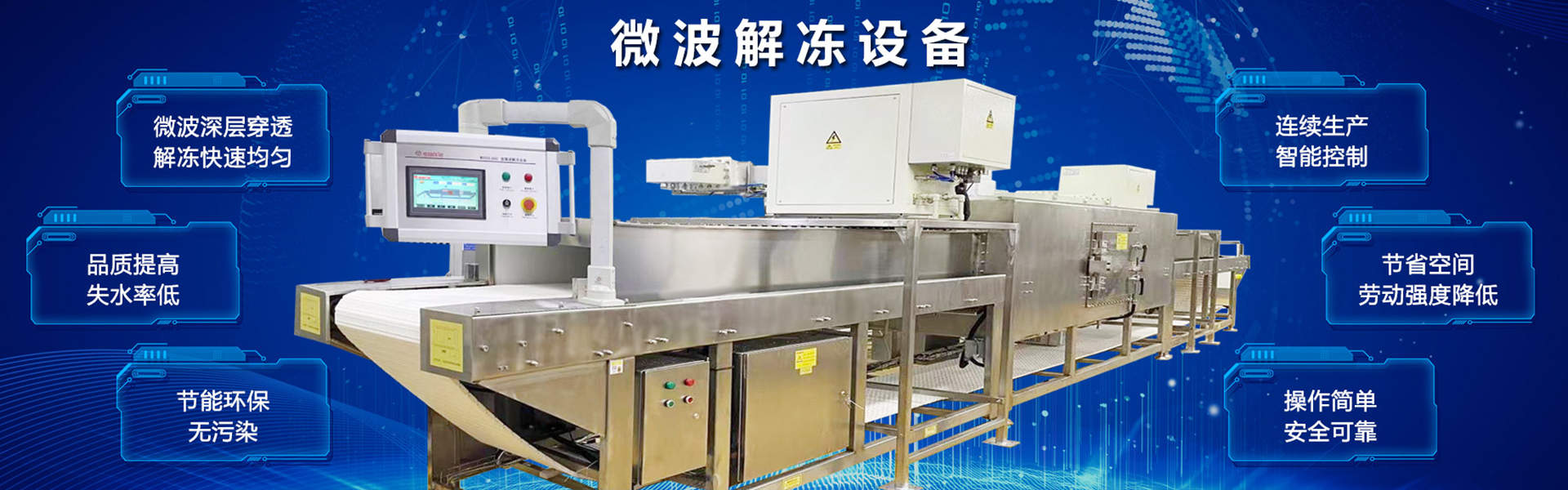
Jiangsu Sanle Microwave Defrosting Technology has developed a new microwave defrosting equipment specifically for frozen meat, utilizing military technology. The BN-100L Microwave Reheating and Defrosting Intelligent Device is mainly used by large food processing enterprises and in the cold chain process for defrosting frozen meat products, offering fast defrosting speeds and high efficiency. It can quickly defrost frozen products, typically from -18℃ to -2±1℃ within 3-6 minutes. The meat loss rate is 0.1%, ensuring uniform defrosting without damaging the internal structure of the meat, locking in its nutritional value, and preserving the original color of the meat. It also avoids the increased meat loss rate and maintains quality associated with traditional defrosting equipment, saving raw materials.
2. High-Voltage Static Defrosting: Offers fast thawing with even temperature distribution in food, minimal juice loss, and effectively prevents oxidation of food fats. The high-voltage static field inhibits and kills microorganisms, benefiting food quality maintenance, and is a promising defrosting method.
3. Frozen at Low Temperature with High Humidity: Although it can prevent the growth of microorganisms, it takes approximately 15 hours to defrost from -18℃ to -2℃ to reach processing temperature. The long duration means defrosting quantity can only be determined based on the factory's volume. The meat loss rate is 3%-8%, and the defrosting is uneven. A large amount of manual labor is required during the defrosting process, making automation impossible.
4. Radio Frequency Thawing: Compared to microwave, the product temperature rises more uniformly. Differences can still occur if the frozen block is not evenly distributed. Therefore, the higher the product is close to 0°C, the greater the risk of localized overheating. The radio frequency thawing process takes approximately 15 to 45 minutes. The temperature non-uniformity of the material after heating can be further exacerbated if the initial temperature of the material or the distribution of the electromagnetic field is uneven.
