
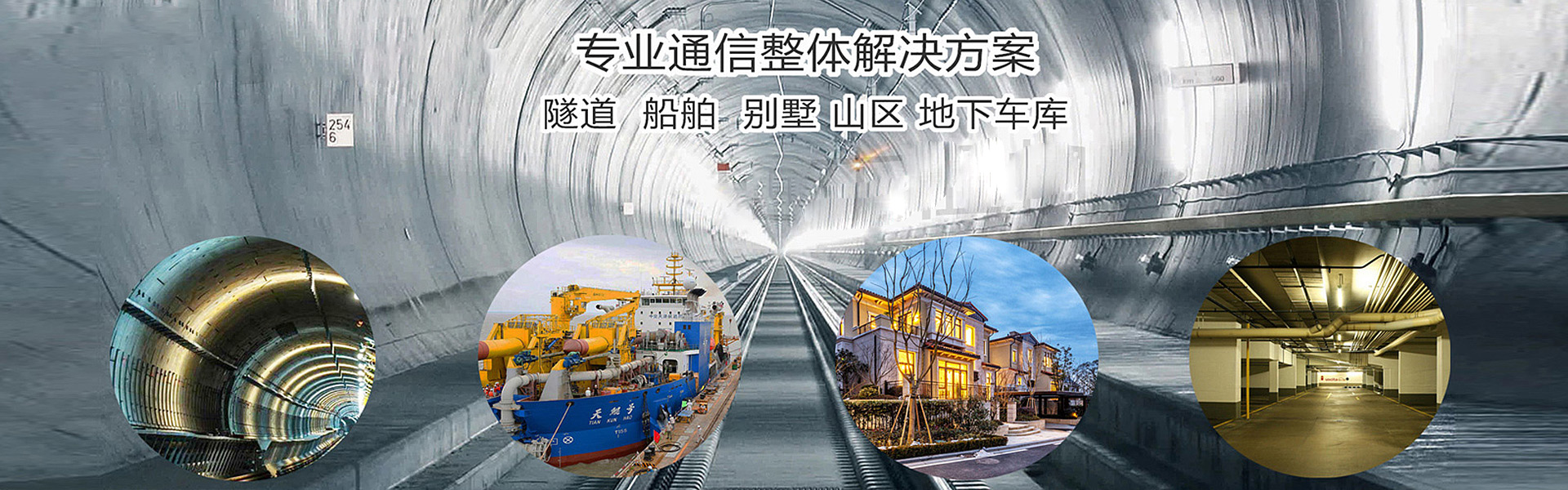

Although wireless communication technology is advancing rapidly, but regardless of what**'sMobile SignalSystem solutions cannot achieve true seamless coverage in complex geographical environments, such as long and short tunnels, comprehensive underground tunnels, and other areas with mobile signal communication. These signal dead zones are often extensive, with strict communication requirements, and even require excellent coverage, such as in long and short tunnels, comprehensive underground tunnels, etc., due to poor indoor mobile signal, which affects the normal conduct of activities. Seamless signal coverage in tunnels or tunnels will present significant difficulties for traffic police on duty or handling traffic accidents and investigations into tunnel construction. In addressing the problem of signal blind spots in small-scale specialized networks, base stations, due to high costs and complex construction, often result in significant resource waste. We are committed to providing cost-effective, easy-to-install, and compact base station signal extension amplification equipment, fiber optic direct amplification stations, to meet the communication needs of our customers. Although wireless communication technology is rapidly developing, no wireless intercom communication system solution can achieve true seamless coverage in complex geographical environments, such as in long and short tunnels, comprehensive underground tunnels, and other areas with wireless intercom system communication. These signal dead zones are typically extensive, with strict communication requirements, and even require excellent coverage, such as in long and short tunnels, comprehensive underground tunnels, etc., due to poor indoor mobile signal, which affects normal activities; seamless signal coverage in tunnels or tunnels will present significant difficulties for traffic police on duty or handling traffic accidents and investigations into tunnel construction.

In addressing the aforementioned small-scale network signal dead zones, the high cost and complex construction of base stations largely result in resource wastage. Our commitment is to provide users with cost-effective, easy-to-install, and compact base station functionality—optical direct stations—to meet their communication needs.
Tunnel tunnels are typically long, cylindrical structures. Due to obstructions such as mountains and trees, signals are strongly shielded, usually creating dead zones. To address coverage issues in long tunnel tunnels and fiber optic links, fiber optic base stations can be installed, effectively resolving the problem of network unavailability in tunnel tunnels. Since fiber optic cables are cost-effective and have low loss, they can extend up to 20 kilometers, with consideration for isolation.
In addressing the coverage issues for short tunnel tunnels, if there is no fiber connection, eight wooden antennas can be used to cover the tunnel near the tunnel tunnel. This solution features simple engineering installation and low cost. For covering long tunnels or curved networks of tunnels and tunnels, passive antennas distributed along the tunnel tunnels are required; leakage cables can also be used for coverage.
Wireless Intercom System Solution for Tunnel Corridors
The split-type direct station consists of a local unit and a remote unit. Depending on the connection between the local and remote units, it can be categorized into fiber base stations and radio frequency base stations.
This coverage method is primarily designed for tunnels or underground utility tunnels, which are often long and have winding routes. Leaky coaxial cables are laid within the tunnels or utility tunnels, ensuring a stable field strength along the entire line and providing a communication link. Near-end units are set up at the tunnel or utility tunnel entrances to amplify the space wave energy and transfer it to the leaky coaxial cables. The leaky coaxial cables radiate signals through their own slots, forming a leaky electromagnetic field around them, enabling communication between mobile platforms. If the distance between the tunnel or utility tunnel is significant, there may be uneven energy leakage along the leaky cables. A large amount of energy might leak out from the arrival slots. To compensate for the decline in cable level during transmission, which causes a decrease in leakage level, several leaky cable routes can be sequentially connected using cables with different coupling losses, thereby reducing fluctuations in the received signal level along the route. The signal coverage project for underground utility tunnels is actually a complex task, and the specific coverage plan needs to be measured on-site based on different tunnels.
To effectively handle emergencies and ensure good communication with rescue personnel, we typically enhance our tunnel pipeline integrated wireless intercom communication system solutions by adding a dispatch wireless intercom subsystem, a frequency modulation broadcasting subsystem, and a fire and wireless signal introduction subsystem.
The fire and wireless signal introduction subsystems include the introduction of digital trunking systems, digital trunking systems, and fire*wireless intercom communication systems. All subsystems utilize the leaky cable transmission system to achieve comprehensive coverage.
The main equipment of the integrated mobile signal communication system for tunnel pipeline includes: introduction antennas, split-combine platforms, fiber direct station near-end units, fiber direct station far-end units, leakage coaxial cables, branching/combiner, couplers, splitters, indoor antennas, outdoor omni-directional antennas, lightning arresters, etc.
