


MAV「Micro Air Vehicle The "micro-aerial vehicle" has garnered attention for its capabilities in reconnaissance, electronic interference, search and rescue, and biochemical detection. Inspired by the agility of insects and birds, researchers are increasingly focusing on the design of micro-flapping wing vehicles. The lightweight structure design of the micro-aerial vehicle's flapping wings and the adjustment of motion parameters are crucial for the long-term stable execution of flight commands. Therefore, kinematic research and structural deformation measurements of the flapping wings are of great importance.
Wing flapping aircraft utilize a technology that characterizes small and flexible wing vibrations. The wing materials are unevenly constructed, combining with a membrane skin and carbon fiber composite materials. The wing design is extremely lightweight and flexible, which is demonstrated by non-contact full-field measurements. Digital Image Correlation (DICC)DICIt is a mature non-contact 3D image measurement technology, which calculates the displacement and strain distribution of an object's surface by matching the random speckle images before and after deformation.
Wing rigidity and elasticity structures exhibit different characteristics during the flapping process, hence the requirement DIC The test experiment must fully capture the entire flapping motion process.DIC Equipment must meet180° Test Field of View Requirements.
Trial Plan Selection
DIC Test Plan1High-speed camera captures flapping vibration characteristics
——Data displacement and deformation analysis can be directly performed, yielding continuous data of the flapping process. Vibration analysis of the flapping structure can be directly conducted, obtaining the working modes.ODSNo Chinese content provided.
DIC Test Plan2Low-speed Camera+ VIC-3D All-Day Fatigue Module
——Utilizing phase synchronization technology, the stroboscope can capture complete cycle experimental data of flapping vibration process, restoring cycle flapping deformation and displacement data; record the flapping cycle and deformation characteristics under peak load; the high-resolution low-speed camera allows for more accurate calculations of local key areas; achieving flapping...180Wide measurement range, low testing cost.
In response to the testing environment requirements, we have adopted the2A more suitable testing plan.
Trial Environment
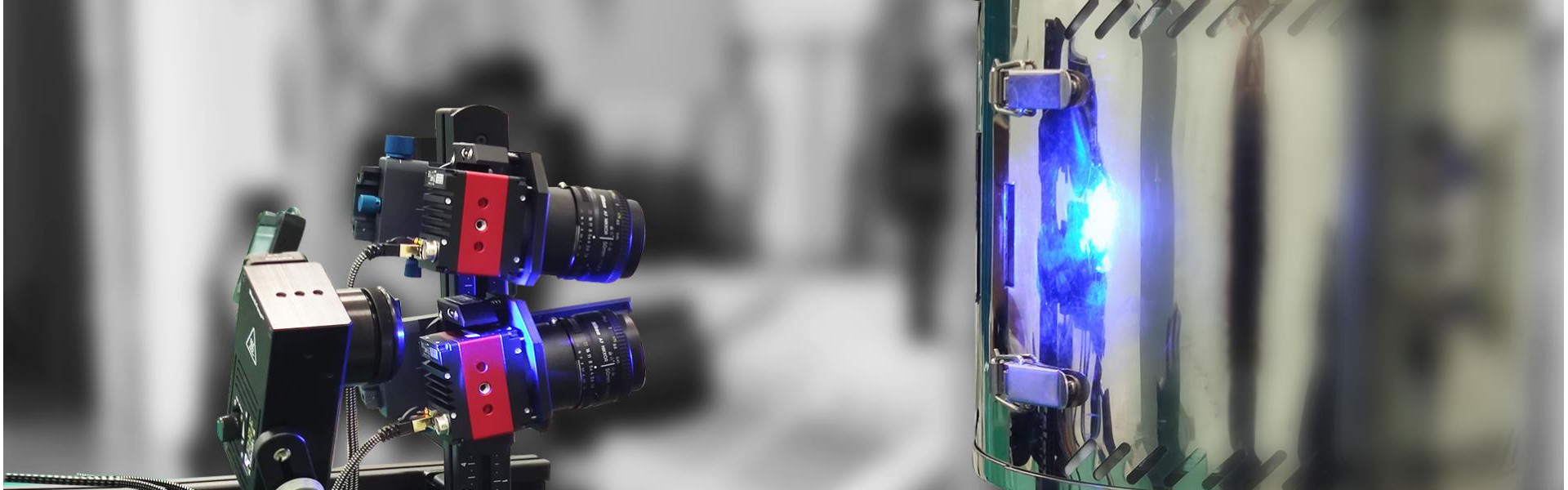
To differentiate the aerodynamic and inertial effects within each cycle and the structural deformation caused by each situation, separate tests are required in both static air and vacuum environments. Consequently, a vacuum chamber was constructed. Four tests were arranged inside. DIC Cameras, divided into two groups. This setup is capable of capturing up to180° Single-wing rigid displacement and structural deformation of the sweep amplitude. Each camera group can capture the wing's90Scan moving images within the scan angle. The camera has a resolution of1624 * 1224 Pixels can capture extremely fine speckle patterns on the wing surface for better image correlation. At this resolution,DICCamera at 60 frames per second15Shooting at the speed of frames.DICCameras are symmetrically arranged around the striking motion on a flat surface. One set of cameras captures the images above the plane during the strike, while another set captures the images below the plane. The complete experimental setup is as shown in the figure below, including the striking mechanism./Wings, collection systems, flashlights, and vacuum covers.
Trial Challenges
1Under vacuum, digital image optical distortion caused by optical refraction beneath the vacuum cover.VIC-3D Our system utilizes advanced optical distortion correction technology, light suppression algorithms, and a unique variable origin correction technique, effectively addressing issues related to light distortion.
2: Fluttering 180Range MeasurementVIC-3D The multi-system splicing enables a comprehensive analysis of wing flutter displacement and strain data within the same coordinate system.
3Wing flapping requires a short exposure time.VIC-3D The full-field fatigue module is equipped with a high-performance strobe meter, effectively addressing the issue of exposure time.
Trial Results
This experiment was conducted under the following conditions: 5Hz The frequency of the clapping90Achieve all results under the impact amplitude. Off-face displacement (w/c, among whichc The root chord (the part of the wing at the base) is contoured at various positions along the wing within the flapping stroke. For dives and climbs, its deformation is alongz/c The deformation measured in the direction is the same. The two following images depict the structural deformation of the wing as measured in air and a vacuum, respectively.
Firstly, it's important to note that in all cases, there is considerable elastic deformation: in some areas, the root chord has reached...18For the wing tested in the air (see above image), due to the inhibitory effect of air loads, the elastic surface typically lags behind the hypothetical rigid wing. Both the top and bottom of each stroke experience substantial bending in the wing span direction, thereby increasing the large and small positions the wing tip passes through. At the mid-plane, the elastic wing exhibits greater deformation at the trailing edge. Between the mid-plane and the peak (small) dihedral angle positions, structural deformation can be negligible.
▲ Structural deformation diagram of the wing in a vacuum
Test results under vacuum slightly differ. Although the bending of the span direction at the top and bottom of the travel plane is very similar to that in the air (due to the force acting here being mainly inertial), the middle plane shows almost no structural deformation. As mentioned above, flexibility may be necessary for generating thrust.
VIC-3D All-in-One Fatigue Module, Effectively Solves180Complete cycle data collection during flapping, recording the complex motion of flapping, and analyzing the deformation characteristics of different flapping structures, including rigid and flexible wings, to provide reliable kinematic and deformation experimental data for the coupled design of rigid and elastic wings. Challenged...VIC-3D The system's measurement limits address challenges such as capturing the rapid movement of measured objects, recording large focal plane displacements, reconstructing flapping motion, and accurately describing wing deformation.
